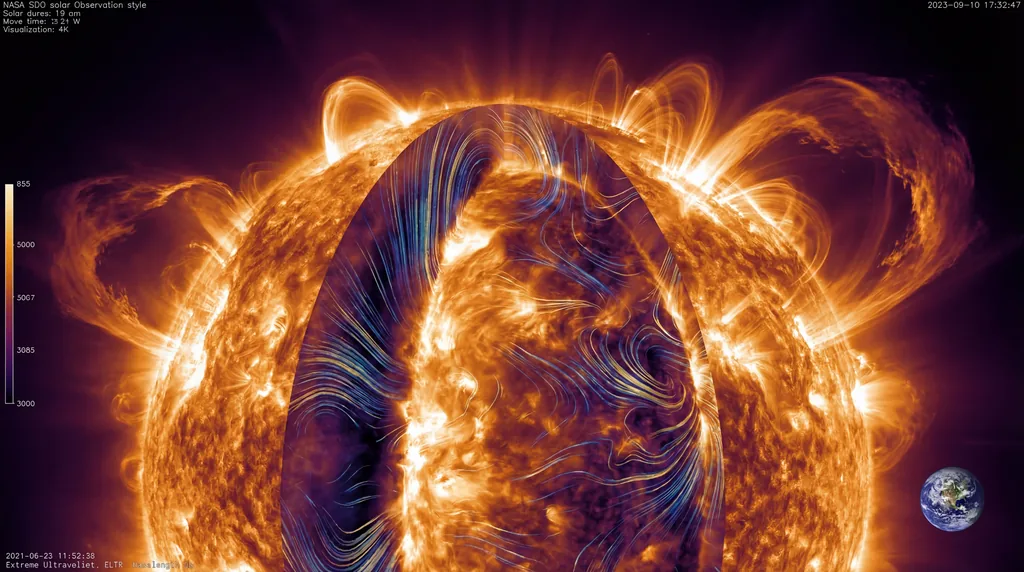

How did NJIT physicists trace the Sun’s magnetic engine using solar oscillation data?
NJIT physicists traced the Sun’s magnetic engine by analyzing nearly 30 years of solar oscillation data from NASA’s MDI and HMI instruments, along with the ground-based GONG network. By employing helioseismic techniques to measure sound waves from turbulent plasma, they identified rotation bands and located the solar dynamo approximately 200,000 kilometers beneath the surface within the tachocline.
Helioseismology functions similarly to terrestrial seismology, where scientists use sound waves to map the interior of a celestial body. For this study, lead author Krishnendu Mandal, a research professor of physics at the New Jersey Institute of Technology (NJIT), bridged observations from the Michelson Doppler Imager (MDI), the Helioseismic and Magnetic Imager (HMI), and the Global Oscillation Network Group (GONG). These instruments have recorded the Sun’s internal vibrations every 45 to 60 seconds since the mid-1990s, providing a massive dataset of billions of individual measurements.
Solar oscillation data reveals how hot plasma rotates and churns deep within the star. By analyzing shifts in the travel times of acoustic waves, the researchers identified distinct bands of faster and slower rotation. These internal flow patterns form a butterfly-shaped migration that mirrors the movement of sunspots observed on the surface. This correlation allowed the team to pinpoint the solar dynamo—the actual engine room of the star's magnetism—at a depth equivalent to stacking 16 Earths end to end.
Why is the discovery of the Sun's magnetic engine important for space weather forecasting?
This discovery is vital because it confirms the solar dynamo operates in the tachocline, allowing for more accurate space weather models. By identifying the specific depth of the Sun's magnetic engine, researchers can improve predictions for solar flares and coronal mass ejections (CMEs) that threaten Earth’s satellite communications, GPS navigation, and power grids.
Space weather forecasting currently relies on simulations that often prioritize near-surface magnetic processes. However, the NJIT findings, published in Nature Scientific Reports on January 12, 2026, suggest that the entire convection zone—and specifically the tachocline—must be integrated into these models to achieve precision. Understanding the solar cycle's origin allows scientists to anticipate the intensity of eruptive events before they manifest as visible sunspots on the photosphere.
Magnetic activity originating deep within the star can take several years to propagate to the surface. By tracking these internal changes early, physicists hope to extend the "lead time" for space weather alerts. As of March 18, 2026, current solar activity remains quiet, with Aurora visibility limited to Arctic regions like Tromsø, Norway (latitude 69.6). However, the ability to forecast when the Kp-index might spike will depend heavily on these new interior models.
What causes solar flares according to the new research?
According to the research, solar flares are driven by magnetic fluctuations generated by the solar dynamo located 200,000 kilometers deep. These flares occur when shearing flows at the tachocline organize intense magnetic fields that eventually rise to the surface, creating sunspots and triggering the explosive release of energy known as solar eruptions.
Magnetic field organization occurs at the boundary between the radiative zone and the convection zone. This thin transition layer, the tachocline, features abrupt changes in rotation speeds. These differential rotation forces stretch and twist magnetic field lines, building up immense tension. When these fields eventually break through the surface, they manifest as sunspots—the dark, cooler regions that serve as the launchpads for solar flares.
Krishnendu Mandal noted that sunspots are merely the "visible footprints" of a much larger, deeper system. While previous theories debated whether the solar dynamo was a surface-level phenomenon or a deep-seated one, this study provides the clearest observational evidence to date that the engine resides at the base of the convection zone. This finding helps explain the 11-year solar cycle and why magnetic activity migrates toward the equator over time.
Listening to the Sun: The Role of Helioseismology
Helioseismology has emerged as the primary tool for peering through the Sun’s opaque outer layers. Because light cannot escape the interior without being scattered, physicists must rely on acoustic waves generated by turbulent plasma. These waves bounce around the interior of the star, and their frequencies are subtly altered by the temperature and movement of the material they pass through. By "listening" to these vibrations, the NJIT team reconstructed a 3D map of the star's hidden dynamics.
- Data Longevity: The team utilized nearly 30 years of continuous data, covering almost three full 11-year solar cycles.
- Instrument Synergy: Combining SOHO (NASA/ESA) and SDO (NASA) satellite data with the ground-based GONG network reduced observational noise.
- Pattern Recognition: The researchers identified zonal flows—underground "rivers" of plasma—that match the butterfly diagram of sunspot appearances.
The 200,000-Kilometer Discovery: Mapping the Tachocline
The tachocline represents a critical anatomical feature of the Sun, located roughly 200,000 kilometers beneath the surface. This region is a thin interface where the solid-body rotation of the inner radiative zone meets the fluid-like, differential rotation of the convection zone. The shear forces generated here are strong enough to amplify magnetic fields to staggering intensities. Finding the magnetic engine at this specific depth resolves a long-standing debate in heliophysics regarding where the star’s magnetic field is amplified and stored.
Alexander Kosovichev, study co-author and NJIT Distinguished Professor, led the analysis at NJIT’s Center for Computational Heliophysics. The team’s work shows that the magnetic structural changes near the tachocline precede surface activity by years. This suggests that the solar cycle is not just a surface phenomenon but a "whole-star" process that begins in the deep interior. This depth—roughly 16 Earths deep—highlights the scale of the forces involved in powering the solar dynamo.
Implications for Stellar Physics and Galactic Research
Stellar magnetism is a universal phenomenon, and the Sun serves as the primary laboratory for understanding stars across the galaxy. Many stars exhibit magnetic cycles similar to our own, but they are too distant for high-resolution helioseismic analysis. By perfecting the model of the solar dynamo, physicists can apply these "rules" to other star systems, helping to determine the habitability of exoplanets which may be subjected to stellar flares even more violent than those from the Sun.
Expertise signals from the study indicate a high impact on the field, as it was supported by the NASA DRIVE Science Center, a prestigious collaboration of 13 U.S. universities. The research, titled "Helioseismic evidence that the solar dynamo originates near the tachocline" (DOI: 10.1038/s41598-025-34336-1), provides a fundamental framework for the next generation of solar missions. Understanding the magnetic engine is a crucial step in safeguarding modern civilization from the unpredictable nature of our nearest star.
Future Directions: Refining Solar Forecasts
Future research will focus on using this 200,000-kilometer benchmark to refine numerical simulations of the solar cycle. While the current findings do not yet allow for day-by-day weather predictions on the Sun, they provide the necessary coordinates for where to look. The NJIT team plans to continue monitoring the current solar cycle to see if the internal flow patterns can predict the specific intensity of the next solar maximum.
Advanced observations from future NASA missions and improved ground-based telescopes will likely build upon this 30-year dataset. As scientists better understand how the tachocline evolves over time, the goal of creating a "weather map" for the Sun’s interior becomes increasingly realistic. For now, the discovery stands as a milestone in heliophysics, finally locating the hidden engine that has driven the solar cycle for billions of years.





Comments
No comments yet. Be the first!