niu students host $100 Space For All Challenge
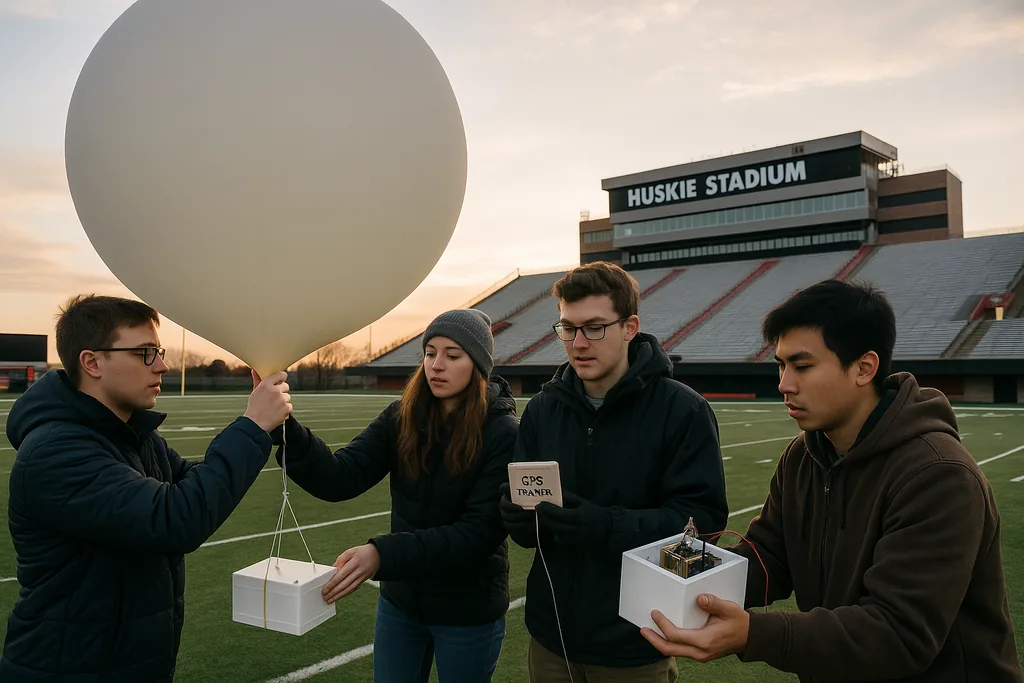
On March 25, 2025, Proxima Centauri Alpha — a new, honors-level STEM society at Northern Illinois University — announced the "$100 Space For All Challenge," inviting anyone at NIU to submit a lightweight object idea that could be attached to a weather balloon scheduled to launch from Huskie Stadium in the first week of May. The winning submission will receive $100 and the chance to have a single small item ascend into the upper atmosphere during the May 3 launch event.
The competition is deliberately simple: entrants fill out a short form and describe a lightweight payload idea; the group's executive board will vote and select the winner. The public launch is set for 10 a.m. on May 3 and the organizers say the flight will include cameras, a GPS tracker and measurement tools including a Geiger counter. That mix of instruments turns an outreach stunt into a genuine STEM exercise — students design, predict, observe and then recover data when the payload parachutes back to Earth.
niu students host $100: how to send a small object to the edge of space
Because the contest centers on a single lightweight item, it’s useful to understand what "sending something to the edge of space" actually means for student balloon teams. High-altitude weather balloons used by universities and student groups routinely climb into the stratosphere, often reaching tens of thousands of metres above the ground. Proxima Centauri Alpha told the campus paper that similar balloons can reach around 140,000 feet (roughly 42 kilometres), though most student launches operate in the 60,000–115,000 foot range depending on payload mass and balloon size. That means students will see the dark sky and the curvature of Earth, but they will almost certainly remain below the Fédération Aéronautique Internationale's (FAI) 100-kilometre Kármán line usually cited as the technical boundary of space.
Practically, a small, lightweight object for this kind of flight needs to meet strict mass and size limits, be secured inside the payload bay, and tolerate low temperatures, low pressure and strong vibration during launch and descent. Most student projects keep the item under a few hundred grams and enclose it inside a foam-lined 3–6 inch cube together with cameras and a tracking beacon. The result is a very real, inexpensive taste of near-space conditions without rocket hardware.
Regulatory and safety fundamentals for balloon flights
Launching a balloon to the stratosphere is not just a backyard experiment: team leaders must coordinate with the Federal Aviation Administration and follow notification rules for unmanned free balloons under U.S. aviation law. Student teams commonly file pre-launch notices and, when required, obtain authorisations that trigger a Notice to Airmen (NOTAM) so aircraft can avoid the balloon's flight path. Proxima Centauri Alpha confirmed it sought FAA clearance ahead of the May launch, a standard step that protects both the public and the recovery team. These formalities are routine but mandatory for high-altitude flights.
On the technical safety side, organizers typically include multiple redundancies: GPS trackers, radio beacons and often two separate location devices to ensure recovery; a parachute to slow descent after the balloon bursts; and sealed housings to keep electronics dry and insulated. Teams also plan retrieval logistics because the landing spot can be several miles — or, in unusual wind conditions, dozens of miles — from the launch site. This planning is part of the educational value: students learn systems engineering, risk assessment and the reality of field operations.
Costs, gear and the $100 angle
One of the recurring surprises about student balloon projects is affordability. Although professional balloon flights and commercial near-space services can run into the thousands, grassroots student launches can be run for a few hundred dollars to a couple of hundred dollars if teams rely on off‑the‑shelf hardware, donated helium and volunteer labour. Low-cost flights typically use a large latex weather balloon, a small payload box, a consumer action camera or two, a tiny single-board computer or data logger, and a GPS tracker. That low price point is why Proxima Centauri Alpha emphasised accessibility with a $100 prize: it signals this is a modest, student-scale exercise rather than a deep-pocketed hardware campaign.
Teams wanting to replicate or learn from the NIU model should budget for the balloon (hundreds of dollars for the larger sizes used to reach the stratosphere), a helium fill, tracking hardware, parachute materials and optional sensors like temperature probes or a Geiger counter. Many colleges reuse cameras and microcontrollers across years of launches to keep costs down; sponsorships and small departmental grants bridge the remainder. As NIU's organizers noted, additional sponsorship can upgrade cameras and tracking gear, improving both outreach imagery and scientific return.
What students learn in the stratosphere
Beyond the spectacle, a weather-balloon launch is a compact, hands-on course in experimental physics and engineering: students calculate ascent rates, predict burst altitudes using balloon lift equations, model trajectories from wind forecasts, integrate electronics, and run post‑flight data analysis. Instruments like Geiger counters, thermistors and pressure sensors record an environment that is otherwise inaccessible without large facilities. Those datasets become class projects, posters and CV material — and the experience is often cited by students as a transformative moment that clarifies their interest in aerospace or instrumentation. NASA and regional Space Grant programs run similar school-focused balloon initiatives precisely because they convert classroom theory into field-tested experimentation.
Recovering the payload and practical tips
Recovery is as important as launch. A successful flight ends with a functioning payload on the ground and usable data. Students commonly attach two independent tracking systems: a cellular-assisted GPS tracker that reports latitude/longitude while coverage exists, and a radio-transmitter for short-range homing after landing. The recovery team follows the trackers' telemetry, plans a safe route to the landing site and retrieves the box with a checklist to avoid damage and preserve experimental integrity. Organizers also warn that weather — especially upper-atmosphere winds — is the main variable that can change recovery plans by shifting landing zones unpredictably.
Why this matters
Simple, low-cost balloon launches are one of the clearest examples of how universities can democratize access to near-space science. For a modest sum and careful planning, dozens of students can design experiments that fly where few classrooms reach. NIU’s contest packages that opportunity into an outreach hook: the $100 cash prize is small in dollar terms but large in symbolic value — it lowers the barrier to participation and promises a tangible, high-altitude payoff. The launch also serves as on‑campus visibility for STEM work and a training ground for students who may later work on larger research balloon missions, CubeSats or orbital projects supported by Space Grant programs and NASA.
Sources
- Northern Illinois University (official internal announcement — "$100 Space For All Challenge").
- Northern Illinois University student newspaper reporting on the Proxima Centauri Alpha launch plans.
- NASA — Nationwide Eclipse Ballooning Project and Balloon Program Office materials on student balloon science.
- Federal Aviation Administration — guidance and AIM sections on unmanned free balloons and notification procedures.
- Fédération Aéronautique Internationale (FAI) statement on the Kármán line and the 100 km definition of the edge of space.




Comments
No comments yet. Be the first!