Lede: a big bet on light in Austin
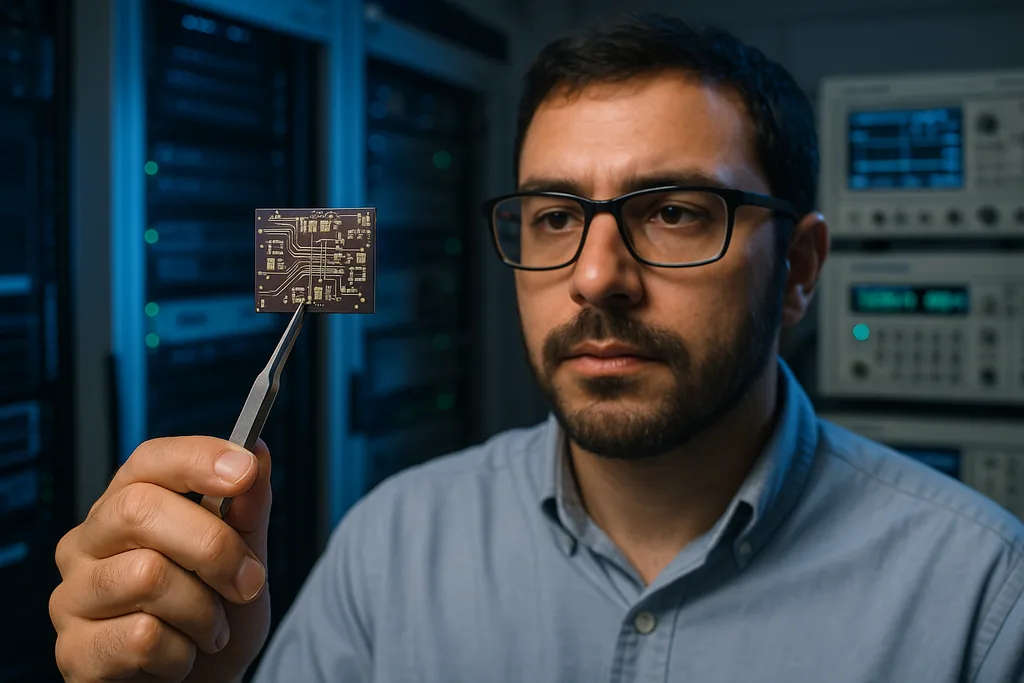
On January 22, 2026, Austin‑based chip startup Neurophos announced $110 million in fresh capital to accelerate development of AI processors that compute with light. The company says its photonic approach could sharply reduce the electricity consumed by large language models and other neural networks — a direct challenge to the GPU‑centric architecture dominated by one incumbent vendor. Neurophos also told local reporters it plans to more than triple its headcount by the end of 2026 as it moves from lab prototypes toward production‑grade hardware.
Photonic acceleration
Neurophos’s pitch rests on a straightforward physics advantage: photons move without the resistive heating that plagues electrons. In integrated photonics, light guided through tiny waveguides and manipulated by optical components performs the core linear algebra — the multiply‑accumulate operations that dominate neural‑network workloads — using interference, phase shifts and modulation rather than transistor switching. For certain classes of AI inference and linear algebra, that can translate into a dramatic improvement in energy per operation.
That promise has been simmering in university labs for years. Neurophos traces its technical lineage to decades of optical and silicon‑photonics research, including work at Duke University that explored engineered optical materials and device architectures. The same body of optics research once lent ideas to exotic demonstrations such as cloaking and metamaterials; Neurophos’s founders are now attempting to reshape those principles into a commercially viable accelerator for modern AI.
Why investors are paying attention
$110 million is a sizable war chest for a device‑level startup attempting to dislodge incumbents in a market worth tens of billions of dollars. For investors, the attraction is twofold: the scale of the AI compute market, and the acute need to rein in energy costs at hyperscale data centres. Large models already consume megawatts in single installations; shaving watts per inference across millions of queries has immediate operational value.
Neurophos’s announcement arrives at a moment when buyers and operators of AI infrastructure are actively seeking alternatives to the dominant GPU‑based stacks. GPUs are exceptionally flexible and supported by a vast software ecosystem, but they deliver performance at the cost of high power draw and complex cooling requirements. Photonic accelerators promise a fundamentally different tradeoff: reduced electrical energy for certain linear algebra workloads at the price of new engineering challenges in precision, packaging and integration.
Technical realities and limits
The physics that makes photonics attractive also sets hard constraints. Optical computation tends to be analog: weights and signals are encoded in light amplitude or phase. That analog nature brings efficiency but also noise, drift, and sensitivity to fabrication tolerances and temperature. Achieving the numerical precision that many modern models require — especially during training — is nontrivial. Even for inference, where lower precision is often acceptable, system architects must solve how to convert between optical compute and the digital memory that holds huge model weights.
Manufacturing is another practical hurdle. Silicon photonics has matured rapidly, but high‑volume production of complex photonic chips still lags behind advanced electronic foundries. Packaging — the process of coupling light sources, modulators, detectors, and control electronics into a robust module — is expensive and often bespoke. That makes the path from prototype to rack‑scale deployment longer and riskier than it can be for purely electronic designs.
Product strategy and near‑term milestones
Neurophos has signalled it will scale staff aggressively through 2026, moving from research to engineering and system integration. The funding round is meant to accelerate those hires and support fabrication runs, test platforms and early customer engagements. The company’s public statements focus on inference workloads in data centres, where deterministic latency and power per query are commercial levers operators care about most.
Execution will require parallel progress on multiple fronts: a photonic engine that demonstrably outperforms GPUs on key metrics, software that plugs into existing ML frameworks, and systems‑level engineering that addresses cooling, reliability and maintainability. Partners — foundries for silicon photonics, optical component suppliers, and hyperscalers willing to pilot new accelerator hardware — will be vital; the announcement did not name specific manufacturing partners or anchor customers.
Competition and the software problem
Neurophos enters a crowded field of startups and research labs exploring alternatives to GPU compute, from custom digital ASICs to specialized analog accelerators and other photonic efforts. The most entrenched competitor is the existing GPU and accelerator ecosystem, which benefits from years of software optimization, compiler toolchains and developer familiarity. That software stack is a major moat: any new hardware must either support the same programming models or provide an overwhelmingly better cost‑performance tradeoff to justify retooling.
Bridging that software gap is often the decisive technical and commercial challenge. Photonic devices need drivers, compilers and numerical libraries that translate neural‑network graphs into optical operations while compensating for analog imperfections. Startups that pair hardware advances with developer‑friendly toolchains are likelier to gain traction than those that rely solely on raw device performance.
Implications for power and climate
If photonic accelerators can deliver a step change in energy efficiency at scale, the climate and economics of AI would be affected. Hyperscalers are under pressure to reduce operational carbon and energy bills, and any technology that lowers the kilowatt‑hours per inference could be adopted quickly. However, those gains will only materialize if devices are robust, manufacturable, and easy to operate in large server farms.
It is also important to note that energy gains in compute do not automatically translate into net emissions reductions: they depend on where and how that compute is deployed, what workloads are shifted, and whether reduced per‑operation energy encourages more expansive use of models. Technology is necessary but not sufficient; system‑level deployment choices determine the real climate impact.
Outlook: high risk, high reward
Neurophos’s $110 million raise buys time and credibility. For the company, the immediate task is to turn physics demonstrations into productized modules that can be fielded and supported in real data centres. Success would mark one of the rare instances where a materials‑ and device‑level innovation meaningfully reshapes a multi‑billion‑dollar platform market dominated by GPU incumbents.
Failure is also a realistic outcome. The startup faces technical scaling challenges, entrenched software ecosystems, and the capital intensity of moving from lab wafers to rack‑level systems. Even with strong results, convincing cloud and enterprise customers to adopt a new accelerator requires pilots, engineering investments and demonstrable return on investment.
For observers of semiconductor supply chains and AI infrastructure, the Neurophos story will be worth watching not just for its technical claims but for what it signals about investor appetite for alternatives to GPU‑first compute. The company’s plans to grow headcount rapidly through 2026 and the size of the new funding round suggest investors see a window of commercial opportunity — but they have placed a big bet on light answering some of modern AI’s most vexing energy questions.
Sources
- Duke University (foundational research on photonics and metamaterials)
- Neurophos (company press materials)




Comments
No comments yet. Be the first!