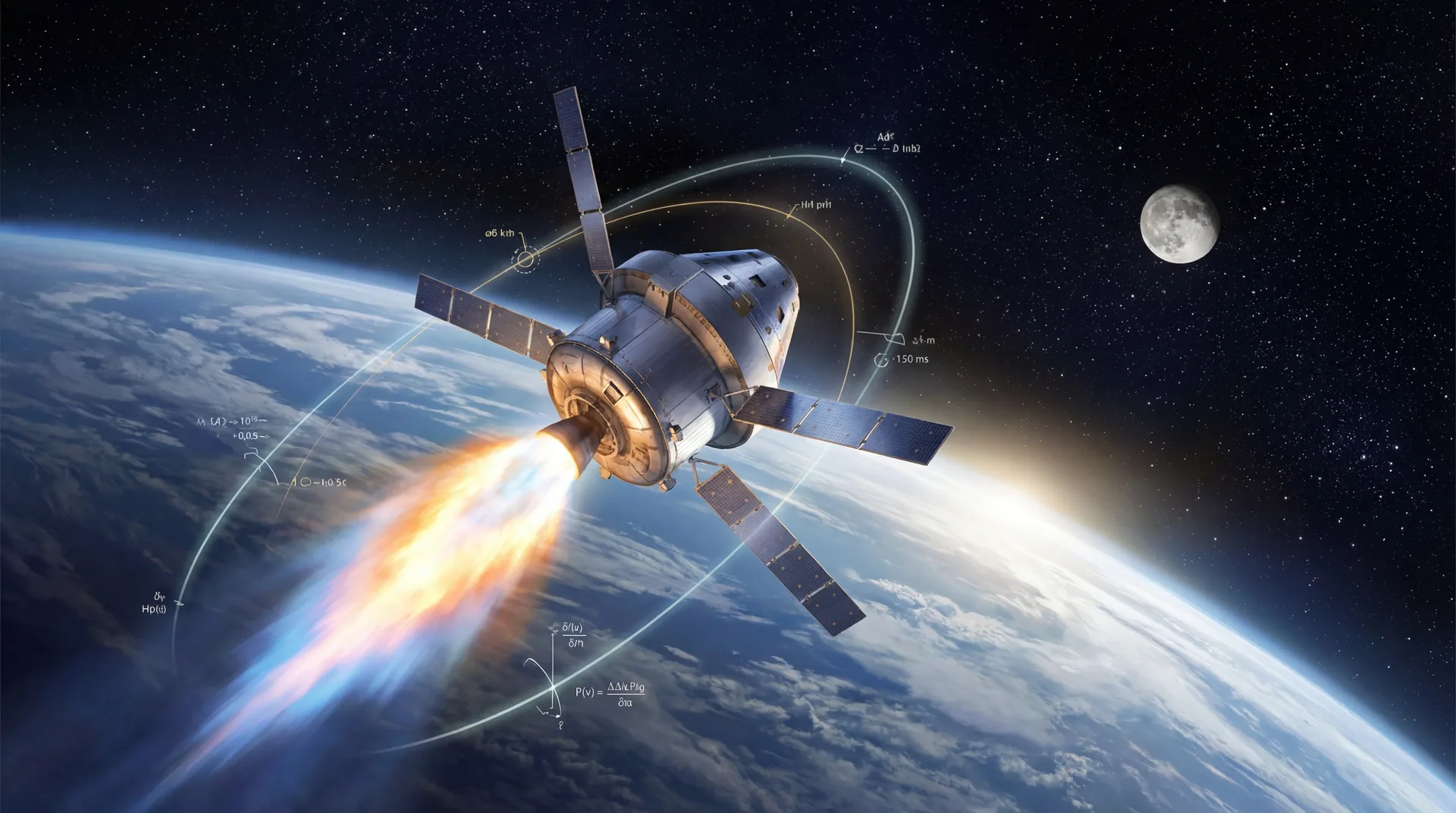

NASA’s Artemis II mission reached a historic milestone on March 31, 2026, as the Orion spacecraft successfully executed its Translunar Injection (TLI) burn, officially sending humans toward the Moon for the first time in over five decades. This high-stakes maneuver utilized the power of the Space Launch System (SLS) to propel the four-person crew out of Earth's gravity well and onto a trajectory toward the lunar environment. By achieving this precise velocity change, the mission has transitioned from an initial checkout phase into a deep-space voyage that marks a new era for international space exploration.
The mission was designed to test the fundamental capabilities of the Orion spacecraft and its life-support systems in a high-radiation environment beyond Low Earth Orbit (LEO). Following a successful launch from Kennedy Space Center, the crew—consisting of NASA and CSA astronauts—spent their initial hours in a High Earth Orbit (HEO) to verify that the vessel’s complex internal systems were functioning optimally. This cautious approach ensured that any technical anomalies could be addressed while the craft was still relatively close to home before committing to the long-duration journey to the Moon.
Why is the TLI burn the 'point of no return' for Artemis II?
The TLI burn serves as the "point of no return" for Artemis II because it commits the Orion spacecraft to a lunar trajectory from which a direct, immediate return to Earth is no longer propellant-efficient. Once this velocity is achieved, the laws of orbital mechanics dictate that the crew must complete a swing-by around the Moon to utilize lunar gravity for a safe return.
Propellant management is a primary factor in designating this burn as the mission's definitive threshold. While NASA flight controllers maintain contingency abort profiles during the first few hours following the burn, these maneuvers become increasingly "expensive" in terms of fuel consumption as the spacecraft gains distance. Once the Orion spacecraft reaches a specific distance from Earth, the energy required to stop and reverse course exceeds the remaining fuel reserves, mandating that the mission proceed through its planned lunar flyby.
Safety protocols for the Artemis II crew are heavily influenced by this ballistic reality. If a major system failure were to occur after the TLI burn, the crew would be required to remain in the spacecraft for the duration of the multi-day trip around the far side of the Moon before the return leg could begin. This commitment underscores the reliability required of Orion’s European Service Module, which provides the primary propulsion and power needed to sustain life during this critical deep-space transit.
How does the TLI burn change the Orion spacecraft's trajectory?
The TLI burn, lasting nearly six minutes, fundamentally alters Orion's path by increasing its velocity to escape Earth’s primary gravitational hold. Performed by the SLS Interim Cryogenic Propulsion Stage (ICPS) at an altitude of approximately 115 miles, the burn shifts the craft from a circular Earth parking orbit into an elongated, hyperbolic trajectory aimed at the Moon.
Trajectory dynamics for the Artemis II mission rely on the precise timing of the ICPS RL10 engine firing to ensure the spacecraft intercepts the Moon’s moving orbital position. Before the burn, Orion maintains a relatively low apogee of roughly 2,200 km; however, the TLI maneuver provides the "kick" necessary to stretch this orbit into the hundreds of thousands of miles. This injection is so precise that the spacecraft enters Earth’s shadow roughly 30 minutes after completion, requiring the crew to manage power loads as they lose solar input.
NASA flight controllers at the Johnson Space Center monitor these velocity and vector changes in real-time using the Deep Space Network. Key metrics tracked during the burn include:
- Delta-v (Change in Velocity): The specific increase in speed required to reach lunar distance.
- Attitude Control: Ensuring the spacecraft remains oriented correctly to prevent trajectory drift.
- Engine Performance: Monitoring the thrust levels of the cryogenic RL10 engine to ensure a clean cutoff.
What comes next for the crew after the TLI burn?
After the TLI burn, the crew enters a mission phase focused on proximity operations and deep-space systems verification. This includes using the recently jettisoned ICPS upper stage as a target for manual handling tests, where the astronauts will practice station-keeping at distances of 300 and 30 feet to evaluate Orion’s responsiveness in a vacuum.
In-flight checkouts will occupy much of the crew's schedule during the four-day coast toward the Moon. Engineers are particularly interested in how the Orion spacecraft handles the transition into the deep-space radiation environment, as this is the first time the modern crew capsule will be exposed to such conditions with humans aboard. These tests include verifying the performance of the toilet system, the exercise equipment, and the communication arrays that must bridge the 240,000-mile gap back to Earth.
The upcoming lunar flyby will see the crew pass within several thousand miles of the lunar surface, marking the furthest humans have ever traveled from Earth. During this phase, the crew will conduct high-resolution photography of potential landing sites for future Artemis missions. This data is critical for the upcoming Artemis III mission, which aims to land the first woman and first person of color on the lunar South Pole. The successful completion of the TLI burn ensures that these future milestones remain within reach.
Looking ahead, the Artemis II mission represents a pivotal shift in NASA's long-term strategy for human spaceflight. By proving that the SLS and Orion can safely transport humans to the lunar sphere of influence, NASA is laying the groundwork for the Lunar Gateway—a planned space station that will orbit the Moon and serve as a staging point for Mars exploration. The precision of the March 2026 TLI burn validates years of engineering and suggests that the road to a permanent lunar base is now open.
As the spacecraft continues its coast, the global scientific community watches with renewed interest in the "America’s Rocket Factory" and its ability to sustain a high cadence of lunar missions. The successful integration of international partners, such as the European Space Agency (ESA) and the Canadian Space Agency (CSA), highlights the collaborative nature of modern space exploration. For now, the focus remains on the four pioneers aboard Orion as they venture into the dark, preparing for a homecoming that will redefine our place in the solar system.





Comments
No comments yet. Be the first!