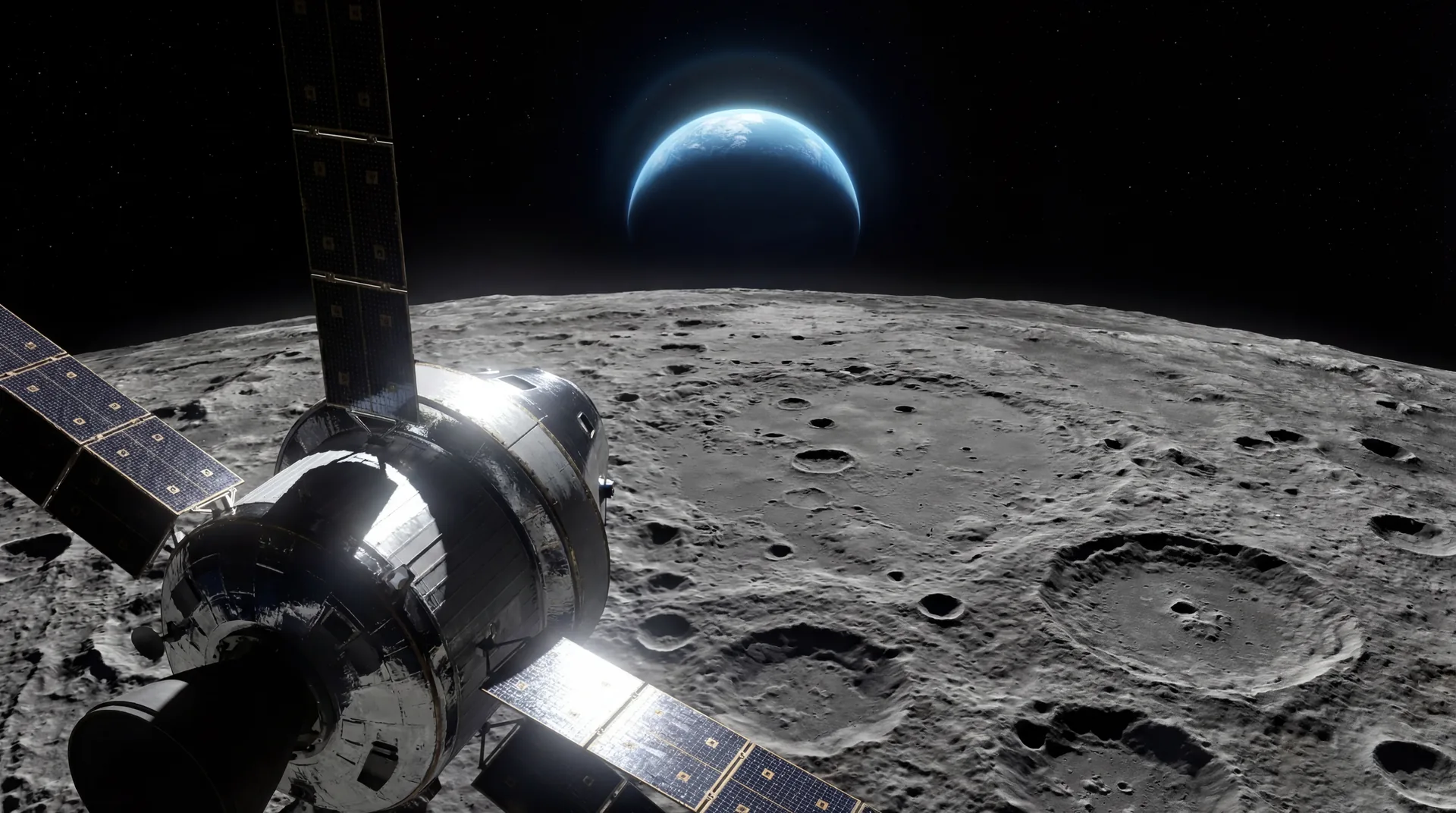

On April 6, 2026, the Artemis II mission officially set a new benchmark for human spaceflight by reaching a maximum distance of 252,756 miles (406,771 kilometers) from Earth. This historic milestone surpassed the previous record set by the Apollo 13 crew in 1970 by more than 4,100 miles. By swinging around the far side of the Moon, NASA astronauts Reid Wiseman, Victor Glover, and Christina Koch, alongside Canadian Space Agency astronaut Jeremy Hansen, have successfully demonstrated the capabilities of the Orion spacecraft for deep-space transit.
The record-breaking journey was made possible through a precision free-return trajectory, a gravitational assist maneuver designed to harness lunar gravity to sling the spacecraft back toward Earth. This trajectory is a critical safety feature for deep-space missions, as it ensures that even in the event of a propulsion failure, the laws of orbital mechanics will bring the crew home. The maneuver allowed the crew to reach the furthest point from our planet ever visited by humans, marking the first time a crewed vehicle has ventured beyond low Earth orbit (LEO) since the conclusion of the Apollo program in 1972.
Psychological endurance was as much a factor as physical distance during this high-stakes flyby. The mission day began with a pre-recorded message from the late Jim Lovell, the Apollo 8 and Apollo 13 pioneer, who welcomed the crew to his "old neighborhood." This emotional bridge between the 20th-century pioneers and the 21st-century explorers underscored the generational significance of the Artemis program. As the crew navigated the vastness of the lunar environment, they balanced rigorous scientific observation with the profound reality of being the most isolated humans in history.
How far did the Artemis II crew travel beyond the Apollo 13 record?
The Artemis II crew reached a maximum distance of 252,756 miles (406,771 kilometers) from Earth, surpassing the 1970 Apollo 13 record of 248,655 miles. This achievement was realized as the Orion spacecraft swung around the lunar farside, placing the four astronauts further into deep space than any humans in history. The mission utilized the Moon's gravity to establish a return path to Earth.
Scientific observation remained the primary focus during this record-setting transit. The crew spent several hours documenting the lunar farside, a region of the Moon that remains permanently hidden from terrestrial view. According to Artemis II Lunar Science Lead Kelsey Young, human eyes can detect nuances in color and texture that high-resolution cameras, such as those on the Lunar Reconnaissance Orbiter, might miss. These direct human observations provide invaluable geological context that will inform future landing site selections for Artemis III and beyond.
Humanity and science converged when the crew requested to name two previously unnamed lunar craters. Canadian astronaut Jeremy Hansen proposed the names "Integrity," in honor of their Orion capsule, and "Carroll," a tribute to Commander Reid Wiseman’s late wife who passed away in 2020. This request, which NASA plans to formally submit to the International Astronomical Union (IAU), highlighted the personal stakes and emotional depth involved in these long-duration missions. The act of naming landmarks serves as a symbolic claim of human presence in the lunar environment.
What technical milestones were reached during the lunar flyby?
During the flyby, the Artemis II crew completed the first human-led scientific survey of the lunar farside in over 50 years and witnessed a unique solar eclipse from the lunar environment. Technical milestones included a successful 40-minute Loss of Signal (LOS) period where the spacecraft operated autonomously behind the Moon, reaching its closest approach of 4,067 miles (6,545 kilometers) to the surface. These tests validated Orion’s communication and navigation systems.
The mission's success during the Loss of Signal period was a critical validation of the spacecraft’s autonomous systems. While behind the Moon, the crew was cut off from Mission Control, forcing a reliance on onboard telemetry and the robustness of the Orion spacecraft’s hardware. During this window, the crew observed the lunar surface at its closest proximity, capturing data that will be essential for mapping the rugged terrain of the southern highlands. This period of silence is a necessary precursor for future missions to Mars, where communication delays can last up to 20 minutes.
Observational physics also took center stage as the crew became the first humans to witness a solar eclipse from the lunar perspective. Seeing the Moon block the Sun from the vantage point of deep space provided a rare opportunity to study the solar corona and lunar limb effects. This unique perspective contributes to our broader understanding of space weather and its potential impact on astronauts during multi-year interplanetary transits. The massive amounts of imagery and commentary generated during this phase are currently being transmitted to Earth for multi-disciplinary analysis.
Is the Orion spacecraft performing as expected for the return journey?
The Orion spacecraft, named Integrity, has demonstrated exceptional performance throughout the flyby and has successfully initiated its return transit to Earth. While full data analysis is ongoing, the vehicle’s life support, power, and propulsion systems have functioned within expected parameters. The final test of its performance will occur during its high-speed atmospheric reentry on April 10, 2026.
The return journey serves as the ultimate rehearsal for the thermal challenges of deep-space exploration. As Artemis II nears Earth, it will experience reentry speeds of approximately 25,000 miles per hour, generating temperatures near 5,000 degrees Fahrenheit on the heat shield. Validating that the thermal protection system can withstand these forces is essential before NASA commits to the crewed lunar landings planned for later this decade. The spacecraft is currently on track for a scheduled splashdown in the Pacific Ocean on Friday at 8:07 pm ET.
The geopolitical significance of the mission was reinforced by a congratulatory call from the White House. President Trump spoke with the crew, emphasizing that while the Moon is the current milestone, Mars remains the long-term objective of American space policy. The President noted the inspiration the mission has provided globally and invited the crew to the White House upon their return. This high-level endorsement reflects the mission's role as a cornerstone of national prestige and international cooperation, particularly with partners like the Canadian Space Agency.
The Path to Mars and Beyond
Future directions for the Artemis program involve the transition from lunar flybys to sustained lunar presence. The data gathered during Artemis II will directly influence the development of the Lunar Gateway, a planned space station that will orbit the Moon and serve as a jumping-off point for deep-space missions. By proving that the Orion spacecraft can safely transport humans through the Van Allen radiation belts and maintain life support over deep-space distances, NASA is systematically checking the boxes required for the eventual multi-year journey to the Red Planet.
The successful return of the Artemis II crew will signal the beginning of a new era in human exploration. With a splashdown anticipated near California, the mission's conclusion will shift the focus to the engineering of the HLS (Human Landing System) for Artemis III. As Jeremy Hansen noted during the presidential call, the ability of a nation to set such grand goals and bring international partners along is "truly incredible." For now, the world watches the Pacific, waiting for the safe return of four pioneers who have officially traveled further from home than anyone in the history of our species.





Comments
No comments yet. Be the first!