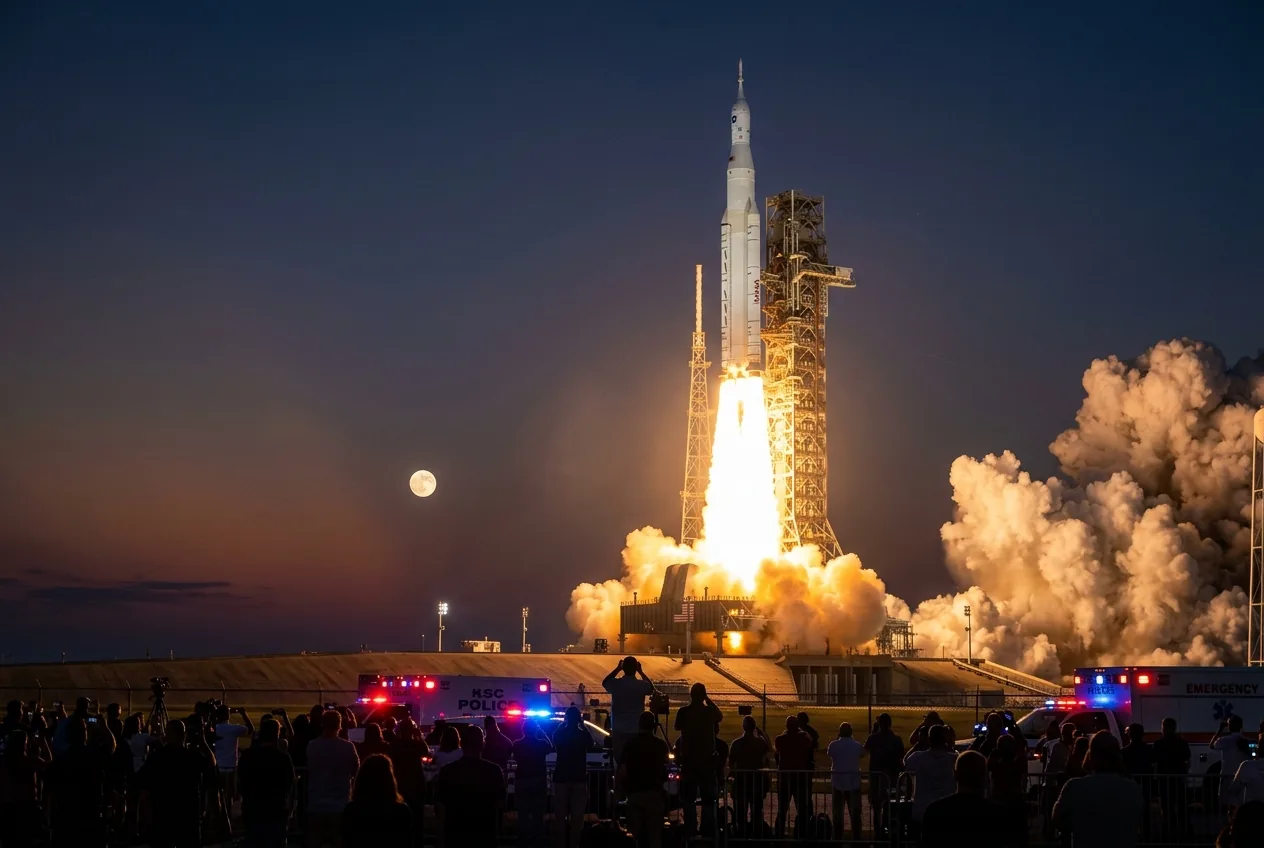
A plume of fire, a full moon and a line of cars that wouldn’t budge
At 6:35 p.m. EDT on Wednesday, a 322‑foot rocket tore the late‑afternoon sky above Launch Pad 39B into a white column of noise and light. People in tour buses and on beaches craned their necks; a man near the Banana River shouted, "There it goes," and then the cloud of steam rolled downhill like a boiling sea. Onboard, Commander Reid Wiseman radioed the line that would become the evening's most replayed soundbite: "We have a beautiful moonrise — we're headed right at it." It was an observed moment: loud, visible for miles, and oddly intimate given the crew's destination more than a quarter of a million miles away.
Why this matters: nasa successfully launches historic Artemis II because the flight is billed as a test but it will carry humans farther from Earth than any since Apollo. For NASA, contractors, and the four astronauts — Reid Wiseman, Victor Glover, Christina Koch and Jeremy Hansen of the Canadian Space Agency — Wednesday's liftoff was the beginning of a tightly scripted, politically watched, technically risky 10‑day mission that will stress spacecraft and people in ways an unmanned flight could no
nasa successfully launches historic: the launch, the glitches, and the gut check
The countdown here was not theatrical ritual so much as risk management. Teams loaded roughly 700,000 gallons of cryogenic propellant into the Space Launch System, ran final checks on the Orion capsule's abort battery after anomalous temperature readings, and cleared a last‑minute command issue with the rocket’s flight‑termination system. Those are the sorts of details engineers sweat over; they also explain why the SLS rolled back to a hangar in March for repairs after a wet dress rehearsal.
At T+9 minutes the core stage separated and the twin solid rocket boosters fell away as planned. Solar arrays on Orion deployed and latched within the first hour, and flight controllers moved the vehicle into a series of high‑stakes checkouts: perigee‑raise burns, a sustained upper‑stage firing to reach high Earth orbit, and the final translunar injection burn that will put the spacecraft on a free‑return trajectory around the far side of the Moon. The mission timeline — about 10 days from launch to Pacific splashdown near San Diego — is compact but deliberately thorough: this is a human test of hardware and procedures, not a tourist trip.
nasa successfully launches historic: what Artemis II is, and what it is not
Artemis II is the first crewed mission of NASA's Artemis program. Unlike Artemis I, which was an uncrewed shakedown in 2022, Artemis II carries a four‑person crew to validate life‑support, navigation and crew operations with humans aboard. It will not land. Instead, Orion will loop behind the Moon on a free‑return trajectory and return the crew safely to Earth — a dress rehearsal for a later surface landing.
The difference is critical. Apollo 8 and Apollo 10 performed analogue roles before Apollo 11's landing; Artemis II is similar in intent but comes with modern complications: a new, larger launch system, a European‑built service module, commercial lunar lander programs in parallel, and a handful of small satellites deployed from the SLS upper stage. The mission is testing the integrated architecture in the real world with real people — which is why some engineers and several external experts have been both excited and, privately, nervous.
The crew, the oddities and the human details
Wiseman, Glover and Koch are experienced long‑duration flyers; Hansen is on his first spaceflight and will be the first non‑American to travel this far. The roster intentionally mixes experienced station hands with a rookie, because part of Artemis II’s remit is assessing crew dynamics and human factors outside low‑Earth orbit for the first time in decades.
Small, human details matter. The mission carries a plush zero‑g indicator chosen from thousands of student entries, a microSD card with millions of names, and food‑warming hardware being tested for the first time in deep space. But the technical priorities are sober: measure radiation exposure beyond Earth’s magnetosphere, exercise Orion’s manual handling and proximity‑operations capability, and subject onboard life‑support to the day‑to‑day habits of a crew — sleeping schedules, exercise, hygiene and stress responses — so NASA can refine systems before sending people to the lunar surface.
Space weather, radiation and an argument over timing
One technical tension has been largely invisible to the public: solar activity. Scientists point out that solar energetic particles and galactic cosmic rays are the main radiation hazards once a spacecraft leaves Earth's protective magnetosphere. Some recent analyses argue that the current solar cycle increases the odds of intense particle events; others note that stronger solar wind can actually suppress background cosmic rays. The trade‑off is not academic: it affects when you launch, what shelters you design into spacecraft, and how you plan astronaut exposure limits.
NASA's approach has been pragmatic: monitor the Sun, accept short‑term flight risk when mission windows align, and rely on Orion's shielding plus operational protocols if a solar event appears. The argument over whether to delay for a more quiescent solar environment is one of those technical debates that meets public expectations of caution — and agency imperatives to keep schedule and budgets from ballooning.
Costs, politics and the unstated bill for going back
There is a policy tension threaded through Artemis: building a durable lunar presence is expensive, legally and politically complex, and dependent on commercial partners. The public moment of liftoff masks the much longer slog: budgets stretching years into the future, procurement fights over lunar landers, and a global patchwork of partners. That has legal consequences — who owns what on the Moon, how scientific data is shared, who pays for rescue contingencies — and practical ones, like the obvious local effect in Florida: hundreds of thousands of visitors, gridlocked roads and police advisories about being prepared for long delays.
For NASA, the launch is also a political proof point: finish a crewed lunar flyby and the conversation shifts from whether the program can operate to how fast it can scale. That will invite closer scrutiny of costs and timelines — the very dynamics that make the program vulnerable to schedule slips and political change.
Three observations others miss
First: calling Artemis II a "test flight" understates its reach. It is a test in name and in engineering objectives, but it will physically put humans farther from Earth than any in living memory — a real, non‑simulated exposure to deep space. Second: routine failures in prelaunch checkouts — hydrogen leaks, a battery with odd temperature readings, command routing for flight‑termination — are not just paperwork; they are the reason this particular test must be run with people aboard. Third: the mission will produce practical, near‑term data about human health, systems performance and operations that cannot come from unmanned runs; those data will reduce risk for future surface landings, but they will not make those landings cheap or politically uncontroversial.
What to watch next
Over the next 48 hours watch for the translunar injection burn and for the suite of human‑health experiments the crew is conducting — some measure cardiovascular and vestibular responses, others log radiation doses in high temporal resolution. If Orion's service module performs as designed, mission control will commit to the lunar flyby on schedule and hand the crew the task of photographing and observing sections of the lunar far side that few have seen directly.
If problems appear — a propulsion anomaly, a significant solar particle event, or a spacecraft systems fault — controllers will have to balance conservative safety calls against the hard political and programmatic pressure to complete the flight. That decision calculus is precisely the reason NASA is flying people now: not because the agency wants flashy headlines, but because certain system‑level questions can only be answered with humans in the loop.
Sources
- NASA (news release and Artemis II mission materials)
- Canadian Space Agency (mission and crew briefings)
- NASA Kennedy Space Center/Johnson Space Center technical briefings and SLS fact sheets




Comments
No comments yet. Be the first!