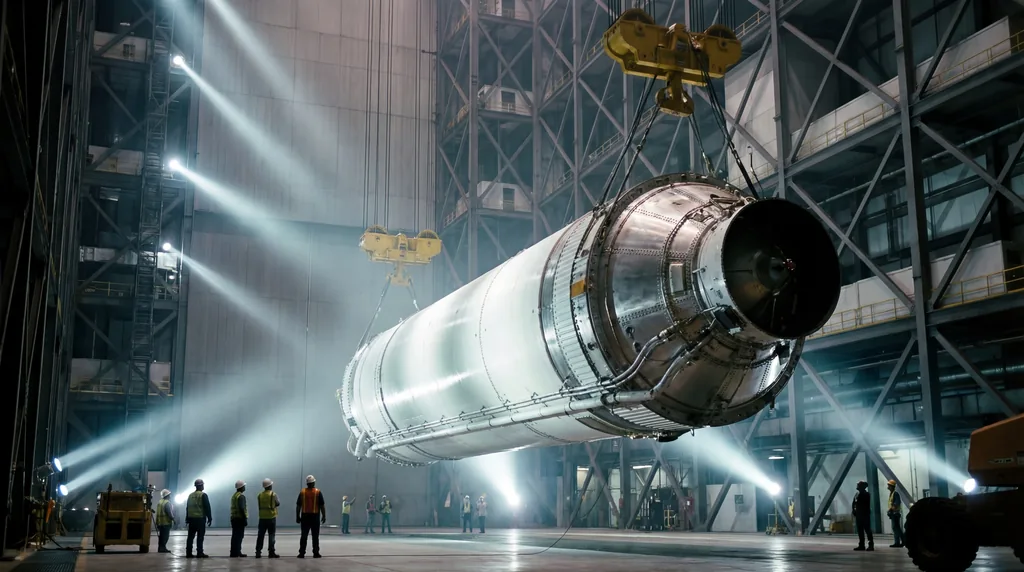

NASA has formalized a contract to utilize United Launch Alliance’s (ULA) Centaur 5 as the primary upper stage for the Space Launch System (SLS), beginning with the Artemis 4 mission. This strategic integration, confirmed on March 7, 2026, leverages the proven flight heritage of the Vulcan rocket to enhance the heavy-lift capabilities required for the Artemis Program. By pivoting to the Centaur 5, NASA aims to streamline its deep-space architecture and ensure a sustainable cadence for lunar exploration.
What happened to the original Exploration Upper Stage (EUS) for SLS?
NASA transitioned away from the Exploration Upper Stage (EUS) due to significant cost overruns and schedule delays that threatened the timeline of the Artemis Program. Originally developed by Boeing, the EUS saw projected costs balloon from an initial $962 million to nearly $2.8 billion, leading the agency to prioritize the flight-proven and more cost-effective Centaur 5 architecture to maintain the 2028 launch window.
The decision to abandon the EUS marks a pivotal shift in the Artemis Program procurement strategy. NASA Administrator Jared Isaacman announced the change during a briefing at the Kennedy Space Center on February 27, 2026, emphasizing a "standardization of the SLS fleet." The move is designed to reduce architectural complexity and accelerate manufacturing processes that were previously bogged down by quality control issues at the Michoud Assembly Facility in Louisiana.
According to a 2024 report from NASA’s Office of Inspector General (OIG), the EUS development was nearly seven years behind its original schedule. The report projected that total SLS Block 1B costs would reach $5.7 billion before its first flight. By integrating the Centaur 5, NASA avoids the "unacceptable schedule impacts" associated with the continued development of the four-engine EUS, which was originally intended to increase lunar payload capacity by 11 metric tons.
How does Centaur 5 compare to Blue Origin's upper stage?
The Centaur 5 was selected over Blue Origin’s New Glenn upper stage because it offers superior compatibility with existing NASA infrastructure, specifically the Mobile Launcher 1 (ML1). While both stages utilize liquid hydrogen (LH2) and liquid oxygen (LOX), the Centaur 5 requires only minor modifications to ground systems, whereas the New Glenn stage would have necessitated a costly redesign of the Vehicle Assembly Building (VAB) height constraints.
Technical evaluations from the Marshall Space Flight Center highlighted several key advantages for the ULA hardware:
- Interface Compatibility: The Centaur 5 aligns with existing Exploration Ground Systems (EGS) interfaces and umbilical retraction mechanisms.
- Engine Maturity: The RL10 engine used by the Centaur 5 has decades of flight heritage and has been human-rated through the Commercial Crew Program.
- Physical Dimensions: Unlike the Blue Origin stage, the Centaur 5 does not require relocating the Mobile Launcher Crew Access Arm.
NASA officials noted that adopting the New Glenn Upper Stage (NGUS) would have required full-scale development and requalification testing for a shortened configuration. This would have introduced "additional cost risk" that the Artemis Program could not absorb given the current mandate for increased launch frequency and mission safety.
Is the NASA ULA Centaur contract a sole-source award?
Yes, NASA issued a sole-source contract to United Launch Alliance for the Centaur 5, citing that ULA is the only provider capable of meeting the rigorous 2028 deadline. An eight-page procurement document confirms that any other alternative would cause "unacceptable delays" due to the time required for new contractor personnel onboarding and hardware rework.
The procurement justification emphasizes the time constraints inherent in the Artemis Program. NASA requires a processing window at the Kennedy Space Center at least nine months prior to launch. Because the Centaur 5 has already completed four successful flights on the Vulcan rocket since 2024, it represents a "low-risk" solution that leverages established support infrastructure. Tory Bruno, former CEO of ULA, had previously indicated that the company was prepared for such an architectural shift if the government requested a change in the SLS design.
The Evolution of SLS Architecture and the Artemis Program
Standardization of the Space Launch System has become the primary objective for NASA leadership to ensure the long-term viability of lunar missions. By moving toward a "near-Block 1 configuration" for the Artemis Program, the agency is prioritizing reliability and launch rate over the theoretically higher performance of the unproven EUS. This evolution acknowledges that a consistent, yearly launch cadence is more valuable for the Lunar Gateway assembly than a single, high-mass delivery system that suffers from chronic delays.
The Artemis 4 mission will serve as the debut for this new configuration. Originally, NASA intended to use the Interim Cryogenic Propulsion Stage (ICPS) for the first three missions before jumping to the EUS. The selection of the Centaur 5 creates a middle ground that provides more performance than the ICPS while maintaining the heritage of the Delta 4 and Vulcan programs. This strategic pivot ensures that the Mobile Launcher 1 remains a critical asset without requiring the massive capital expenditures associated with Mobile Launcher 2 upgrades.
Technical Profile: The Centaur 5 Advantage
The Centaur 5 upper stage represents a significant technological leap over the Centaur 3, featuring a larger diameter and increased propellant capacity. Designed for the Vulcan rocket, it utilizes advanced thermal management systems that allow for long-duration coast phases in cislunar space. This capability is essential for Artemis Program mission profiles that require precise orbital insertion near the Moon after hours of transit from Earth.
Beyond its 5.4-meter diameter, the Centaur 5 is powered by two Aerojet Rocketdyne RL10C-1-1 engines. These engines provide high specific impulse, which is critical for deep-space injection. The stage’s ability to use the same propulsion commodities—liquid oxygen and liquid hydrogen—as the SLS core stage simplifies the logistics of fueling operations at the Launch Complex 39B. Furthermore, the Centaur 5 has already demonstrated its reliability across varied mission profiles for the U.S. Space Force, providing NASA with a robust data set for human-rating certification.
Flight Heritage: From Vulcan to SLS
The successful performance of the Centaur 5 across its first four Vulcan launches since January 2024 provided the empirical evidence NASA needed to finalize the contract. This flight heritage was a primary driver in the selection process, as it mitigates the "first-flight" risks typically associated with new rocket stages. For the Artemis Program, using a stage that has already survived the rigors of atmospheric ascent and vacuum restarts is a major safety advantage for crewed missions.
NASA's Exploration Ground Systems team has already begun collaborating with ULA to finalize the minor modifications needed for SLS integration. These teams bring years of experience from the Atlas 5 and Delta 4 programs, ensuring that the personnel handling the hardware at the Kennedy Space Center are well-versed in the stage's operational nuances. This "institutional memory" is viewed by NASA as an intangible but vital asset for maintaining mission safety and schedule adherence.
Future Outlook for the Artemis Program
The integration of the Centaur 5 sets a new trajectory for the SLS Block 1B and Block 2 configurations, focusing on a sustainable heavy-lift independence. While the Artemis Program has faced criticism for its budget, this "back to basics" approach is intended to stabilize the program’s financial footprint. By utilizing commercially developed hardware like the Centaur 5, NASA is successfully blending its traditional deep-space goals with the efficiencies of the modern commercial space sector.
Looking ahead, the Artemis 4 mission will be the ultimate test of this new architecture. If successful, the Centaur 5-powered SLS will become the workhorse for Lunar Gateway logistics and human landing system (HLS) support. This contract not only secures United Launch Alliance’s role as a critical partner in the lunar supply chain but also provides NASA with a clear path forward to Artemis 5 and beyond, free from the developmental hurdles that sidelined the original Exploration Upper Stage.





Comments
No comments yet. Be the first!