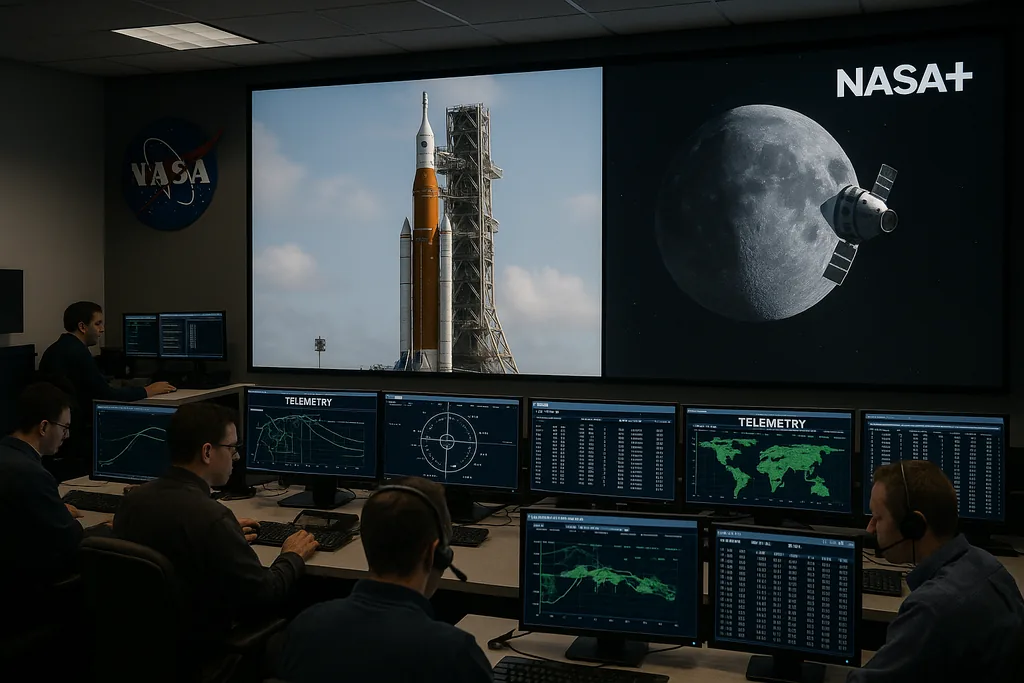
This week nasa+ prepares live stream operations and rehearsals that will carry the Artemis II mission from launch pad to lunar flyby and back into viewers' living rooms. Agency producers Rebecca Sirmons and Brittany Brown have shown how the new direct‑to‑consumer platform is combining traditional broadcast workflows, low‑latency ingest and cloud playout with satellite relays and NASA’s Deep Space and Near Space networks — all while preparing to reach billions of people across connected TVs, mobile devices and the web.
nasa+ prepares live stream: building a space‑to‑screen pipeline
Live broadcasting a spacecraft that will travel beyond the Moon puts unusual demands on people and kit. At a recent industry summit NASA+ leaders described a production that looks like a conventional launch broadcast on the surface, but multiplies complexity by a factor of ten: raw telemetry, multiple spacecraft feeds, crew commentary, onboard camera streams and mission control video must be stitched together, captioned and packaged for distribution in real time. That workflow must tolerate link gaps, high latency, and the limits of deep‑space telemetry without losing the immediacy viewers expect.
Behind the camera are media‑systems engineers working with mission planners and communications specialists. NASA’s Near Space Network and Deep Space Network provide primary mission telemetry and some of the uplink/downlink capacity; commercial distribution layers — NASA+ apps, a Prime Video FAST channel and partner platforms — handle the public delivery and audience scaling. The production team is rehearsing countdown demonstrations and simulated outages, and building redundant ingest paths so a loss of one relay won’t black out the picture for millions of viewers.
The result is a hybrid model: mission control keeps responsibility for command and spacecraft telemetry while NASA+ and its broadcast partners focus on storytelling and global delivery. Producers say the aim is to offer live launch coverage, continuous mission highlights and curated slices of spacecraft camera footage and crew interactions — presented with the context and graphics modern audiences expect.
nasa+ prepares live stream: where and how you can watch Artemis II
NASA has positioned NASA+ as the primary digital destination for Artemis II live coverage. That means viewers should expect comprehensive prelaunch programming, live liftoff coverage and mission‑event broadcasts (crew checks, translunar injection, lunar flyby and re‑entry) on the NASA+ apps and website. NASA+ is designed to reach connected TVs, mobile devices and desktop browsers; the agency has also expanded distribution by launching a free, ad‑supported NASA+ channel on Prime Video and by agreeing partnerships to make selected live programming available on other streaming platforms.
For audiences who prefer conventional paths, NASA will also simulcast core events on its public YouTube channel and on social platforms. That gives a simple, global fallback: if you cannot reach NASA+ through a smart‑TV app or local platform, NASA’s YouTube livestreams have historically provided near‑universal access and, for Artemis II, will host the main live feed and mission highlights. International partners — including the Canadian Space Agency and the European Space Agency — will mirror and localize content in their territories, widening access and translating mission material for global viewers.
Practically speaking: to watch Artemis II live, install or open the NASA+ app on your streaming TV, mobile device or browser and follow the livestream schedule; if you don’t have the app, check the Prime Video FAST channel for NASA+ coverage or watch NASA’s YouTube channel where the core live stream will be available. NASA’s outreach teams have also promised countdown pre‑shows, explainer segments and on‑demand highlights keyed to mission milestones so viewers can catch up if they miss a live window.
Artemis II mission, crew and communications preparations
Artemis II will be the first crewed test flight in NASA’s Artemis campaign, sending a four‑person crew on roughly a 10‑day lunar roundtrip to validate Orion systems in deep space. The crew includes NASA astronauts Reid Wiseman, Victor Glover and Christina Koch and Canadian Space Agency astronaut Jeremy Hansen, who will be the first Canadian to fly on a lunar mission. The spacecraft will test life‑support, navigation and crew systems, travel beyond the far side of the Moon, and splash down in the Pacific on return.
The mission plan and communications architecture also constrain how and when live video is possible. When Orion is in direct line‑of‑sight with Earth, bandwidth and latency are far better; when it passes behind the Moon or traverses high radiation regions, the only way to carry crew camera feeds or voice to Earth is via relay satellites and scheduled DSN/NSN passes. NASA is preparing operational plans that pace public streaming around mission events — for example, extended commentary and high‑bandwidth camera feeds during launch and re‑entry, and curated telemetry visuals and mission‑control audio during long coasting phases.
Ground‑side teams are also rehearsing contingency plans. NASA and international partners are building lunar relay capacity — both government satellites and commercial services — so future missions can sustain higher data rates and more continuous public coverage. The European Space Agency’s Moonlight programme and commercial initiatives such as Lunar Pathfinder are part of that broader effort to give the Moon an internet‑like backbone for data and navigation.
Science, human biology and the experiments riding with the broadcast
Artemis II is not only a media event; it is a research flight. The crew will collect biomedical samples and run experiments designed to probe how deep‑space conditions — radiation, microgravity and isolation — affect human physiology. NASA’s ARCHeR campaign and payloads such as AVATAR (miniaturized tissue chips seeded by crew blood) will travel with the crew to measure immune response, radiation damage and cellular effects that are impossible to reproduce fully in low Earth orbit.
These biomedical efforts are tightly integrated with mission operations and public programming: NASA intends to surface research milestones and contextual explainers alongside live coverage so audiences can follow the science in near‑real time. That gives the broadcast an educational arc beyond the spectacle of launch — enabling viewers to see how health data collected in deep space will guide countermeasures for long‑duration missions to the Moon, Mars and beyond.
Technical hurdles and what could go wrong
Streaming a lunar mission to millions is technically feasible but not trivial. The main constraints are bandwidth, latency and the availability of relay assets. Deep‑space links have higher latency and lower sustained throughput than terrestrial internet pipes; lunar topology and line‑of‑sight geometry can cause multipath interference or temporary blackouts. To protect mission operations, spacecraft command and critical telemetry will always have priority over public media streams, which means viewers may see graceful degradations of picture quality or gaps in live video when priority lines are busy.
Why this broadcast matters beyond the launch
What NASA+ is attempting with Artemis II is a test of public engagement as much as of spacecraft hardware. Live coverage that combines real‑time telemetry, crew camera perspectives and structured science storytelling can democratize access to deep‑space exploration in a way that Apollo could not. It also creates new expectations: audiences now expect high resolution, constant access and context — and agencies and commercial partners are investing to meet them.
Successful streaming of Artemis II will help normalize continuous multimodal data flows between deep‑space missions and the public, accelerate standards for lunar communications and provide real‑world lessons for future long‑duration missions. For the engineers building lunar relays, telecom standards groups adapting 4G/5G to the Moon, and the content teams stitching together the narrative, Artemis II is the first dress rehearsal for an era in which human exploration and mass audiences travel together.
Sources
- NASA (press materials on Artemis II, NASA+ and agency mission updates)
- Canadian Space Agency (Artemis II mission page and crew materials)
- European Space Agency (Moonlight and Lunar Pathfinder technical descriptions)




Comments
No comments yet. Be the first!