Near-miss confirmed after a winter of alarm
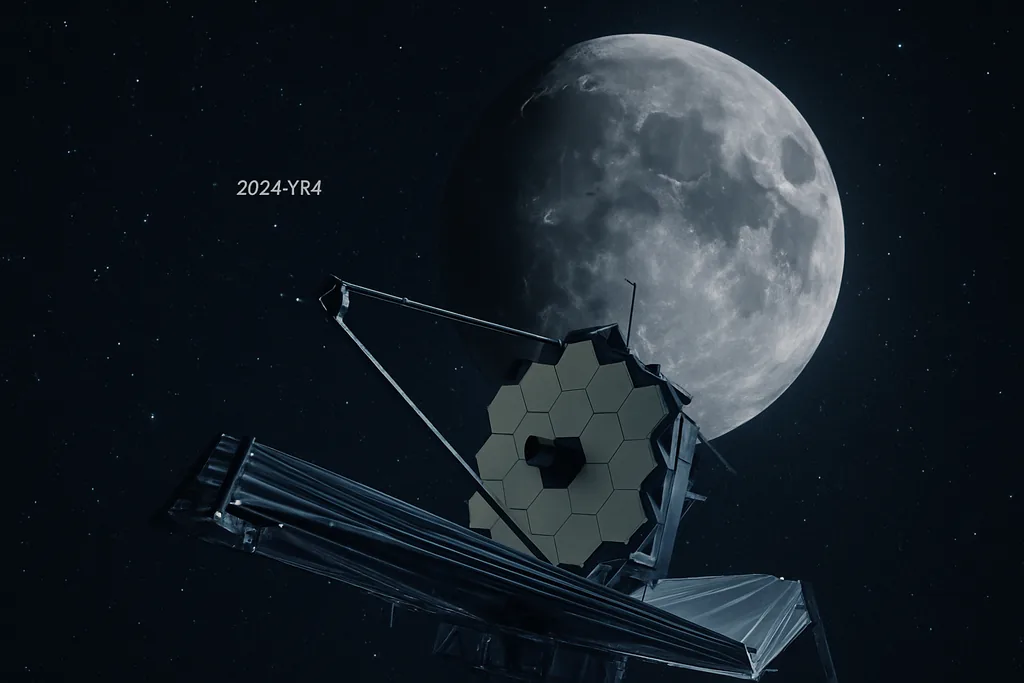
This week astronomers announced that the 100-metre-wide object could hit the Moon — but won’t. The space rock, catalogued as 2024 YR4 and discovered in December 2024, briefly carried some of the highest short-term impact odds seen in recent years: early calculations gave it a small probability of hitting Earth in 2032, then a separate window suggested a 4%‑plus chance of striking the lunar surface that same year. New, very faint detections with the James Webb Space Telescope in February and orbit refinements published in early March 2026 have closed that window. The latest orbit fits place 2024 YR4 well clear of the Moon in December 2032, putting to rest the small but unsettling scenario that had kept planetary defence teams on alert.
100-metre-wide object could hit: trajectory, telescopes and uncertainty
What changed was not a sudden alteration of the asteroid’s path but better data. When 2024 YR4 was first seen, observers had only a handful of measurements and the range of possible future positions — the so-called uncertainty region — was large enough to include both Earth and the Moon. With each new observation that uncertainty shrinks. Two time-critical Webb tracking sessions in February 2026, combined with ground-based follow-up, extended the observational arc and allowed teams at NASA’s JPL Center for Near-Earth Object Studies and ESA’s Planetary Defence office to tighten the orbit. The result: 2024 YR4’s predicted close approach to the Moon is now comfortably outside impact range, with closest-pass estimates in the tens of thousands of kilometres from the lunar surface.
That process — detect, refine, rule out — is the routine of modern planetary defence. The more powerful the telescope and the longer the time baseline of observations, the smaller the error bars on an object's future location. Webb’s sensitivity was decisive because 2024 YR4 is extremely faint at present, reflecting tiny amounts of sunlight; Webb’s infrared instruments and their moving-target tracking made a follow-up possible months earlier than ground telescopes alone could manage. Upcoming facilities such as the Vera Rubin Observatory and space missions designed to survey near the Sun will further reduce the blind spots that allow objects like 2024 YR4 to slip into ambiguous trajectories.
What would have happened if a 100-metre-wide object could hit the Moon
Even though Earth itself was spared, scientists modelled the consequences of a direct lunar hit because the Moon is our nearest airless world and a valuable natural laboratory. A roughly 50–70 metre rock striking the Moon at typical impact speeds would produce a crater on the order of hundreds of metres to about a kilometre across — comparable to Meteor Crater in Arizona — and throw up a cloud of fine ejecta. Published models suggested such an impact could be the largest fresh crater on the visible lunar hemisphere in millennia.
Most of the ejecta would fall back to the Moon, but a fraction of the smallest, fastest particles — sand‑to‑grit sized — could be launched into trajectories that intersect Earth. Those particles would be decelerated and mostly burn up in our atmosphere, producing an intense, short-lived meteor shower a few days to a few months after impact. There was no plausible scenario in these studies where people on Earth would be directly harmed by lunar ejecta. The real worry was space infrastructure: even millimetre‑ to centimetre‑scale particles travelling at orbital speeds can damage or disable satellites, and models showed a lunar strike could briefly create meteor fluxes equivalent to many years of normal micrometeoroid exposure compressed into days.
100-metre-wide object could hit: consequences for satellites and lunar operations
The principal practical risk from a hypothetical lunar impact was to hardware, not to people on the ground. Modern economies and militaries rely on satellites for navigation, communications and Earth observation; many low-Earth orbit constellations include thousands of small, relatively fragile spacecraft. An intense burst of small, high‑speed debris could lead to temporary service disruptions, increased collision risk for active satellites, or damage to solar panels and sensors. For any lunar habitats, landers or astronauts on the surface, fast-moving ejecta (unattenuated by atmosphere) could pose a direct hazard.
That is why planetary defence agencies treat lunar impact scenarios seriously even when they pose no direct terrestrial danger: we now have expensive and strategic assets both in orbit and on the Moon whose safety is worth protecting. Operators would have had time to enact mitigations if the impact probability remained non‑negligible — for example, manoeuvring crucial satellites, reorienting solar arrays, or re‑scheduling launches and lunar surface activities — but those actions depend on good, early orbital solutions and international coordination.
How often does a 100-metre-sized object strike the Moon, and how do scientists track such rocks?
Small impacts on the Moon are common on geological timescales; the lunar surface records billions of collisions. For objects in the tens to hundreds of metres class, impacts on the Moon occur on timescales of thousands of years for very large craters and much more frequently for small pits that are too small to see with naked eyes. Researchers estimated that an impact capable of making a kilometre‑scale crater is a once‑in‑a‑few‑thousand‑year event on the visible lunar hemisphere. The Earth sees comparable-sized strikes much less frequently because atmosphere destroys many small bodies before they reach the ground.
Tracking candidates starts with survey telescopes such as ATLAS, the Catalina Sky Survey and Pan‑STARRS on the ground, and space assets such as NEOWISE and future dedicated infrared surveyors. When a new object is found, follow-up observers worldwide — and, when needed, space telescopes — gather position and brightness measurements. Those data feed orbit‑determination systems at institutions like JPL’s CNEOS and ESA’s NEO offices; every new data point reduces the orbital uncertainty and reshapes impact probabilities. Public hazard metrics such as the Torino and Palermo scales are useful shorthand, but the underlying process is a continuous probabilistic refinement rather than a single decisive calculation.
What the YR4 episode teaches us about planetary defence going forward
The brief alarm over 2024 YR4 stretched across two lessons. First, detection is only the start: an early discovery gives scientists time to measure an object’s motion and to decide whether intervention or mitigation is ever needed. Second, as humanity expands into cislunar space and plans longer‑term lunar activities, planetary defence must widen its remit. Protecting Earth remains the priority, but we will increasingly be asked to consider collateral risks to satellites, crews, and infrastructure beyond Earth orbit.
We already have proof‑of‑concept tools: kinetic impactors have been tested (DART in 2022) and a suite of mitigation concepts — gravity tractors, albedo modification and, as a last resort, nuclear options — exist on paper. But all of those responses require early warning. That is why agencies and observatories are investing in more sensitive infrared survey telescopes and funding international coordination mechanisms: better detection buys time, and time buys options.
For now, 2024 YR4 will continue to be monitored as it moves around the Sun. It will reappear in telescopes’ fields of view later in the decade and astronomers will refine its orbit further. The immediate relief is real: the Moon is safe for 2032. The larger take-away is less dramatic but more important — our system for finding, tracking and characterising small near‑Earth objects is working: scary scenarios are detected early, scrutinised, and usually resolved without harm. The Webb follow‑ups this winter are the clearest, most recent demonstration of that capability.
Sources
- NASA — Center for Near-Earth Object Studies (JPL) and NASA Planetary Defense updates
- European Space Agency — Planetary Defence Office and NEOMIR briefings
- James Webb Space Telescope observations and Space Telescope Science Institute analysis
- Western University (Paul Wiegert) modelling on lunar impact ejecta and effects
- Johns Hopkins Applied Physics Laboratory and NOIRLab / Gemini observational contributions



Comments
No comments yet. Be the first!