Plan light earth night: the Reflect Orbital proposal
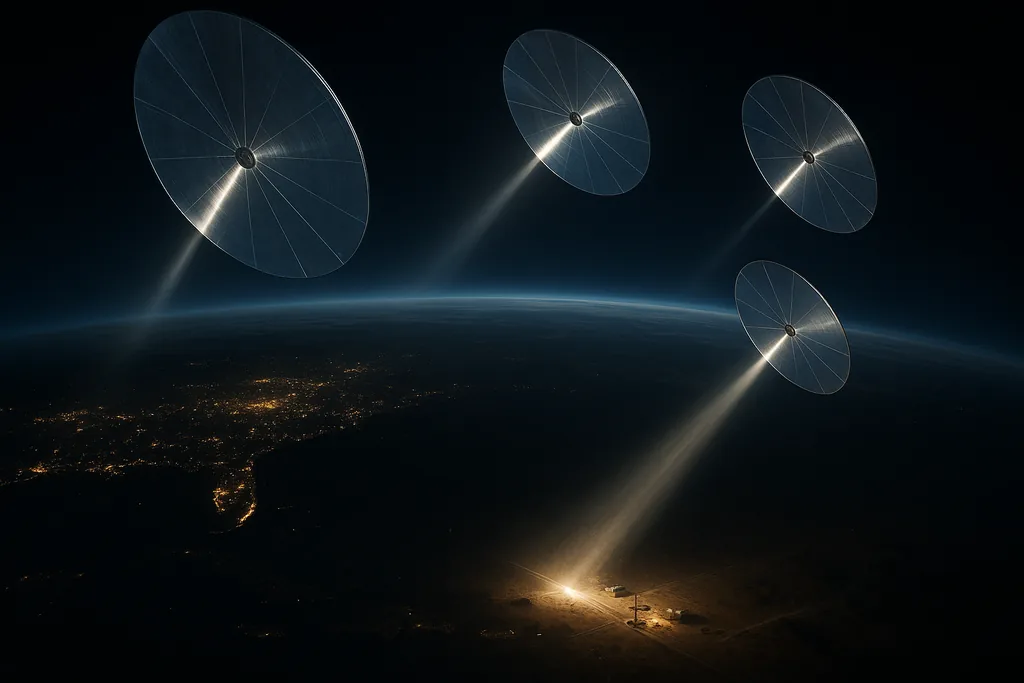
The proposal, filed with US regulators, outlines a constellation of mirrors deployed in low Earth orbit that can be oriented to aim sunlight at specific terrestrial targets after the Sun has set locally. The company behind the plan envisages a build-out of tens of thousands of reflective surfaces — the Times report cites a long-term goal of about 50,000 mirrors — each as large as roughly 54 metres across. The sales pitch is simple and bold: provide artificial daylight to construction sites, disaster zones, or solar farms so they can operate outside natural daylight hours.
Technical briefing materials and media coverage accompanying the filing describe concentrated beams of light that, on target, could be significantly brighter than normal moonlight — the article estimates each beam could be about four times the brightness of a full moon. But the filing also acknowledges that reflected light will not be perfectly confined to intended areas, and stray and scattered light will leak across the night sky.
That leakage is what has alarmed astronomers. Even if most mirrors are aimed at specific ground locations, they will transit the sky as satellites do, and side-on reflections can be bright enough to be seen as moving points comparable to the planet Venus. The Royal Astronomical Society has described the plans as "unacceptable" and argued that they threaten both scientific observation and the public's right to a natural night sky.
Plan light earth night: how the mirrors would work and their technical challenges
At a basic level the engineering is straightforward: polished or deployable reflective surfaces, attitude control systems to aim them, and propulsion or drag management so they remain in useful orbits. But practical implementation raises a long list of hard problems. Precise pointing is required to strike a ground target from hundreds of kilometres up, and tiny errors magnify into large position errors on the surface. Atmospheric scattering and variable weather mean much of the reflected light will be diffused rather than forming a tight beam, reducing efficacy and increasing collateral illumination.
Large, thin mirrors in low orbit are also structurally delicate and pose debris risks. Maintaining tens of thousands of them in formation will require continuous station-keeping and deorbit planning at end of life; failure to manage those requirements increases collision risk for other satellites and long-term orbital congestion. The mirrors' apparent brightness as they cross the sky depends on geometry: when illuminated side-on they can become intensely visible, creating streaks and glints across wide areas — exactly the outcome astronomers fear.
Powerful as the idea sounds in marketing copy, the real-world combination of orbital mechanics, atmospheric physics, and operations logistics means the company would face sustained technical and regulatory scrutiny long before any large-scale deployment could proceed.
Astronomy and satellite science at risk
Ground-based astronomy is especially vulnerable to artificial light. Wide-field surveys and deep exposures rely on dark, stable skies; even a few bright streaks across an image can ruin months of observing time for a sensitive instrument. The Times article referenced estimates that observations with large facilities such as the Very Large Telescope in Chile could lose on average about ten percent of usable data because of bright streaks from satellites crossing a camera's field of view.
Beyond imaging, scattered light raises the background sky brightness and reduces contrast, degrading spectroscopy and photometry that underpin studies from exoplanet atmospheres to faint, distant galaxies. If a constellation of mirrors made the sky three to four times brighter overall, as some estimates suggest, many programmes that depend on detecting faint signals would become slower, more expensive, or impossible from the ground.
There is also a cumulative effect when multiple commercial projects are stacked together. The same coverage that makes mirrors visible will also increase the number of bright objects moving through survey fields — compounding the impact of planned and existing megaconstellations of communications satellites. Scientists warn that thousands of additional bright objects could outnumber visible stars in some parts of the sky and introduce systemic errors into long-term sky surveys.
Environmental, ethical and cultural consequences
The night is not only a resource for science — it is an ecological, cultural and human-health resource too. Artificial night lighting affects nocturnal wildlife, migrating birds, and ecosystems that rely on predictable light cycles. Expanding bright, targeted beams from orbit adds a new and poorly understood dimension to global light pollution. Scientists and dark-sky advocates argue that altering the sky at a planetary scale without broad societal consent raises ethical questions about who owns and governs the night.
Culturally, the stars and the dark night sky are part of shared human heritage in many places. The Royal Astronomical Society framed its objection partly in those terms, defending the public's "right to enjoy the night sky." Critics also point out that promises of narrowly targeted benefits — extended work hours, temporary disaster relief lighting — look modest beside the systemic, global change to atmospheric and night-time conditions that a large mirror fleet would cause.
Regulation, filings and what comes next
Reflect Orbital and other companies — the Times piece also mentions a separate SpaceX filing for satellites intended as space-based data centres — have submitted proposals to the US Federal Communications Commission, which must evaluate launch and spectrum permissions. The FCC review process opens the door for formal comments from scientific bodies and public stakeholders; both the Royal Astronomical Society and the European Southern Observatory have registered objections.
Regulators will need to weigh operational claims against foreseeable harm. That balancing act may include requests for environmental assessments, constraints on orbital parameters, limits on surface brightness, or outright denial if impacts are judged unacceptable. International law and norms for outer space use — including principles from the Outer Space Treaty about not causing harmful interference — will inform but not fully determine national licensing decisions.
The unfolding dispute highlights gaps in pre-existing rules: current space-traffic management and light-pollution governance were not designed with intentional planetary-scale illumination in mind. As a result, this single filing could prompt regulatory updates, cross-border discussion, and new standards for assessing light and visual impacts from space activities.
Public questions and technical realities
People naturally ask practical questions: How bright would these beams be on the ground? Could they be switched off? Would they wreck astronomy permanently? The short answers are nuanced. On-target brightness could be useful for specific needs, but the scattered and transient components are unavoidable. They can be mitigated but not eliminated; turning satellites off doesn’t prevent the visible glints as reflectors transit the sky. And while large observatories may develop new mitigation strategies, such as scheduling adjustments and software to remove streaks, those are partial fixes and do not substitute for dark skies.
The debate is therefore not solely technical but political and ethical. Regulators now have to reconcile commercial ambition with scientific and public-interest values. How that reconciliation proceeds will affect not only telescopes and night-time workers, but wildlife, cultural heritage and the future of space governance.
Sources
- Royal Astronomical Society (formal comments and public statements)
- European Southern Observatory (Very Large Telescope operations)
- US Federal Communications Commission (application filings and review process)




Comments
No comments yet. Be the first!