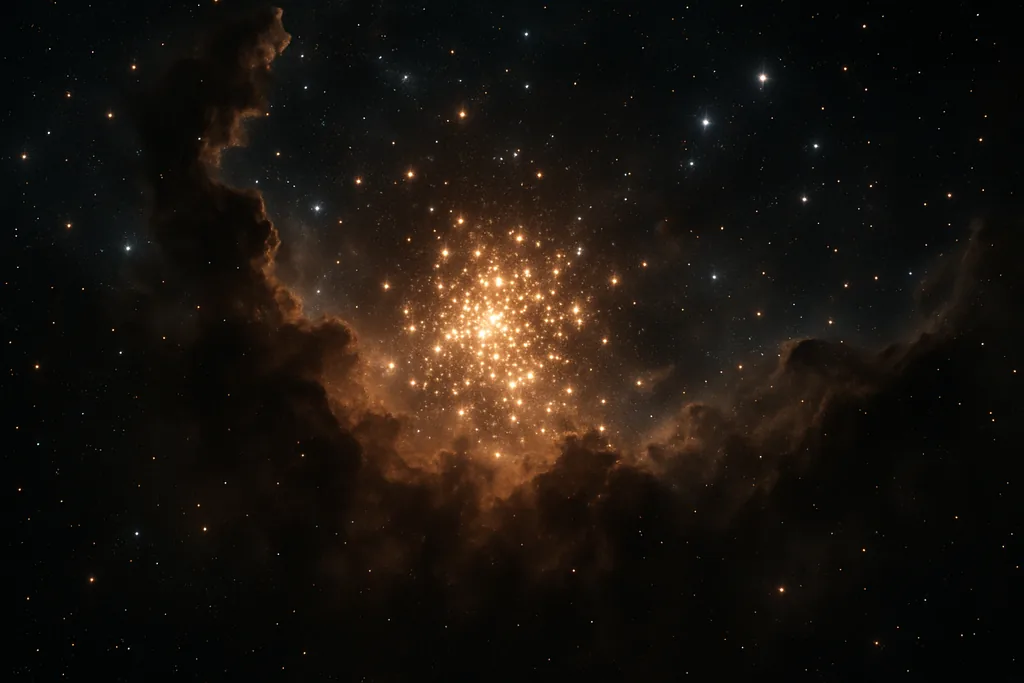
Deep within dense clouds of gas and dust, the birth of stars is often a hidden process that defines the future of entire galaxies. Using the combined power of the James Webb Space Telescope and the Hubble Space Telescope, a team of researchers including Drew Lapeer, Daniela Calzetti, and Kathryn Grasha has discovered that the most massive star clusters clear their natal clouds significantly faster than their smaller counterparts. This study reveals that massive clusters exceeding 5,000 solar masses emerge from their gas envelopes in approximately 5 million years (Myr), while lower-mass clusters take roughly 7 Myr, creating a high-speed race for any developing planetary systems nearby.
What is the typical emergence timescale for massive young star clusters?
The typical emergence timescale for massive young star clusters averages approximately 6 Myr, during which clusters transition from an embedded state to being fully exposed. More massive clusters exceeding 5,000 solar masses emerge faster, in about 5 Myr, while those around 1,000 solar masses take approximately 7 Myr. These measurements are critical for understanding how stellar feedback clears natal material.
Star clusters begin their lives invisible to optical telescopes because they are cocooned within "natal clouds" of dense molecular gas. This embedded phase is a period of intense growth, but it also shields the early stages of stellar evolution from view. Quantifying the emergence timescale—the time it takes for a cluster to blow away this gas—is fundamental to measuring the star formation cycle within galaxies. Historically, this has been one of astronomy's greatest challenges due to the complex interplay between stellar feedback and the vast physical scales of gas clouds.
The significance of the emergence timescale lies in its ability to constrain modern simulations of galactic evolution. If stars remain embedded for too long, they cannot effectively ionize the surrounding interstellar medium; if they emerge too quickly, it suggests that stellar feedback mechanisms like radiation pressure and stellar winds are more potent than previously thought. By establishing a baseline of 6 Myr, researchers can now provide a concrete metric for theorists to test the accuracy of their star formation models.
How do JWST observations help study young star clusters in M83?
Observations from the James Webb Space Telescope allow astronomers to penetrate dust-obscured regions in M83 to identify emerging young star clusters (eYSCs) that are invisible at optical wavelengths. By cross-matching infrared data with Hubble Space Telescope observations, researchers can measure the duration of the obscured phase (1.3 Myr) and the subsequent partially obscured phase (3.7 Myr) with unprecedented precision.
The multi-galaxy survey conducted by Lapeer and Calzetti analyzed thousands of young star clusters across four nearby galaxies: M51, M83, NGC 628, and NGC 4449. This broad scope allowed the team to account for different galactic environments, ranging from grand-design spirals to dwarf irregular galaxies. The use of the James Webb Space Telescope was pivotal, as its infrared capabilities act as a "thermal heat map," identifying the warm dust surrounding hidden clusters that the Hubble Space Telescope simply cannot see.
Infrared observations are essential for identifying the "hidden" population of star clusters that are still in their infancy. By comparing the number of clusters visible only in the infrared (embedded) to those visible in both infrared and optical (emerging) and those visible only in optical (exposed), the team can calculate the relative time spent in each phase. This statistical approach, applied to thousands of clusters, provides a robust timeline for how long stars remain trapped within their birth environments across different mass regimes.
Why is quantifying star cluster emergence timescales challenging?
Quantifying star cluster emergence timescales is challenging because the transition from being dust-embedded to fully exposed occurs rapidly, making it difficult to capture all evolutionary stages. Additionally, heavy dust obscuration hides the earliest phases of star formation from visible-light telescopes, requiring sensitive infrared instruments to observe the "missing" population of young, embedded clusters.
Previous studies of star cluster evolution often relied on spectral energy distribution (SED) fitting, which attempted to age-date clusters based on their colors. However, these methods frequently yielded varying estimates between 2 and 5 Myr and lacked a complete sample of the most heavily obscured clusters. Without a comprehensive census of every stage—from the first spark of fusion to the final clearing of gas—astronomers were essentially trying to piece together a movie while missing the first ten minutes.
The rapid transition from embedded to exposed phases means that transitional clusters are relatively rare in any given galactic snapshot. To overcome this, the research team utilized the high sensitivity of the James Webb Space Telescope to find clusters in the "partially obscured" phase. These clusters are in the process of breaking through their natal cocoons, providing the "missing link" required to calculate the exact duration of the emergence process and how it relates to the stellar mass of the cluster itself.
The Mass Correlation: Why Size Dictates Speed
The core finding of the research is a strong correlation between cluster stellar mass and the speed of gas dispersal. Massive clusters exert significantly more stellar feedback than their smaller counterparts, utilizing intense radiation pressure and powerful stellar winds to physically push gas and dust away from the cluster center. This finding provides a critical constraint on simulations of star formation, which often struggle to reproduce the exact timing of cluster emergence and the resulting escape of ionizing radiation.
Stellar feedback mechanisms are more efficient in high-mass environments, where the sheer number of O-type and B-type stars creates a collective force capable of clearing the surrounding medium in just 5 Myr. In contrast, lower-mass clusters lack this concentrated power, leading to a more prolonged emergence period of 7 Myr. This 2-million-year difference might seem small on a cosmic scale, but it has profound implications for the physical environment in which stars—and their planets—develop.
The Cosmic Race: Implications for Planet Formation
Rapid gas dispersal significantly limits the raw material available for the growth of planets within massive star clusters. When a cluster clears its natal cloud quickly, it effectively "shuts off" the supply of gas and dust that would otherwise fall onto protoplanetary disks. Furthermore, the early exposure of these disks to intense UV irradiation from neighboring massive stars can lead to photoevaporation, where the disk material is literally boiled away before planets have time to coalesce.
- Gas Infall: Early emergence stops the accretion of new material onto forming planetary systems.
- UV Irradiation: High-mass clusters expose disks to harsh radiation earlier than low-mass regions.
- Disk Longevity: Planetary systems in massive clusters have a shorter window (approx. 5 Myr) to form before their building blocks are dispersed.
Contrasting these environments with more isolated regions reveals why the location of a star's birth is so vital. In lower-mass star-forming regions, the 7-million-year window provides a longer, more protected environment for planetesimals to grow. The findings suggest that the most massive clusters in the universe may be among the most hostile places for traditional planet formation, potentially leading to a lower frequency of gas giants in those high-density environments.
Future Directions in Star Formation Research
These findings represent a major step forward in our understanding of galactic evolution and the life cycles of stars. The research led by Daniela Calzetti and her team emphasizes the central role that massive clusters play in driving the escape of ionizing radiation into the wider galactic medium. As this radiation escapes more rapidly than previously assumed, it may play a larger role in heating the interstellar medium and regulating the overall rate of star formation within a galaxy.
Looking ahead, the James Webb Space Telescope will continue to refine these timescales by observing even more distant galaxies with varying metallicities and star-formation rates. Scientists hope to determine if the 5-to-7 Myr timeline is a universal constant or if it varies significantly in the early universe. By continuing to probe the earliest moments of stellar life, astronomers are slowly uncovering the hidden clockwork that governs the growth of galaxies and the birth of planetary worlds.




Comments
No comments yet. Be the first!