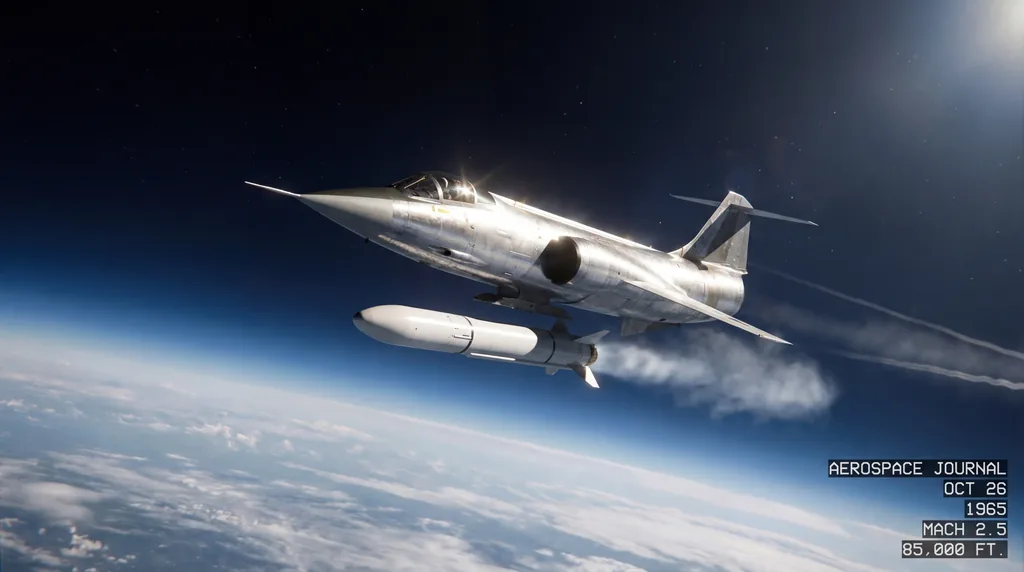

In a significant advancement for the commercial aerospace sector, Starfighters Space Inc. has announced the successful completion of a dedicated wind tunnel campaign for its STARLAUNCH 1 air-launch vehicle. This technical milestone, concluded in late January 2026, represents a critical step in validating the suborbital rocket’s ability to safely and predictably detach from a supersonic carrier aircraft. By achieving clean separation under a variety of high-speed flight regimes, the company has cleared one of the most complex aerodynamic hurdles in the development of its modular launch architecture.
The Mechanics of Supersonic Air-Launch
Air-launch systems offer a compelling alternative to traditional vertical ground launches. By utilizing a carrier aircraft as a "reusable first stage," companies can bypass the densest layers of the atmosphere and provide a significant velocity boost before the rocket even ignites. Starfighters Space Inc. leverages a fleet of modified supersonic aircraft operating out of NASA’s Kennedy Space Center to facilitate this process. Launching from a supersonic platform further reduces the energy requirements for reaching suborbital altitudes, allowing for smaller, more efficient rocket designs that can still carry substantial scientific and commercial payloads.
The primary challenge of this approach, however, lies in the transition between the carrier aircraft and the rocket. When a vehicle is released at speeds exceeding Mach 1, the shockwaves and pressure gradients created by the aircraft can interfere with the rocket’s trajectory. Ensuring that the two bodies do not collide or experience unstable aerodynamic forces is paramount to mission success and the safety of the pilot and platform.
Methodology: Simulating Extreme Flight Regimes
To address these challenges, the Starfighters engineering team conducted an extensive test series at the Florida A&M University/Florida State University (FAMU/FSU) Joint College of Engineering Polysonic Wind Tunnel. This facility is uniquely equipped to handle tests across multiple Mach regimes, providing the high-fidelity data necessary to model complex fluid dynamics. The campaign specifically focused on validating the STARLAUNCH 1’s behavior during separation at Mach 0.85 (transonic) and Mach 1.3 (supersonic).
The methodology involved a rigorous comparison between Computational Fluid Dynamics (CFD) simulations and physical experimental data. Engineers measured the specific forces, moments, and flow interactions occurring at the moment of release. By running ten successful wind tunnel tests, the team was able to map the pressure distributions and angle-of-attack variables that the STARLAUNCH 1 will encounter during real-world operational missions.
Detailed Findings and Aerodynamic Validation
The results of the campaign were overwhelmingly positive, demonstrating what engineers describe as "clean separation" across all evaluated flight conditions. No adverse aerodynamic interactions were reported, meaning the airflow between the rocket and the aircraft did not create unexpected suction or turbulence that could compromise the clearance between the two vehicles. This predictability is a foundational requirement for any air-launched system, where even minor deviations in the separation sequence can lead to catastrophic failure.
Furthermore, the data collected from the FAMU/FSU facility showed a high degree of correlation with the company’s pre-test CFD predictions. This alignment is critical for risk reduction; it confirms that the mathematical models used to design the vehicle are accurate reflections of physical reality. In the world of aerospace engineering, this correlation allows designers to proceed with confidence into more expensive phases of development, knowing that the underlying physics of the vehicle are well-understood.
Leadership Insights on Technical Readiness
Rick Svetkoff, Chief Executive Officer of Starfighters Space Inc., emphasized the importance of this phase in the broader context of the STARLAUNCH 1 program. "Demonstrating clean, predictable separation across these flight regimes is a foundational requirement for an air-launched system," Svetkoff stated. He noted that the success of these tests allows the company to move methodically from analytical validation toward the fabrication and testing of physical flight hardware.
The CEO’s sentiments reflect a broader trend in the industry toward rigorous early-stage testing to mitigate the high costs of flight-test failures. By securing this data now, Starfighters positions itself as a reliable provider in the emerging market for rapid, cost-effective suborbital access. The company’s ability to combine supersonic flight heritage with modern aerodynamic modeling is a key differentiator in the commercial space race.
Implications for the Aerospace Sector
The successful validation of the STARLAUNCH 1 separation dynamics has implications that extend beyond the vehicle itself. Starfighters Space Inc. intends to use the insights gained from this campaign to bolster its broader aerospace testing services portfolio. The expertise developed in managing high-Mach separations can be applied to other advanced programs, including hypersonic vehicle development and defense-related research where clean release from a carrier platform is a mission-critical necessity.
For the scientific community, the progress of STARLAUNCH 1 promises a new avenue for microgravity research. The vehicle is designed to support short-duration missions, providing a platform for experiments that require brief exposure to the space environment without the high costs and long lead times associated with orbital missions. As a pathfinder for future air-launch concepts, STARLAUNCH 1 could lower the barrier to entry for universities and smaller research institutions.
Future Directions: Toward Instrumented Flight
With the wind tunnel campaign successfully concluded, Starfighters Space Inc. is transitioning into the next phase of its development roadmap. The company has begun the procurement of instrumented drop test articles. These units, which mimic the shape and weight of the actual rocket, will be equipped with sophisticated onboard sensors and telemetry systems to capture real-time dynamics during actual flight tests.
Upcoming Developmental Milestones:
- Procurement and assembly of instrumented drop test vehicles.
- Full-scale separation tests from the Starfighters supersonic fleet at the Kennedy Space Center.
- Integration of suborbital payloads for pathfinder missions.
- Expansion of supersonic "testbed" services for third-party hypersonic programs.
As the program moves from the wind tunnel to the open sky, the data captured at the FAMU/FSU facility will serve as the baseline for all future flight maneuvers. By systematically ticking off technical milestones like the STARLAUNCH 1 separation campaign, Starfighters Space Inc. is carving out a specialized niche in the aerospace landscape—one defined by speed, precision, and the unique advantages of supersonic air-launch technology.




Comments
No comments yet. Be the first!