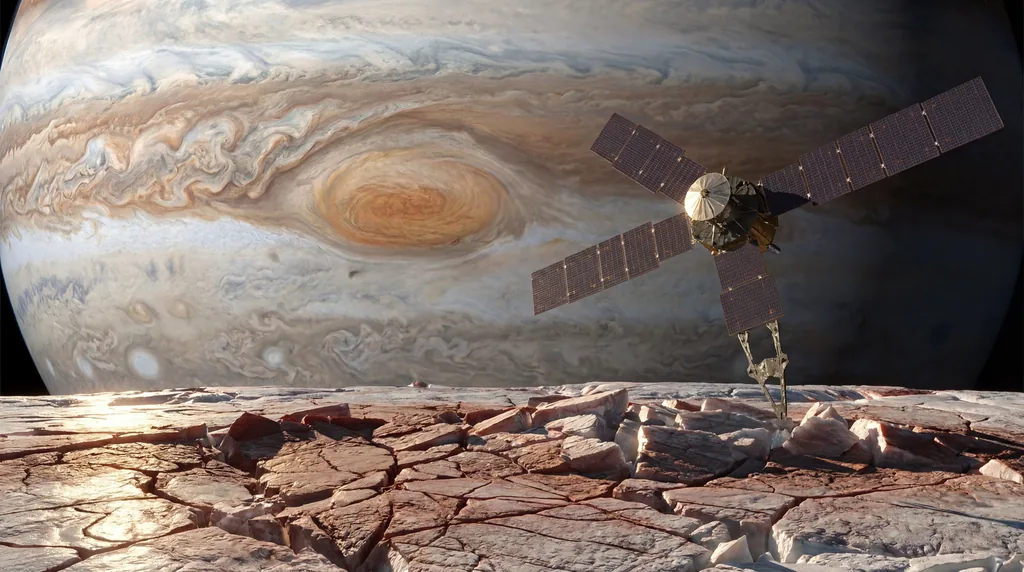

Juno’s Microwave Observations Reveal the 18-Mile Depth of Europa’s Icy Crust
For decades, planetary scientists have debated the nature of the icy shroud encasing Jupiter’s moon Europa, a world long considered one of the most promising candidates for extraterrestrial life in our solar system. The central mystery has revolved around the thickness of this shell: is it a thin, fragile veil or a massive, miles-thick barrier? New data from NASA’s Juno mission, published in the journal Nature Astronomy, has finally provided a definitive answer. Utilizing the spacecraft’s Microwave Radiometer (MWR), researchers have determined that Europa’s icy crust averages approximately 18 miles (29 kilometers) in thickness, providing a critical new constraint for models of the moon’s potential habitability.
The discovery comes following a daring close flyby on September 29, 2022, when the solar-powered Juno spacecraft descended to within 220 miles (360 kilometers) of Europa’s fractured surface. While Juno was originally designed to probe the deep atmosphere of Jupiter, its suite of instruments has proven remarkably versatile for studying the Jovian moons. By "peering" beneath the ice, the MWR was able to distinguish between competing "thin-shell" and "thick-shell" hypotheses, the latter of which suggests a much more formidable barrier between the moon’s frozen exterior and its hidden saltwater ocean.
The 18-Mile Barrier: Mapping the Icy Shell
The measurement of 18 miles represents the average thickness of the cold, rigid, and conductive outer layer of Europa’s shell. This finding settles a long-standing scientific controversy that had estimated the ice thickness to be anywhere from less than half a mile to several tens of miles. Steve Levin, the Juno project scientist and a co-investigator from NASA’s Jet Propulsion Laboratory (JPL), noted that the 18-mile figure specifically describes a pure water ice composition. However, the internal structure may be even more complex than a single measurement suggests.
“If an inner, slightly warmer convective layer also exists, which is possible, the total ice shell thickness would be even greater,” Levin explained. Conversely, the presence of dissolved salts within the ice—a possibility suggested by several geological models—could alter the estimate. According to Levin, a modest amount of salinity would reduce the calculated thickness by roughly three miles. Regardless of these minor fluctuations, the data firmly places Europa in the "thick-shell" category, a realization that has significant implications for how energy and matter move through the moon’s interior.
How the Microwave Radiometer Sees Through Ice
The methodology employed by the Juno team represents a significant leap in planetary reconnaissance. The Microwave Radiometer is uniquely equipped to detect the thermal emission coming from the moon’s subsurface. Unlike optical cameras that only see the surface, microwaves can penetrate solid ice, with different wavelengths reaching different depths. By analyzing these signals, the team could create a thermal profile of the crust, distinguishing between the solid ice and the warmer, more liquid-rich environments that may lie deeper within.
Operating in the high-radiation environment of the Jovian system presents immense technical hurdles. The MWR had to filter out intense background noise while capturing data across nearly half of Europa’s surface during the brief flyby window. This process allowed the team to not only measure depth but also identify "scatterers" within the ice. These scatterers are small irregularities—cracks, pores, and voids—estimated to be only a few inches in diameter. The data suggests these features extend several hundred feet below the surface, providing a detailed look at the "upper crust" of this alien world.
Implications for Habitability and Nutrient Transport
The confirmation of a thick ice shell shifts the perspective on Europa’s habitability. For life to exist in the subsurface ocean, there must be a mechanism to transport oxygen and organic nutrients from the surface—where they are produced by radiation—down into the water. An 18-mile-thick barrier represents a much longer and more difficult journey for these essential building blocks of life. If the ice were thin, surface materials might easily cycle into the ocean through tidal flexing or small-scale fractures.
With a thicker shell, the transport of nutrients likely depends on slower, large-scale geological processes, such as convection or massive tectonic shifts. The MWR data regarding the shallow depth of cracks and pores suggests that these features are unlikely to serve as direct "highways" to the ocean. Instead, the moon’s habitability may depend on the thermal energy generated by tidal heating—the constant squeezing and stretching of Europa by Jupiter’s immense gravity—which maintains the liquid state of the ocean and potentially drives the movement of the ice shell over millions of years.
The Road to Europa Clipper
Juno’s findings serve as a vital reconnaissance mission for the next phase of Jovian exploration. NASA’s upcoming Europa Clipper mission, specifically designed to investigate the moon’s potential for life, will carry a sophisticated ice-penetrating radar. The baseline established by Juno’s Microwave Radiometer will help the Clipper team refine their instruments and target specific regions of interest where the ice might be thinner or more geologically active.
“How thick the ice shell is and the existence of cracks or pores within the ice shell are part of the complex puzzle for understanding Europa’s potential habitability,” said Scott Bolton, Juno’s principal investigator from the Southwest Research Institute (SwRI). By providing the first direct measurements of the shell's depth, Juno has transitioned Europa from a world of theoretical models to one of measurable physical parameters. As we look toward future missions, the 18-mile barrier stands as a testament to the scale of the challenge—and the potential reward—of searching for life in the dark, cold reaches of the outer solar system.
Future Directions in Icy World Research
As scientists continue to process the wealth of data from the 2022 flyby, focus is shifting toward regional variations in the ice shell. While the 18-mile average is now a standard metric, researchers are eager to determine if the shell is significantly thinner at the moon’s poles or in areas of "chaos terrain," where the surface appears to have melted and refrozen. Such variations could provide the "windows" needed for future landers to eventually probe the waters below.
The success of the MWR on Europa also opens new doors for studying other icy moons, such as Ganymede and Callisto. The technique of microwave radiometry has proven to be a robust tool for looking inside planets, effectively turning a spacecraft into a remote-sensing "X-ray" machine. With this new understanding of Europa’s crust, the search for life in our solar system has a clearer, albeit deeper, path forward.




Comments
No comments yet. Be the first!