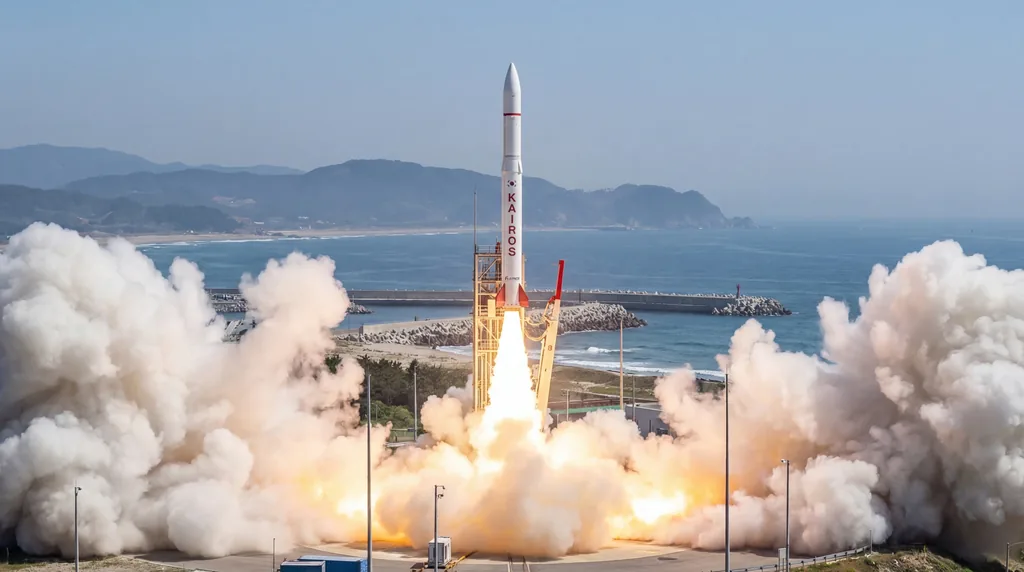

On March 6, 2026, at 11:10 AM JST, the Japanese aerospace startup Space One experienced a significant setback when its KAIROS rocket exploded approximately two minutes into its third flight attempt. The mission, launching from Space Port Kii in Kushimoto, Wakayama Prefecture, was intended to prove the reliability of Japan’s first privately developed orbital launch vehicle after two previous failures in 2024. Instead, the 18-meter-tall rocket met a fiery end mid-ascent, raining debris into the Pacific Ocean and leaving the future of the company’s commercial ambitions in question.
What happened during the KAIROS rocket's third launch attempt?
Space One’s KAIROS No. 3 rocket suffered a catastrophic failure approximately 120 seconds after liftoff from Space Port Kii on March 6, 2026. While the initial ascent appeared stable, the vehicle’s Autonomous Flight Termination System (AFTS) was triggered following observed trajectory deviations, resulting in a mid-air explosion. This marks the third consecutive loss for the KAIROS program, following failures in March and December of 2024.
The flight profile of the third KAIROS mission showed early signs of technical struggle, as broadcast footage captured the rocket attempting multiple attitude corrections during its first-stage burn. According to reports from Space One, the rocket was destroyed by its internal safety systems after the vehicle drifted outside of its approved safety corridor. Observers at the scene reported seeing multiple fragments tumbling from the sky, with the main body of the rocket appearing to enter an end-over-end tumble before impact. This failure is particularly discouraging for the team, as it failed to reach the milestones set by previous flights despite improvements made after the 2024 anomalies.
The timeline of the KAIROS flight history illustrates the immense difficulty of private orbital development:
- March 2024: The inaugural flight exploded just five seconds after liftoff due to a flight termination trigger.
- December 2024: The second flight failed shortly after first-stage separation due to a loss of attitude control.
- March 2026: The third flight lasted roughly two minutes before trajectory deviations forced a self-destruction.
What caused the explosion two minutes after the KAIROS launch?
The explosion of the KAIROS rocket was a controlled destruction initiated by the onboard Autonomous Flight Termination System (AFTS). This safety protocol was activated when the rocket's flight computer detected that the vehicle was deviating dangerously from its intended trajectory. While the specific mechanical or software root cause is still under investigation, the AFTS functioned as designed to prevent the vehicle from becoming a threat to populated areas.
Technical analysis suggests that the solid-fuel stages of the KAIROS rocket may have experienced an imbalance in thrust or a failure in the thrust vector control system. During the live broadcast, commentators noted that the vehicle appeared to be "fighting" to maintain its path before the termination signal was sent. Unlike liquid-fueled rockets, solid-fuel boosters cannot be throttled, making precision guidance during the high-stress phases of atmospheric ascent incredibly challenging for a first-generation airframe. The loss of the vehicle highlights the persistent "valley of death" that many private space companies face when transitioning from suborbital tests to orbital reality.
How does the KAIROS rocket's autonomous flight termination system work?
The KAIROS rocket's Autonomous Flight Termination System (AFTS) is an onboard computer-driven safety mechanism that monitors the vehicle's position, velocity, and health in real-time. Unlike traditional systems that require a human safety officer to send a "destruct" command via radio, the AFTS makes the decision locally if it determines the rocket has moved outside its "flight corridor." This ensures an instantaneous response to malfunctions, protecting ground infrastructure and personnel.
The use of AFTS technology is a modern standard in commercial spaceflight, popularized by companies like SpaceX and now adopted by Space One to streamline operations at Space Port Kii. For the KAIROS system, which consists of three solid-fuel stages and a final liquid-fuel stage, the AFTS must constantly compare GPS and inertial data against a pre-set mission profile. If the deviation exceeds a specific threshold—as seen in the March 2026 launch—the system detonates ordnance on the rocket to disperse its fuel and halt its forward momentum. While this results in mission failure, it is considered a success of the safety protocols designed by Space One engineers.
Is Space One still planning more KAIROS launches after three failures?
Space One has expressed a continued commitment to the KAIROS program, though the timeline for a fourth attempt remains uncertain. Following the March 2026 failure, company leadership indicated they would conduct a rigorous data review to identify why the trajectory corrections failed. However, the company faces mounting financial pressure, having previously relied on crowdfunding via the Ready For platform to finance the third mission.
The strategic importance of Space One to the Japanese aerospace sector cannot be overstated, particularly as the nation currently lacks consistent domestic space access. With JAXA’s H3 rocket facing its own investigation and the Epsilon rocket grounded until the Epsilon S configuration is flight-ready, Space One represents a critical secondary path for Japanese satellite deployment. The company’s resilience will be tested in the coming months as they seek to reassure investors and the Japanese government that the KAIROS rocket can eventually overcome its "three for three" failure streak.
Despite these setbacks, the broader Japanese private space industry continues to move forward with several key players:
- Interstellar Technologies: Developing the ZERO methalox rocket with a target launch of 2027.
- Honda: Testing reusable vertical take-off and landing (VTOL) technology as of June 2025.
- Space Port Kii: Japan’s first dedicated private orbital launch facility, which remains operational despite the recent accident.
The path to orbit has historically been paved with failure. Just as SpaceX's early Falcon 1 rockets suffered three consecutive losses before reaching success, Space One finds itself at a pivotal crossroads. The data gathered from the two-minute flight of KAIROS No. 3 provides more telemetry than any previous attempt, offering a glimmer of hope that the fourth flight might finally achieve orbital insertion. For now, the global space community watches as Japan navigates the difficult birth of its commercial launch industry.


Comments
No comments yet. Be the first!