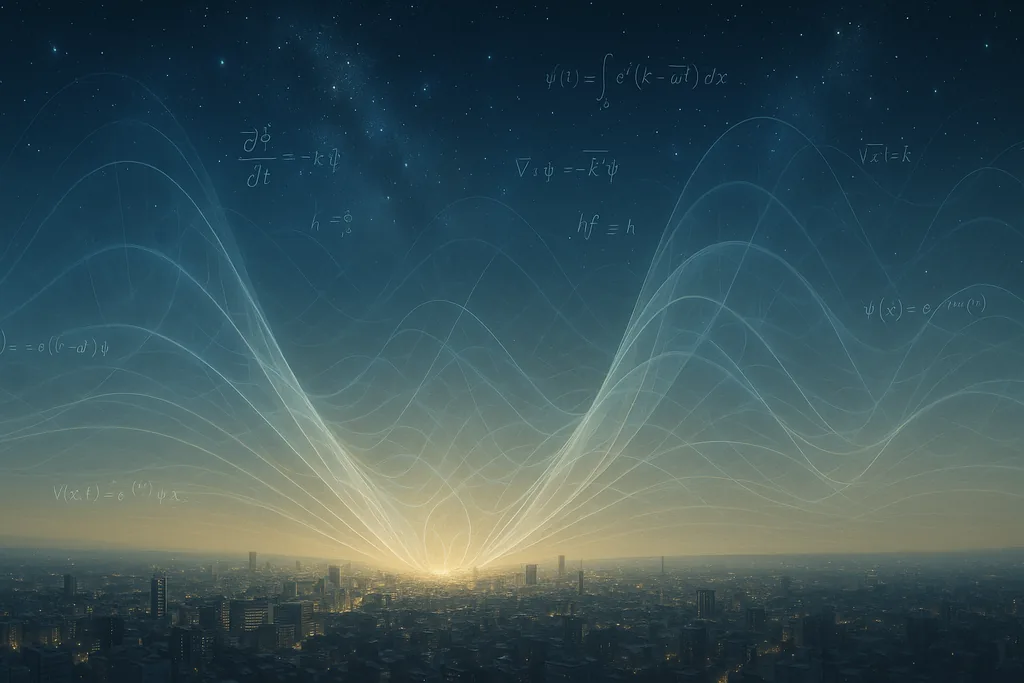
reality illusion? theory challenges — the proposal in plain terms
Strømme’s paper, titled in the journal entry as a bridge between quantum physics and non‑dual philosophy, does not present a single experiment that proves consciousness is fundamental. Instead it constructs a language and set of equations intended to map how a homogeneous, conscious field could undergo patterning to produce differentiated experiences, causal relations and the geometry of spacetime. The model leans on field‑theory intuition: imagine a scalar or tensor field that encodes degrees of integrated awareness, and allow local instabilities and couplings to create the effective degrees of freedom we read as matter and observers. That move reframes the explanatory direction: physical law becomes a higher‑level description of processes rooted in an awareness substrate rather than the other way round.
Why does this matter beyond metaphysics? Because if a useful, predictive formalism can be written that links conscious‑field dynamics to observable correlations, it becomes — in principle — a scientific proposal. Strømme’s work is explicit about this ambition: it claims testable consequences and sketches how the new variables might connect to quantum information, entanglement structure and thermodynamic flow. The paper has attracted attention not only because of its philosophical echoes in idealist traditions, but because it appears in a mainstream, peer‑reviewed physics journal.
reality illusion? theory challenges and quantum mechanics
One reason the idea reads well in popular headlines is that quantum mechanics already complicates naive realism. Observer‑dependent effects, entanglement, and the measurement problem open conceptual room for proposals that treat ‘observer’ or ‘measurement’ as more than bookkeeping. Strømme’s framework tries to place those observerly ingredients at the bottom of the stack: quantum events and geometry emerge from coherence structures in an underlying awareness field, which would recast measurement not as a brute collapse but as a selection process within the field. The paper links its language to standard quantum formalism so it can be compared, extended and — crucially — confronted with experiment.
Reception, tests and grounded scepticism
Responses have ranged from excitement among writers and some interdisciplinary researchers to caution and scepticism from mainstream scientists. Reporters and public outlets have amplified the more sensational framing — that physics now admits reality might be an illusion — while specialist commentators stress that the paper is a theoretical invitation rather than a confirmed overthrow of materialism. Critics point out that historically similar moves (for example, calling on new fields or hidden variables) often founder on the practical challenge of generating precise, novel predictions testable in a lab or telescope. The community discussion today therefore emphasizes rigorous replication, precise derivations and concrete empirical targets rather than metaphysical rhetoric.
What would count as a test? The paper sketches places to look: subtle departures from predicted decoherence rates, correlations in neural‑scale systems that exceed classical communication bounds, or cosmological signatures tied to early symmetry breaking in the proposed field. Each candidate is technically demanding and, so far, contested. Importantly, Strømme and others emphasise that absence of current evidence is not proof of absence; transforming a speculative ontology into experimental practice requires sustained, interdisciplinary programs spanning quantum physics, neuroscience and cosmology.
Historical precedents and philosophical echoes
Ideas that place mind before matter are not new. Philosophical idealism, panpsychism, and 20th‑century physicists’ notions of participatory universe or implicate order have all circulated similar intuitions: that mind and matter are two descriptions of a more primitive unity. What distinguishes modern proposals like Strømme’s is their attempt to couch these intuitions in contemporary mathematics so they can be compared to physical theory. That move invites cross‑disciplinary borrowing — from Donald Hoffman’s interface theory (which treats perception as an evolved user‑interface rather than a veridical window), to integrated information approaches and field‑theoretic models in theoretical neuroscience — and positions the debate at the intersection of philosophy and testable science. The headline question ‘Is reality an illusion?’ thus folds into a sharper inquiry: which model best accounts for observed regularities, and which yields new, falsifiable predictions?
Media coverage and the Coast to Coast AM angle
Popular outlets — including SciTechDaily and radio and podcast shows with broad audiences — have seized on the provocative framing. Coast to Coast AM ran a story on March 5, 2026 that summarised the idea in accessible terms, emphasising the mystery and cultural resonance of the hypothesis. Such coverage has helped the paper reach lay audiences quickly, but it also tends to flatten nuance: a theoretical proposal with mathematical scaffolding becomes, in short order, an asserted fact in many headlines. For readers and reporters alike, the responsible move is to separate the paper’s careful technical claims from the speculative extrapolations that often accompany press stories.
Where this leads: research, skepticism and public conversation
At this stage the story is less a reversal of science than a recalibration of the questions scientists are willing to put in equation form. If a consciousness‑first account can be developed to the point of offering crisp, testable deviations from standard models — and if those deviations are observed — the implications would be profound for physics, neuroscience and even AI research. Equally possible is that the field‑language will yield useful metaphors and cross‑disciplinary tools without overturning the causal primacy of matter. The healthy scientific path lies through detailed modelling, independent replication, and frank engagement between philosophers, experimentalists and theorists.
For the curious reader, the answers to the Google‑style queries circulating in the public discussion are nuanced: modern physics contains puzzles that make the idea that “reality is an illusion” attractive as a metaphor, but turning that metaphor into a scientific claim requires precise mathematics and experiments. The new theory that challenges modern physics — as headlines put it — is best understood as a formal, peer‑reviewed attempt to build that bridge, not a settled verdict. How it will stand up to empirical pressure remains an open question and one that the scientific community is only beginning to explore in detail.



Comments
No comments yet. Be the first!