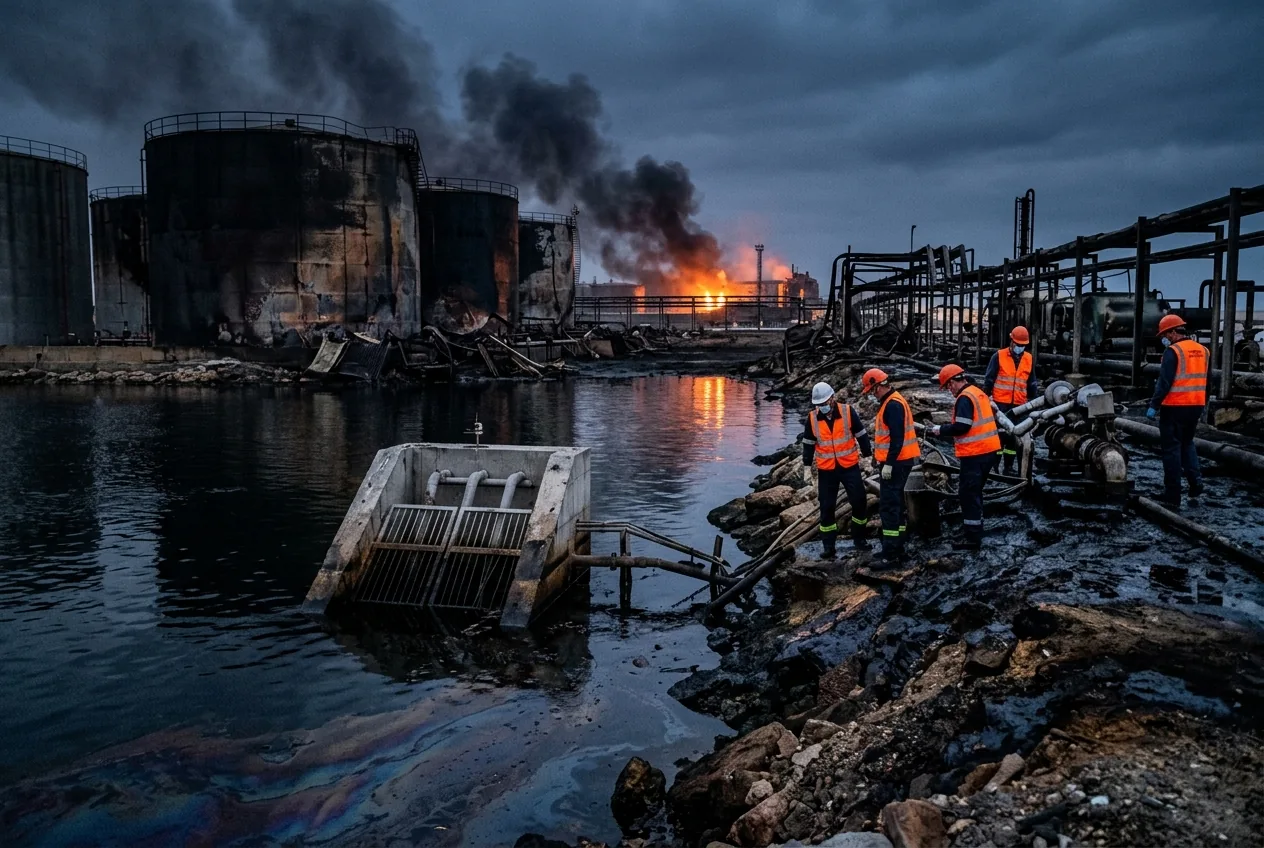
Smoke, slick and a single port: a region on a knife-edge
Onshore from the Ras Isa fuel terminal in al-Hudaydah this spring, charred infrastructure and black smoke have become shorthand for a dangerous new mix: active combat and industrial petrochemicals. Yemeni officials told the United Nations that repeated airstrikes have damaged storage tanks and port facilities, and Press TV reported the attack on Ras Isa killed at least 80 people and put oil handling infrastructure "on the brink of collapse." Fractured tanks, ruptured pipelines and burning fuel are not only immediate humanitarian disasters — they also create the conditions for rapid, large-scale oil pollution that can spread across the Red Sea and into the Arabian Gulf by currents and wind.
Why this matters now — and what the phrase catastrophe inevitable? attacks gulf implies
The phrase catastrophe inevitable? attacks gulf has been circulating in media and social feeds as shorthand for a larger question: can localized military strikes cascade into a regional environmental crisis? The short answer from hazard analysts is that a catastrophic outcome is not pre‑ordained, but it is plausibly close to the threshold in the current operational environment. The Gulf states and Red Sea littoral already rely heavily on coastal oil terminals, on‑shore refineries, and densely packed tanker traffic; the damage or loss of one large vessel or a port facility loaded with crude can produce an oil spill measured in millions of barrels, contaminate desalination intakes, choke fisheries and trigger health crises for coastal communities.
catastrophe inevitable? attacks gulf — The tanker and spill risk
Tanker strikes — deliberate or accidental — are a particularly dangerous failure mode. Analysts who study past conflicts point to two precedents: the deliberate setting of fires and sabotage during the 1991 Gulf War, when retreating forces ignited hundreds of oil wells and millions of barrels were lost to fire and sea, and more recent regional incidents that produced heavy smoke and localized contamination. A single strike that breaches the hull of a fully laden crude carrier or severs a marine terminal's manifold can release huge volumes of oil in minutes, and containment options at sea are logistically and technically limited once weather and waves spread the slick.
Ship routing through chokepoints such as the Bab el‑Mandeb and the Suez Canal concentrates risk: a spill there has a high probability of affecting long shipping lanes and coastal ecosystems, and it would immediately reverberate through global trade. Economists warn that even a major localized spill in the southern Red Sea could paralyse traffic, lift freight premiums and tighten energy markets around the world.
catastrophe inevitable? attacks gulf — Desalination, water security and public health
Across the Gulf, desalination plants deliver the majority of municipal water to cities in Saudi Arabia, Kuwait and Oman. Those plants are designed to take relatively clean seawater; an oil slick or large particulate plume near an intake forces shutdowns almost immediately because oil fouls membranes, poisons pre‑treatment systems and risks sending hydrocarbons into the distribution network. Press TV cited Yemeni claims that coastal port damage could cut off fresh water for up to eight million people; even where that number is an estimate, the mechanism is clear: a major spill can morph into a water crisis in days.
When desalination stops, the public health impacts are fast and uneven. Hospitals and emergency services have to ration water for critical uses; civilians may resort to unsafe groundwater or untreated surface water; and the poorest neighbourhoods — which often have the weakest backup systems — are the first to lose access. For populations already stressed by conflict and displacement, those effects compound faster than international relief can scale up.
Marine food webs, coral reefs and the slow poison of contamination
Oil and the chemical cocktails released when petrochemical facilities burn are not simply a surface problem. Volatile compounds evaporate into toxic plumes that can fall as sooty, contaminated "black rain" — a phenomenon already observed in neighbouring theatres during heavy bombardment — injecting hydrocarbons and particulate carcinogens directly into soils and freshwater catchments. In the marine realm, oil adheres to plankton, is eaten by filter feeders and progressively moves up the food chain through bioaccumulation. That process can devastate fisheries in months and leave seafood unsafe for years, with economic and nutritional consequences for coastal communities that depend on the sea as a protein source.
Coral reefs in the Red Sea are among the region's ecological linchpins and are themselves under stress from warming seas. Oil smothering and acute toxic exposure can kill reef organisms outright or leave reefs unable to recover, magnifying long‑term biodiversity loss and undermining the ecosystem services that protect coasts from erosion and sustain fisheries.
Institutional contradictions, fragile monitoring and the politics of responsibility
Two competing claims complicate the response. U.S. Central Command frames strikes in the area as efforts to restore freedom of navigation and counter attacks on shipping; Yemeni authorities and local monitoring groups describe repeated damage to civilian infrastructure and warn of environmental collapse. That institutional contradiction matters for two reasons. First, it shapes whose data is trusted in international fora, and second, it influences the allocation of resources for response rather than prevention.
On the technical side, the Gulf region has limited regional coordination for large oil‑spill responses compared with global norms. Effective spill containment requires rapid access to booms, skimmers, dispersants and trained crews — assets that are often held far from hot zones or are politically difficult to deploy during active hostilities. Remote sensing and oceanographic modelling can forecast spill trajectories, but those tools require good baseline data on currents and real‑time wind fields; conflicts tend to degrade both the data flow and the willingness of outside agencies to intervene.
How governments and industry are preparing — and where gaps remain
There are standard measures for protecting energy infrastructure: hardened storage, double‑hulled tankers, naval escorts, prepositioned response equipment and mutual aid agreements. Some Gulf states have invested heavily in redundancy and hardening because the economic costs of lost oil exports and failed desalination are simply too high. Military escorts and convoy protection have been scaled up in parts of the region to protect shipping lanes, and individual companies have adjusted insurance and routing to reduce exposure.
But even with those steps, significant gaps remain. Climate‑driven stresses (higher sea surface temperatures, stronger storms) are increasing the fragility of coastal systems at the same time as hostilities are rising. Response capacity is further hampered by sanctions, political mistrust and the sheer scale of potential releases — a fully breached export terminal or a burning refinery can emit volumes and combustion products that overwhelm regional mitigation plans. Independent monitoring by neutral scientific teams would help, but deploying those teams in active combat zones is politically fraught.
Practical steps for communities and an uneasy role for external aid
Communities near vulnerable facilities can take several pragmatic steps to reduce harm: stockpiling potable water and water‑treatment kits, mapping and protecting alternative intakes and wells, and organizing local responder cohorts trained in firstaid and shoreline protection. Local fisheries can be advised on safe harvest windows and testing protocols to avoid contaminated catches entering food chains. These measures are stopgaps; they reduce immediate human suffering but do not substitute for region‑scale spill response.
Final note: the genome is precise; the Gulf is anything but
Attacks on energy infrastructure do not automatically produce ecological armageddon — but they increase the odds in ways that are measurable and, in many places, immediate. The question that keeps coming back is not whether a catastrophe is physically possible; it is whether political decision‑makers and companies will accept responsibility for preventing the avoidable parts of it. The answer to catastrophe inevitable? attacks gulf depends less on models and more on whether governments choose prevention, coordination and transparent monitoring over escalation and strategic opacity.
Sources
- United Nations (correspondence and reporting relating to coastal infrastructure damage)
- University of Leeds (research on Arctic sea‑ice and rapid environmental feedbacks)
- National Aeronautics and Space Administration (NASA climate monitoring and sea‑ice analyses)
- National Oceanic and Atmospheric Administration (NOAA climate indicators and extreme‑heat records)




Comments
No comments yet. Be the first!