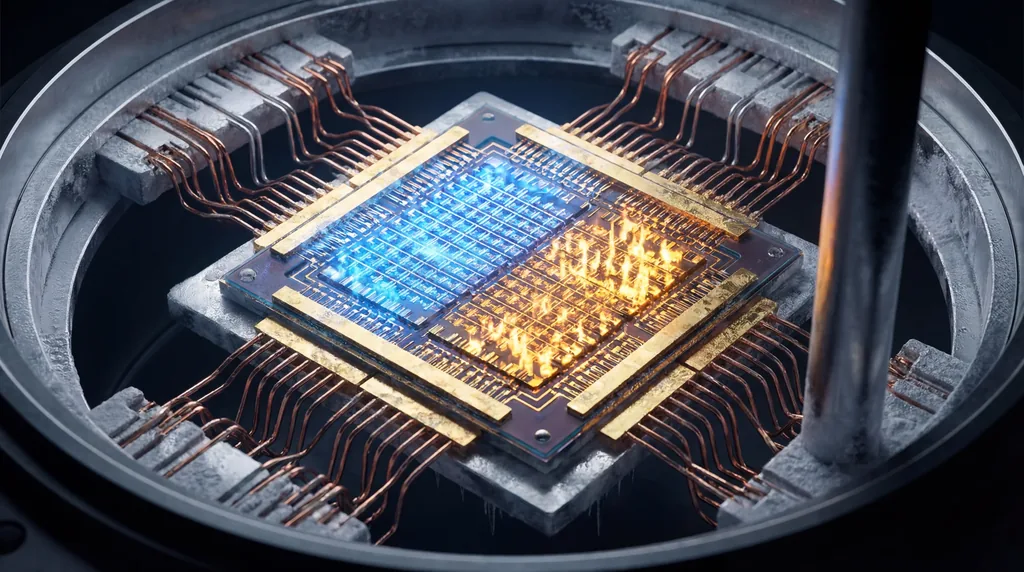

How do IBM quantum processors create chimera states?
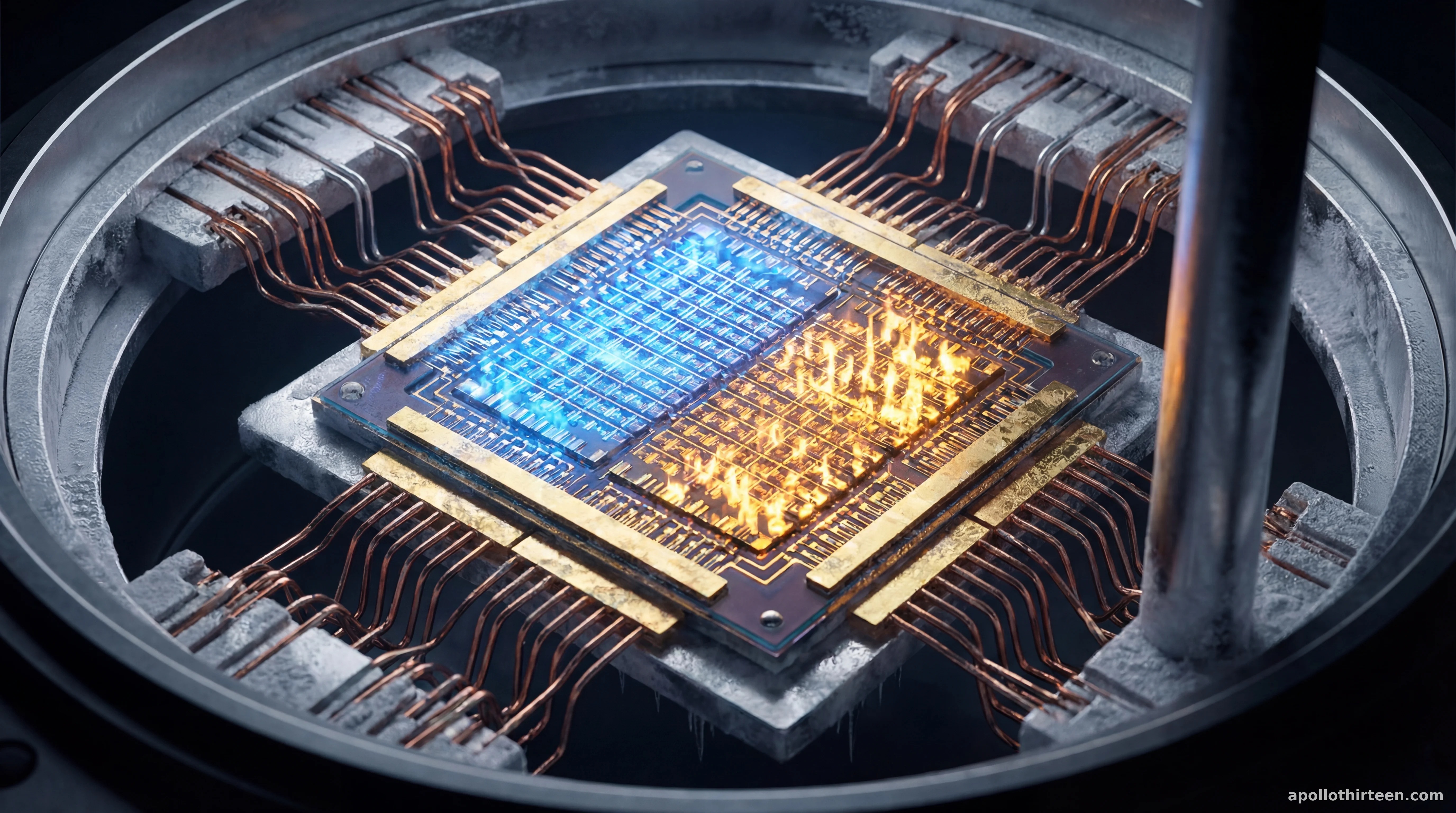
IBM quantum processors create chimera states by executing programmable Floquet dynamics on a two-dimensional Heisenberg model using a 156-qubit heavy-hex device. Researchers Seiji Yunoki, Kazuhiro Seki, and Kazuya Shinjo observed that initially randomized spins self-organize into coexisting regions of synchrony and asynchrony. This discovery demonstrates that large-scale quantum hardware can simulate complex collective behaviors previously limited to classical systems.
The research, conducted on IBM Quantum superconducting devices, utilized stroboscopic evolution to drive the system into a non-equilibrium state. By carefully tuning the initial phase randomness of the qubits, the team was able to trigger a phase transition where the system no longer synchronized globally. Instead, the 156-qubit lattice split into distinct domains: some areas maintained rigid phase-locking, while others remained in a state of chaotic, incoherent motion.
This experimental realization of a quantum chimera state is significant because it highlights the capability of superconducting quantum computing to maintain many-body coherence at scale. The study utilized the following key technical components:
- Heavy-hex architecture: A lattice design that reduces frequency crowding and improves qubit connectivity.
- Floquet dynamics: Periodic driving of the quantum system to maintain non-equilibrium phases.
- 2D Heisenberg model: A fundamental mathematical framework for describing interacting spins in a lattice.
What is quantum synchronization and why is it important?
Quantum synchronization refers to the spontaneous phase-locking of quantum oscillators or spins, serving as a bridge between classical non-linear dynamics and many-body quantum physics. It is vital for understanding how coherence persists in large-scale systems, which is a prerequisite for advanced quantum computing and high-precision sensing. These states reveal how quantum systems resist noise and maintain order.
Synchronization is a ubiquitous phenomenon in nature, famously observed in the rhythmic flashing of fireflies or the alignment of pendulum clocks. However, achieving this in the quantum realm is notoriously difficult due to the Heisenberg uncertainty principle and the tendency of quantum states to decohere. Researchers Seiji Yunoki, Kazuhiro Seki, and Kazuya Shinjo sought to determine if a many-body quantum system could self-organize into a stable, synchronized state despite these inherent challenges.
The importance of this work lies in its potential to stabilize quantum information. In traditional quantum systems, randomness and noise usually lead to the rapid decay of information. In contrast, symmetry-protected synchronization suggests that certain many-body states can remain coherent over long periods if protected by fundamental symmetries, such as SU(2) symmetry. This finding could lead to the development of new classes of "self-correcting" quantum states that are naturally resistant to environmental disturbances.
The Experimental Setup: IBM's Heavy-Hex Devices
The research team utilized IBM Quantum processors featuring the heavy-hex lattice architecture, which is specifically designed to minimize crosstalk and gate errors. This geometry provides a unique environment for simulating the 2D Heisenberg model, where each qubit interacts with its neighbors in a predictable, programmable manner. By implementing stroboscopic Floquet dynamics, the researchers were able to simulate a system that evolves in discrete, periodic steps.
Programmable superconducting qubits are particularly well-suited for this research because they allow for precise control over the interaction strengths between spins. The team used these processors to initialize qubits with varying degrees of phase randomness, effectively "tuning" the level of chaos in the system from the start. This high degree of programmability allowed for the direct observation of how synchronization emerges from a seemingly disordered initial state.
Data collected from these runs provided a high-resolution map of the system's evolution. By measuring the expectation values of the spin operators at each time step, the scientists could track the growth of global coherence. The heavy-hex device proved robust enough to maintain these dynamics over multiple Floquet cycles, providing clear evidence of a stable, non-equilibrium phase of matter.
Scaling from 28 to 156 Qubits
Initial experiments were performed on a 28-qubit subset, where the researchers confirmed that symmetry-protected synchronization was possible. In this smaller regime, they observed that initially phase-randomized spins would spontaneously align their oscillations across the entire lattice. To verify the role of symmetry, the team performed explicit symmetry-breaking experiments, which resulted in the immediate loss of synchronization, proving that SU(2) symmetry acts as a stabilizing force.
The study then scaled up to a massive 156-qubit array to explore how synchronization behaves in much larger many-body systems. As the number of qubits increased, the dynamics became qualitatively more complex. While global synchronization still occurred under conditions of low initial randomness, a new phenomenon emerged when the randomness was increased: the system began to fragment into different dynamical zones.
This transition to the 156-qubit regime was critical for identifying the "chimera state," a phenomenon where the system is neither fully ordered nor fully chaotic. The researchers used statevector and matrix-product-state simulations to validate their experimental findings. These simulations confirmed that the patterns observed on the IBM Quantum hardware were not the result of noise, but were intrinsic properties of the many-body Floquet dynamics.
Defining the Chimera State in Quantum Systems
A chimera state is a complex dynamical regime characterized by the simultaneous coexistence of synchronized (ordered) and desynchronized (chaotic) sub-populations within a homogeneous system. In the context of the 156-qubit processor, this meant that some clusters of qubits oscillated in perfect harmony while neighboring clusters moved independently. This state represents a rare middle ground between absolute order and total entropy.
The emergence of this state is triggered by strong initial phase randomness. When the initial "messiness" of the system exceeds a certain threshold, the SU(2) symmetry can no longer protect a global synchronized phase. Instead, the system finds a local equilibrium, where subsets of qubits that happen to be more aligned "capture" each other in a phase-lock, while others are left to drift.
Analyzing these states requires sophisticated statistical tools to differentiate between local phase coherence and global decoherence. The researchers found that these local synchronized regions were surprisingly robust, persisting throughout the duration of the experimental window. This coexistence provides a unique opportunity to study the boundaries of quantum coherence and how different phases of matter can inhabit the same physical space at the same time.
Can chimera states be used for quantum computing applications?
Chimera states and synchronized phases on IBM Quantum platforms offer significant potential for benchmarking hardware performance and developing error-mitigation protocols. By observing how symmetry protects these states, scientists can design quantum algorithms that are more resilient to the noise inherent in current hardware. These states also serve as a testbed for studying non-equilibrium phases of matter.
One potential application is the use of synchronization as a diagnostic tool. Because the chimera state is highly sensitive to the underlying interactions and symmetries of the processor, monitoring the formation of these states can reveal hidden flaws or inhomogeneities in the qubit lattice. This provides a more holistic view of processor health than traditional single-qubit metrics.
Furthermore, the ability to engineer and control chimera states could lead to novel ways of storing and processing information. In a standard quantum computer, all qubits must typically be kept in a single coherent state. However, a system that can reliably maintain multiple distinct dynamical regions—like those in a chimera state—might allow for parallel processing or the isolation of sensitive calculations from the rest of the processor's noise.
Implications for Quantum Information Science
The discovery of symmetry-protected synchronization on a 156-qubit device marks a milestone in the study of non-equilibrium quantum matter. It proves that we have reached an era where programmable quantum many-body systems can be used as laboratories to explore fundamental physics that cannot be easily replicated on classical supercomputers. The work by Yunoki, Seki, and Shinjo provides a roadmap for using these devices to find other exotic phases of matter.
Looking forward, the research team aims to explore how these synchronized states behave in even larger systems and under different types of interactions. The transition from 28 to 156 qubits already revealed entirely new physics; moving toward the 1,000-qubit mark may reveal even more complex collective behaviors. These findings ensure that superconducting quantum computing will remain at the forefront of condensed matter physics and quantum information science for years to come.
Ultimately, the ability to observe and manipulate chimera states brings us one step closer to understanding the transition from the quantum world to the classical one. By seeing how order emerges from chaos in a controlled, programmable environment, researchers are uncovering the fundamental rules that govern the universe’s most complex systems.




Comments
No comments yet. Be the first!