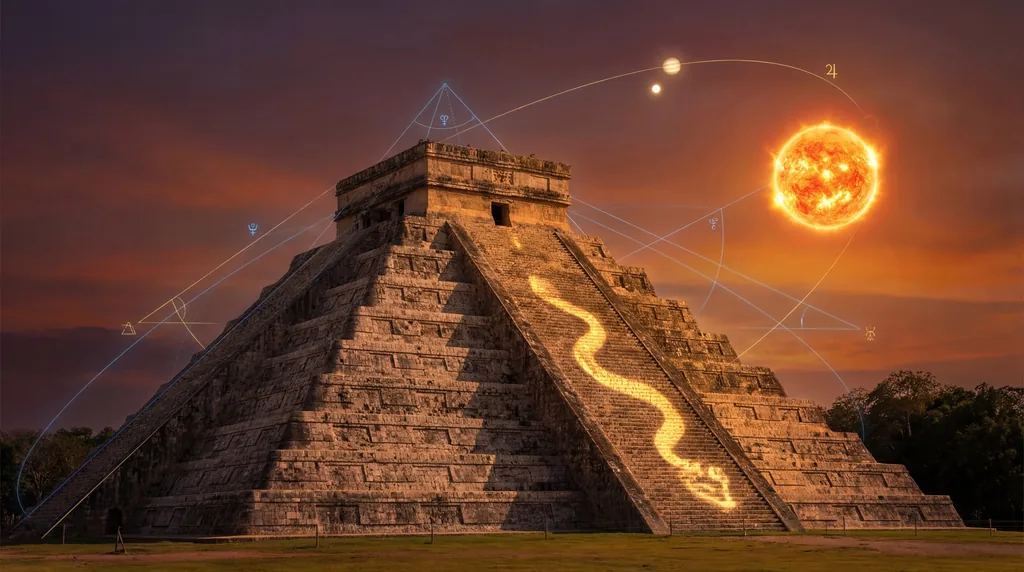

Twice a year, the sun performs a remarkable feat of engineering at the Temple of Kukulkan in Mexico’s Yucatán Peninsula. As the sun sets during the equinox, the interplay of light and shadow transforms the pyramid’s northern staircase into a slithering, illuminated serpent, revealing the deep astronomical knowledge of the pre-Columbian Maya. This phenomenon, which bridges the gap between terrestrial architecture and celestial mechanics, continues to draw thousands of spectators to the ancient site of Chichén Itzá to witness a spectacle centuries in the making.
Is the equinox effect at Kukulkan pyramid real?
The equinox effect at the Temple of Kukulkan is a verified solar phenomenon where the sun casts a series of seven triangular shadows against the northern staircase. These shadows connect with the stone serpent head at the base, creating the illusion of a descending feathered serpent. While the visual effect is real and observable, researchers debate whether the Maya engineered it with mathematical precision or if it emerged as a fortunate byproduct of the pyramid's alignment.
The geometry of the Temple of Kukulkan, also known as El Castillo, is central to this illusion. The structure consists of nine square terraces, which provide the edges necessary to cast shadows as the sun reaches a specific azimuth. During the late afternoon of the Spring Equinox and Autumnal Equinox, the angle of light creates a rhythmic pattern of triangles. This "slithering" effect lasts for several hours, though its peak clarity occurs when the sun is positioned to perfectly link the shadow "body" to the sculptural "head."
Scholars note that the structure stands approximately 30 meters tall and 55 meters wide, providing a massive canvas for this light display. Built between the 9th and 12th century, the pyramid serves as a testament to Mayan ingenuity. The intentionality of the serpent is supported by the fact that the shadow only forms on the staircase adorned with the serpent’s head, suggesting a deliberate synthesis of art, religion, and astronomy designed to signal the changing of seasons to the agrarian society.
What astronomical alignments are in Mayan pyramids?
Mayan pyramids like the Temple of Kukulkan feature sophisticated alignments reflecting the solar year and the Mayan calendar cycles. The pyramid's four staircases each have 91 steps, which, when combined with the final platform at the summit, total 365 steps—one for each day of the Haab' solar calendar. Additionally, the structure's 52 panels correspond to the 52-year cycle of the Calendar Round, illustrating a complex integration of time and stone.
Beyond the solar count, the Temple of Kukulkan is oriented to align with the sun's position during the equinoxes, when day and night are of nearly equal length. This alignment allowed the Maya to track the passing of time with incredible accuracy, essential for their agricultural and ritualistic life. Recent acoustic studies have also uncovered that the pyramid's design produces a "chirp" echo resembling the sacred quetzal bird when a person claps at the base, further suggesting that the builders incorporated sensory celestial connections into the architecture.
The precision of these alignments indicates that the Maya were master observers of the sky. By positioning the Temple of Kukulkan at a specific angle relative to the cardinal points, they ensured that the transition from winter to spring was marked by a clear, public signal. This use of "archaeo-astronomy" allowed the ruling elite to demonstrate their connection to the divine, as the return of the Feathered Serpent (Kukulkan) coincided with the arrival of the planting season.
Chichén Itzá in a Galactic Frame
A featured 2019 NASA Astronomy Picture of the Day (APOD) captured the Temple of Kukulkan framed against the backdrop of the Milky Way galaxy. This composite image highlights the pyramid’s relationship with the broader cosmos, showing Jupiter and Saturn straddling the diagonal central band of our galaxy. The imagery underscores that while the Maya focused on the sun, their architectural planning was part of a holistic view of the celestial sphere.
In the NASA imagery, the presence of Jupiter and Saturn serves as a reminder of the planets' roles in ancient observations. The Maya tracked the movements of Venus and other planetary bodies with high-precision tables, such as those found in the Dresden Codex. Seeing the pyramid beneath the Milky Way emphasizes that the Temple of Kukulkan was not just a local monument, but a terrestrial anchor for a civilization that viewed the stars as the dwelling place of gods and ancestors.
The relationship between the pyramid and the galaxy reflects a deep understanding of precession and orbital mechanics. While the serpent illusion is a solar event, the pyramid's orientation also respects the positions of various constellations throughout the year. This galactic framing helps modern scientists appreciate how pre-Columbian civilizations synthesized their environment with the infinite reaches of space, creating a cultural landscape that was literally written in the stars.
When is the best time to see the serpent descend the pyramid?
The best time to witness the serpent's descent is between 3:45 PM and 4:30 PM local time during the week of the Spring or Autumnal Equinox. While the official equinox date is the peak, the shadow effect is often visible for several days before and after the event. Clear skies are mandatory, as even light cloud cover can obscure the triangular shadows necessary to form the serpent’s body.
- Spring Equinox: Occurs around March 20-21, signaling the start of the planting season.
- Autumnal Equinox: Occurs around September 22-23, marking the harvest period.
- Optimal Window: The most dramatic "connection" between the shadow and the stone head occurs approximately 45 minutes before sunset.
- Atmospheric Conditions: Visitors should look for high-visibility days with minimal humidity for the sharpest shadow definition.
Observers should note that the Temple of Kukulkan attracts massive crowds during these windows, often numbering in the tens of thousands. To see the full progression, one must arrive early to secure a view of the northern staircase. As the sun moves lower in the sky, the triangles appear to "crawl" down the side of the pyramid, a process that takes roughly 45 minutes to complete before the entire staircase is swallowed by the evening shadow.
The Global Equinox and Modern Astronomy
The physics of the equinox dictates that the Earth’s axis is tilted neither toward nor away from the sun, resulting in nearly equal day and night. This astronomical event occurs globally, but the Temple of Kukulkan remains one of the most iconic sites for observing its effects. Modern astronomy continues to use these dates to calibrate instruments and study Earth’s orbital relationship with the sun, much like the Mayan priests did over a millennium ago.
The legacy of Mayan archaeo-astronomy provides a vital link to our understanding of ancient science. By studying how the Temple of Kukulkan interacts with light, researchers gain insights into the mathematical capabilities of the Maya, who utilized a base-20 numbering system and the concept of zero. Their ability to predict eclipses and solar cycles without modern telescopes remains a subject of intense academic study and admiration within the scientific community.
As another equinox approaches, the world looks to sites like Chichén Itzá to reconnect with the rhythms of the planet. The enduring power of the Feathered Serpent serves as a reminder that humanity has long sought to harmonize its greatest architectural achievements with the movements of the heavens. Future research into the Temple of Kukulkan will likely focus on lidar mapping and 3D modeling to uncover even more hidden alignments within this masterpiece of Mayan engineering.





Comments
No comments yet. Be the first!