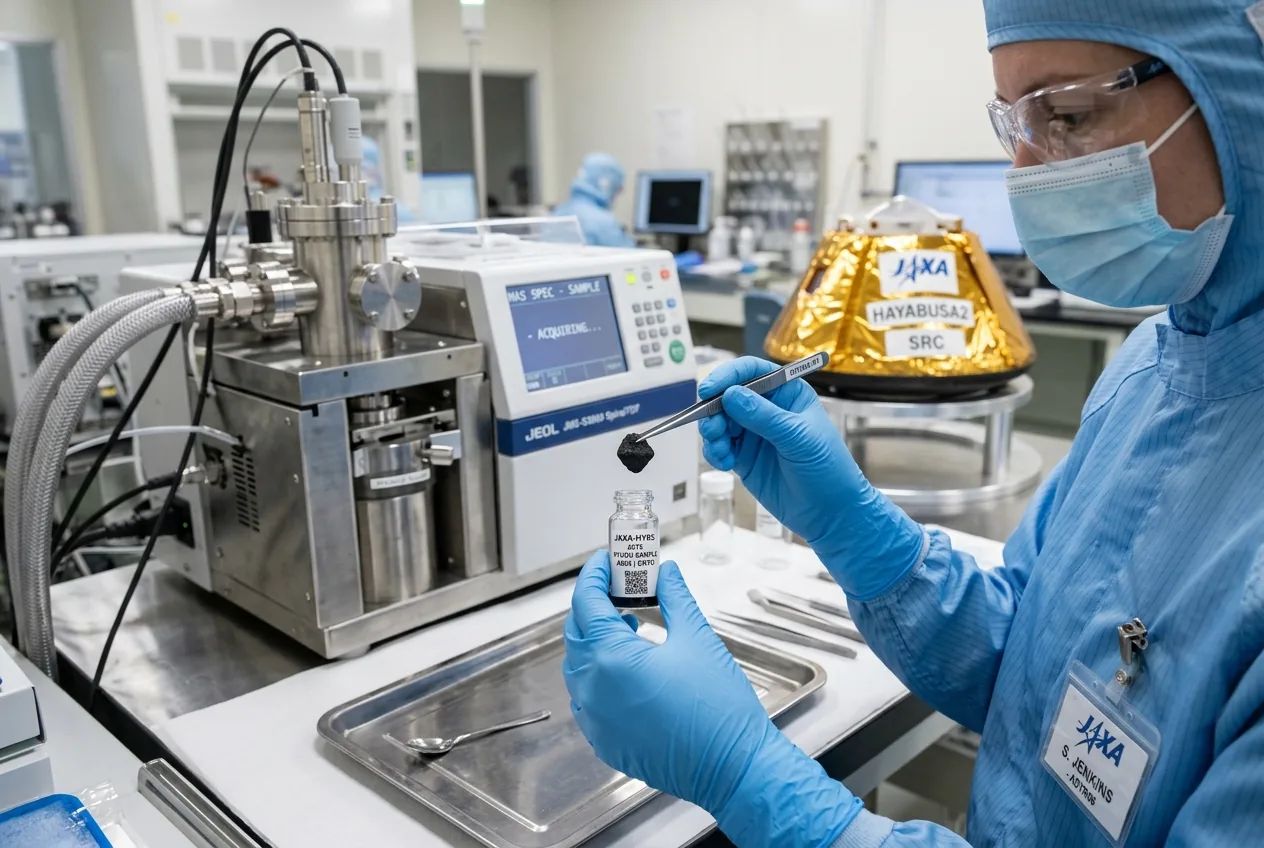
A small black pebble, a big claim: asteroid samples contain genetic letters
On the bench under ultra-clean hoods in Japan this month, researchers opened a capsule that Hayabusa2 delivered to Earth in 2020 and announced something striking: asteroid samples contain genetic molecules long thought to be strictly a product of earthly chemistry. The team, led by biogeochemists working with Japan’s sample curation facilities, reported detecting all five canonical nucleobases—the molecular "letters" that make up DNA and RNA—in two tiny fragments of the carbon-rich asteroid Ryugu. Those fragments are a fraction of the 5.4 grams returned by the mission; the finding itself rests on careful extraction and mass-spectrometry work performed in clean labs to reduce the risk of contamination.
Why this is news now: asteroid samples contain genetic clues to early Earth chemistry
We already had hints that space rocks carry organic complexity: meteorites like Murchison and Orgueil have long yielded amino acids and some nucleobases, and NASA’s OSIRIS-REx returned material from Bennu that earlier showed a full set of nucleobases. What makes the Ryugu result timely is that it adds a second pristine sample return—collected directly from an asteroid and handled under curated conditions—to that list. For origin-of-life researchers, this strengthens the case that the raw molecular ingredients of heredity were not rare curiosities on Earth but were likely present throughout the early Solar System and could have been delivered to the young planet during heavy bombardment.
asteroid samples contain genetic letters: what exactly was detected in Ryugu?
The molecules identified are the five canonical nucleobases: adenine, guanine (the purines), and cytosine, thymine and uracil (the pyrimidines). These are the nitrogen-containing heterocycles that, when attached to sugars and phosphates, form nucleotides—the monomer units of RNA and DNA. The Ryugu team used solvent extraction followed by purification and high-resolution mass spectrometry to pick these compounds out of complex organic mixtures. Importantly, the researchers report finding the same five bases in each of the two fragments they analyzed, which reduces the likelihood that the signal came from a single contaminated particle.
asteroid samples contain genetic diversity — comparing Ryugu, Bennu and meteorites
The Ryugu result doesn’t arrive in isolation. Bennu, the target of NASA’s OSIRIS-REx mission, yielded a similar complete set of nucleobases in analyses published last year, and terrestrial meteorites such as Murchison and Orgueil have previously shown nucleobase inventories. But the three bodies differ in detail: Ryugu shows roughly balanced purine and pyrimidine abundances, Bennu and Orgueil are richer in pyrimidines, while Murchison leans toward purines. Those differences appear to correlate with the presence of ammonia and other chemical parameters within the parent bodies, suggesting that small variations in asteroid chemistry can shift which nucleobases form or persist.
Lab rigour, contamination risk and what the analysts did to check
One of the immediate questions when anyone says "asteroid samples contain genetic molecules" is whether the molecules came from Earth. Hayabusa2’s samples were handled under curated, sterile conditions designed to keep Earthly organics out; analysts used tiny sample masses, solvent extractions, and multiple blanks and standards. The team also compared the results to meteorites that arrived on Earth decades ago—rocks that are more prone to contamination—to show consistent signatures across independent extraterrestrial sources. Still, contamination is never a closed case: traces of terrestrial compounds can be stubborn, and the community will expect independent labs to replicate measurements on separate aliquots before treating the finding as settled.
What this does — and more importantly, what this does not — prove about life on Earth
Finding the five nucleobases on Ryugu tells us that the chemical subunits for genetic polymers can form in space and be stored in carbon-rich asteroids for billions of years. It does not show that nucleobases arrived on Earth already assembled into functioning RNA or DNA, nor does it show that those molecules polymerized into longer chains there. Crucially, the detection is of bases, not nucleotides or intact nucleic acid strands; sugars and phosphate groups, and the chemistry linking them into polymers, are additional—and harder—steps. So while the evidence bolsters a story where asteroid delivery supplemented Earth’s prebiotic inventory, it does not amount to a demonstration of life hitching a ride from space.
How these ingredients could (or could not) have seeded biology
Asteroids can deliver organics in two different ways: fragile molecules locked in hydrated minerals might be protected from total thermal destruction during entry, or more robust refractory organics could survive as dust and particulates. Laboratory simulations show some nucleobases can survive shock and heating, but survival rates and concentrations matter: prebiotic chemistry needs a sustained supply and the right microenvironments to concentrate, link and stabilize molecules into polymers. In short, delivery supplies pieces of the puzzle, but we still lack solid evidence that the pieces arrived in the right place at the right concentration and chemistry to assemble into the first replicators.
Institutional incentives, missing data, and the limits of current assays
The discovery illuminates scientific incentives as well as chemistry. National sample-return programs—JAXA’s Hayabusa2 and NASA’s OSIRIS-REx—have unique access to curated, uncontaminated material, so they naturally set the benchmark. But those programs produce only gram-scale payloads; analyses typically use milligram or sub-milligram subsamples, limiting statistical power and the ability to probe heterogeneity across an asteroid. We still need larger sample sets and independent laboratories performing blind replications. Other missing data include information on sugar partners, phosphate chemistry, chirality of the molecules, and isotope ratios that could more strongly tie the organics to a genuine extraterrestrial origin rather than low-level contamination.
Ethics, policy and the uneven geography of origin-of-life work
High-profile sample returns concentrate scientific authority in a few labs and nations that control curation and early access. That centralization accelerates discovery but also shapes narratives about what the evidence means. Researchers outside the core teams must be given timely, transparent access to aliquots for independent verification; otherwise, the community risks overinterpreting initial results. Funding patterns also matter: origin-of-life chemistry and prebiotic simulation labs tend to be under-resourced relative to the engineering cost of sample returns, creating a mismatch between hardware missions and the follow-up science needed to test their significance.
The genome is precise; the world it lives in is anything but. The Ryugu finding sharpens our picture of the Solar System’s prebiotic richness but leaves the hard questions about synthesis, concentration, and polymerization on Earth stubbornly open.
Sources
- Nature Astronomy (research paper on nucleobase detections in Ryugu samples)
- Japan Aerospace Exploration Agency (Hayabusa2 sample curation and return)
- NASA (OSIRIS-REx Bennu sample analyses)




Comments
No comments yet. Be the first!