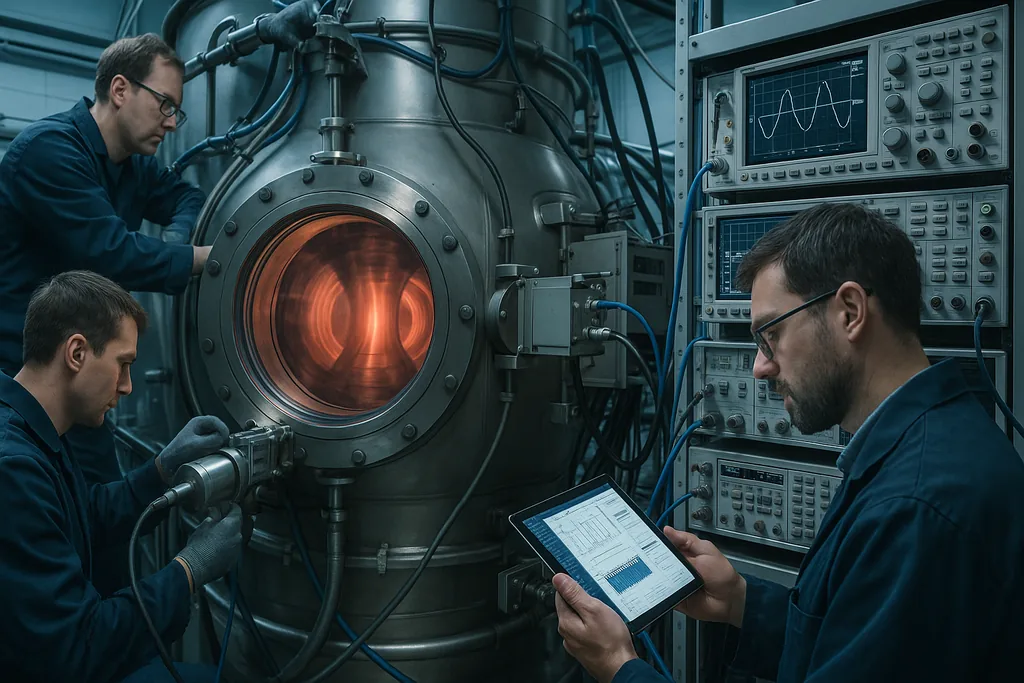
Diagnostics as the overlooked engine of the fusion race
On 8 March 2026 a Department of Energy–backed report, assembled from a 2024 Basic Research Needs workshop, put a spotlight on what it called the hidden technology that could finally make fusion power work: measurement systems. The document — led by scientists at the Princeton Plasma Physics Laboratory and the Laboratory for Laser Energetics at the University of Rochester — argues that reliable, fast, and radiation‑tolerant diagnostics are as critical as magnets, lasers and fuel chemistry for turning experimental successes into steady electricity.
That phrasing may surprise people who picture fusion's ceiling as a purely engineering fight over superconducting magnets or laser energy. The report reframes the challenge: create instruments and software that can see, in real time, what the plasma is doing inside a reactor, and then use that data to control the machine, validate models and speed engineering decisions.
Hidden technology that could accelerate fusion diagnostics
The workshop's core recommendation is blunt: accelerate investment in measurement innovation. Practically, that means three intertwined streams of work. First, build sensors and optics that survive and function inside the extreme radiation, heat and neutron flux of a pilot fusion plant. Second, develop ultrafast diagnostics that can resolve processes in inertial‑confinement fusion (ICF) and magnetic‑confinement fusion (MCF) on their natural timescales. Third, pair those hardware advances with software — AI, machine learning and digital twins — that turn raw signals into reliable state estimates for control and design.
Those technical goals are complementary. A new high‑speed camera or neutron spectrometer is only useful if its data are calibrated, interpreted and integrated into control loops. For this reason the report recommends national coordination — a CalibrationNetUS-style network, national teams to move ideas into operational diagnostics, and standardised calibration protocols that make measurements comparable across labs and companies.
Why measurements matter for reactor operation
Fusion plasmas are unforgiving. The difference between a burning plasma and a crash can be a small change in local temperature, density or impurity content that unfolds in microseconds. Without diagnostics that can sense those changes and software that can act on them, pilot plants cannot be run safely, reliably or at commercial availability levels suitable for a grid operator.
Measurements feed three critical activities. They provide the feedback needed for active control systems; they validate simulation codes used to design components and predict lifetime; and they give regulators and funders the objective evidence required to move from experimental facilities to demonstration and commercial plants. In short, diagnostics are the eyes, the truth source and the confidence engine for fusion commercialization.
Hidden technology that could survive reactor radiation
A persistent shortcoming is survivability. Sensors that work well in today’s research tokamaks or laser facilities often degrade rapidly when exposed to the neutron fluence expected in a power plant. The report calls for materials science and engineering efforts to produce radiation‑hard electronics, robust optical windows, remote fiber feeds and modular diagnostics that can be serviced remotely or replaced without lengthy shutdowns.
Developing radiation‑tolerant diagnostics is not only an instrumentation problem; it crosses into device engineering, materials research and supply‑chain planning. High‑temperature superconductors — the same class of materials used to build stronger magnets — can also play a role by enabling higher‑field coils that reduce reactor size, which in turn eases some diagnostic placement challenges. Similarly, resilient optical coatings and fiber technologies are needed where lasers and ultrafast probes monitor ICF capsules and edge plasmas.
AI, digital twins and the data deluge
The report singles out artificial intelligence and digital twins as enabling tools that will amplify the value of better hardware. Fusion experiments already generate terabytes of heterogeneous data per pulse: interferometry, X‑ray and neutron detectors, magnetic probes, spectrometers and hundreds of auxiliary channels. AI methods can accelerate signal processing, identify emergent failure modes and suggest control actions faster than human operators.
Digital twins — high‑fidelity computational replicas of a device and its plasma — allow researchers to test diagnostics in silico, validate interpretation codes, and simulate remote operation scenarios before rolling them into an actual machine. The workshop recommended validating design modeling codes against improved diagnostics to shrink the uncertainty in digital twins and make them trustworthy partners in design and control.
How magnets, lasers and superconductors fit into the picture
This emphasis on measurements does not downplay the established roles of magnets, lasers and superconductors. High‑field superconducting magnets remain the most direct lever to improve confinement in tokamaks and stellarators, shrinking device scale and cost. In inertial fusion, powerful lasers deliver the energy to compress and heat fuel rapidly. But both approaches depend on diagnostics: magnets require precise field mapping and quench detection, and lasers require ultrafast optical metrology to understand pulse shape and symmetry. Better sensors close the loop between the hardware that creates extreme conditions and the software that makes those conditions stable and repeatable.
Put differently: you still need magnets and lasers to make fusion happen, but you need diagnostics to know when and how it happens — and to make it sustainable over millions of pulses or long dwell times.
Workforce, standards and the path to pilots
Concrete next steps include establishing calibration networks, piloting remote‑operation measurement suites for future plants, and creating sharing mechanisms so private fusion firms can benefit from public lab experience. These institutional measures — often less glamorous than a breakthrough magnet or laser — influence how quickly a fusion device can be certified and scaled to commercial operation.
Timelines and realistic expectations
How close does this actually bring fusion to the grid? The report tempers optimism with realism: measurement innovation can accelerate development, but it is not a magic bullet that erases the physical challenges of heating, confining and extracting energy from plasma. The Fusion Science & Technology Roadmap referenced in the report looks toward milestones into the mid‑2030s; diagnostics work is cast as an enabler that shortens cycles for design, testing and certification within that horizon.
In practice, progress will be iterative. Improved diagnostics will make simulations more reliable; better simulations guide magnet and material choices; those hardware choices create new diagnostic challenges, and so on. If funding and national coordination follow the report’s recommendations, the community could plausibly compress timelines for demonstration plants and reduce technical risk — pushing fusion from episodic breakthroughs toward operational maturity.
Sources
- Princeton Plasma Physics Laboratory — Final Basic Research Needs report on Measurement Innovation (DOE Fusion Energy Sciences)
- U.S. Department of Energy, Office of Science, Fusion Energy Sciences program — Basic Research Needs Workshop materials
- University of Rochester, Laboratory for Laser Energetics — workshop co‑chairs and diagnostics expertise
- Oak Ridge Institute for Science and Education — workshop organisation and collaboration




Comments
No comments yet. Be the first!