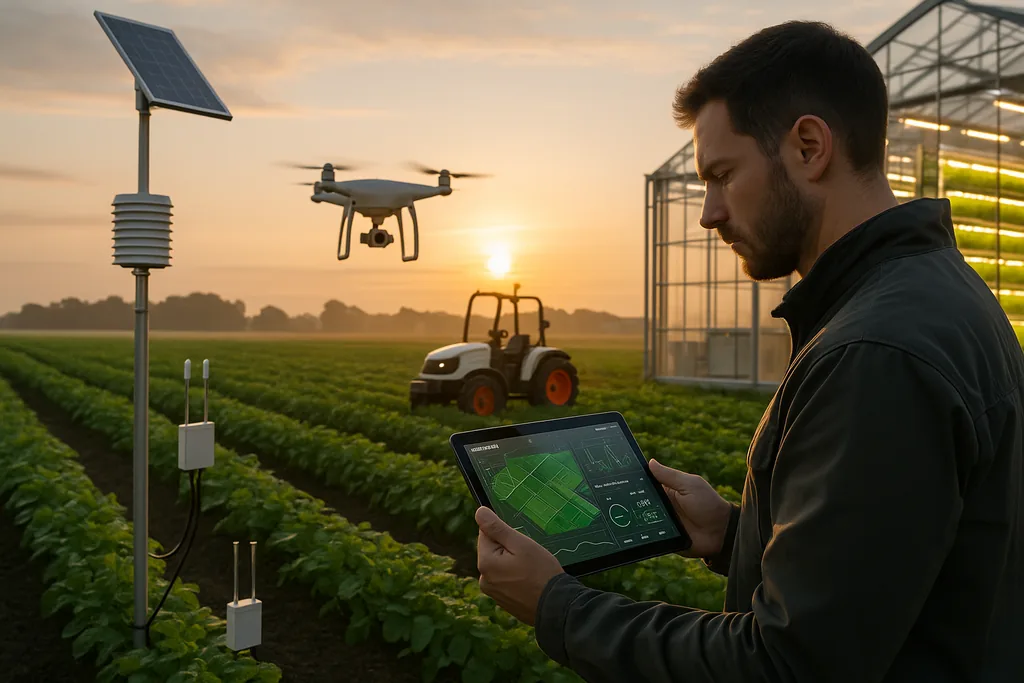
On a chilly testing plot outside Davos this week, scientists demoed an AI-driven soil scanner that reads not just which nutrients are in the ground but how available they are to plants. It is a small scene, but it captures a much bigger shift: agriculture is rapidly leaving the purely mechanical age and entering a data-and-biology era. The stakes are enormous—global agriculture must, by many estimates, produce roughly 60 percent more food by mid-century while simultaneously shrinking its climate footprint—so new tools are arriving fast, from microbes and gene-edited seeds to drones, live maps and power-hungry data systems.
Precision sensing and diagnostics
One of the clearest changes on farms is better situational awareness. A new generation of sensors, cameras, spectrometers and lab-on-a-chip devices can measure soil moisture, pH, nutrient concentrations and pathogen signals in near real time. Startups and legacy agribusinesses are packaging these measurements into cloud dashboards that tell a grower which field needs lime, where nitrogen is locked in unavailable forms, or which sector shows early signs of disease.
Those capabilities matter because they change farm decisions from reactive to targeted. Instead of blanket fertilizer or pesticide applications, treatments can be applied at variable rates to square metres that need them. Early trials suggest this raises yields while lowering inputs and runoff; the approach also makes emissions accounting more granular, which matters as carbon markets and regulatory reporting increasingly touch agriculture.
Biology is the new machinery
Biological innovations are arriving alongside electronics. Companies are developing soil probiotics and microbial consortia that improve nutrient cycling and soil carbon storage, while plant scientists push crop genetics to raise resilience to heat, drought and new pests. Some research aims at radical changes—plants or associated microbes that fix nitrogen more efficiently, or indoor systems that ‘‘grow protein from air’’ by fermenting microbes at scale.
These biological fixes promise to reduce reliance on synthetic chemicals that damage ecosystems and to rebuild soil health on degraded lands. But biology also brings variability: living systems respond to context. Field trials that look promising in one place can fail in another, and broad, long-term studies will be needed to separate hype from scalable gains.
AI, maps and the cloud: coordinating action across fields
Data only becomes useful when it is connected. Mapping companies that decades ago digitized roads are now streaming live, high‑definition maps that update from millions of sensors; the same architectural ideas are being repurposed for agriculture. Farm machinery, drones and satellites feed telemetry and imagery into cloud platforms where AI models stitch together crop health, irrigation status and logistics constraints in near real time.
This digital nervous system enables smarter supply chains: harvest windows can be matched to processing capacity, trucks routed to avoid delays, and energy use synchronized with grid conditions. But it also creates new dependencies. Many agritech platforms sit on hyperscale cloud services and require reliable power—an issue highlighted at recent energy forums, where speakers warned of rising electricity demand from computing and electrified industries. The upshot: electrifying tractors, powering vertical farms and running AI analytics all add to rural power needs that planners must meet.
Robots and automation—augmentation first
Robots and autonomous vehicles are finally useful on farms for repetitive, precise tasks—weed removal, selective harvests, and monitoring. Yet lessons from AI use in other industries are instructive: the most successful deployments tend to augment human work rather than replace it. On farms, that means human operators remain in the loop for complex decisions—when to change crop mixes, whether to accept a marginal field for harvest, or how to respond to a novel pest outbreak.
Designs that preserve farmer control and deliver clear, auditable recommendations will be adopted faster than black‑box systems. That human-in-the-loop approach reduces the risk of costly hallucinations or misapplied treatments that can occur if AI systems make unchecked decisions in messy, variable biological environments.
Regenerative practices meet market incentives
Technology alone will not regenerate agriculture. Regenerative approaches—cover cropping, reduced tillage, diversified rotations—restore soil and sequester carbon but require new financing models, measurement protocols and market structures. Financial institutions, bioenergy firms and sustainability advisers are experimenting with bundled projects that mix carbon credits, bioenergy value streams and farm income, aiming to create predictable returns for farmers who adopt regenerative practices.
Accurate, verifiable measurement is a prerequisite. Remote sensing and in‑field sensors help, but robust third‑party validation and standardized rules will decide who gets paid for ecosystem services. Without credible verification, markets risk rewarding the wrong behaviours or leaving smallholders behind.
Who gains—and who is left behind?
One of the biggest social questions is equity. Large farms in high‑income countries can absorb the capital cost of sensors, robots and subscriptions to analytics services. Smallholder farmers, who produce a large share of certain staple crops globally, often lack access to reliable electricity, broadband or financing. Unless business models and public policy explicitly include them—through cooperatives, subsidised sensors, or extension services that translate data into local practice—the technology wave could widen existing divides.
Data ownership and privacy are also emerging fault lines. Farm data can reveal yields, management practices and income. Who controls that data—the farmer, platform provider or a downstream buyer—will determine bargaining power in supply chains. Policymakers and industry groups are already debating rules for interoperable data standards and fair access.
Energy, carbon and the cost of compute
High‑resolution monitoring and machine learning take power. Vertical farms, indoor protein production and large‑scale AI training require electricity and cooling; their climate benefits depend on the carbon intensity of that power. Events convening energy and climate leaders have emphasised the need to integrate grid planning, virtual power plants and storage to accommodate the electrification of food production and the rising compute load of agritech platforms.
That integration offers opportunities: farms with battery storage and solar can become grid assets when they modulate irrigation pumps or indoor lighting, creating new income streams while smoothing renewables’ variability.
What success looks like
In a successful transition, technology reduces input intensity (fertilisers, pesticides and diesel), raises yields and makes farms more resilient to climate shocks, while ensuring small producers gain access to tools and markets. It will require scientists, banks, technology companies, utilities and farmers to coordinate—sharing standards, financing pilots and building transparent measurement systems for soil carbon and biodiversity.
The most promising applications follow a pattern: they solve a well‑defined, repeatable problem; they augment rather than replace farmers’ judgment; and they connect to credible markets or services that reward sustainable outcomes. Where those three conditions are met—regularity, human oversight and economic incentive—technology is already delivering real gains.
Risks to manage
Technology is not a silver bullet, but it is reshaping agriculture's toolkit. The coming decade will decide whether that reshaping favours a few well‑capitalised operations or produces broad benefits: healthier soils, smaller emissions and more resilient food systems. To get there, engineers and agronomists must design tools that respect biological complexity and human expertise, while policymakers and markets must reward long‑term stewardship as much as short‑term output.
Sources
- Rabobank agricultural finance and analysis
- UK Centre for Ecology & Hydrology (natural‑capital and ecosystem services research)
- Here Technologies (live mapping and sensor integration for mobility and logistics)
- Stanford University (economics of AI and augmentation research)
- Dana‑Farber Cancer Institute and Mayo Clinic (examples of AI diagnostics and limits)
- Technical reports and industry briefings on regenerative agriculture and bioenergy




Comments
No comments yet. Be the first!