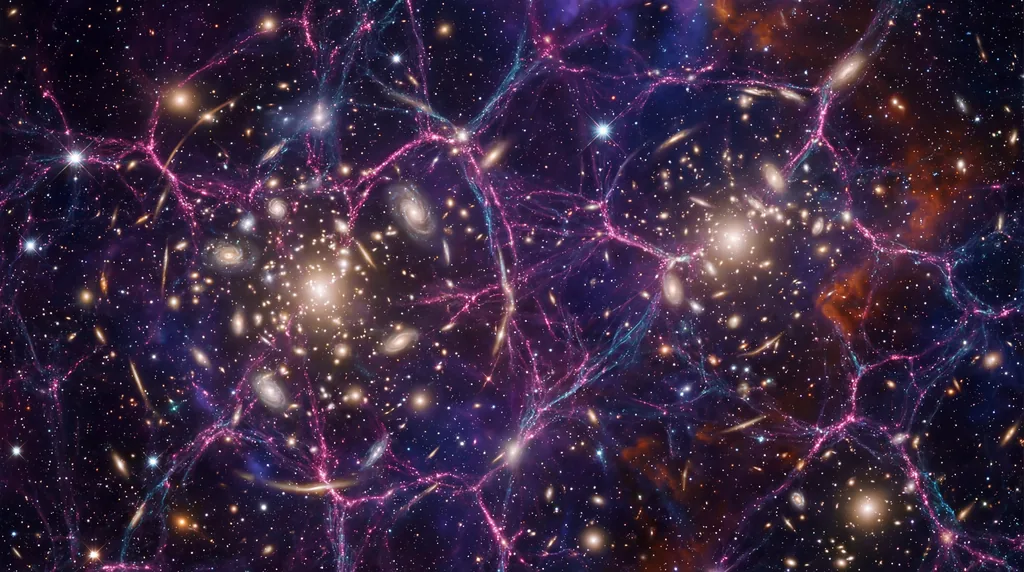

Weak gravitational lensing is the subtle distortion of background galaxy shapes caused by the gravitational field of intervening mass, including dark matter, as predicted by general relativity. This phenomenon occurs when light from distant galaxies is deflected as it travels through the cosmic web, the invisible scaffolding of the universe. To detect this faint signal, astronomers like C. Carbone, C. Giocoli, and S. Pires use the Euclid Telescope to measure coherent shear and convergence, requiring statistical averaging over millions of galaxies to map mass distributions that do not emit light.
The Euclid Telescope is designed to solve one of the greatest mysteries in modern physics: the nature of the "dark" universe. Because dark matter neither emits nor reflects light, it remains invisible to traditional telescopes. However, its immense gravity acts as a structural framework for galaxy clusters, pulling gas and stars into the dense nodes of the cosmic web. By refining how we detect these massive structures, researchers are essentially creating a blueprint of the universe's evolution over billions of years.
What is weak lensing and how does it work?
Weak lensing works by measuring the statistical distortions in the shapes of background galaxies caused by the gravitational influence of foreground mass. Unlike strong lensing, which creates visible arcs, weak lensing is nearly imperceptible and requires analyzing lensing maps to identify mass concentrations. This technique allows researchers to map dark matter independent of whether it is associated with visible stars or gas.
In a recent study published in the context of the Euclid Telescope mission, researchers utilized a wavelet multi-scale detection method to isolate these signals. By using wavelets, the team could identify signals of varying sizes, from individual galaxy clusters to larger filaments of the cosmic web. This multi-scale approach is essential because mass is not distributed uniformly; it exists in a complex hierarchy that requires sophisticated mathematical filters to untangle from background noise.
How do future surveys like Euclid improve weak lensing detection?
Future surveys like Euclid improve weak lensing detection through larger sky coverage, greater depth, and higher image quality, which increases the galaxy number density available for study. These advancements allow for more precise shear measurements and the use of source redshift tomography, which slices the sky into different time periods to create a three-dimensional map of mass growth across cosmic history.
The research team, including C. Carbone and colleagues, applied these improvements to mock data sets modeled after the expected output of the Euclid Telescope. They focused on a technique known as the $z_{s,\mathrm{min}}$-cut, which involves combining peak detections from multiple source redshift bins. By simulating a maximum depth of $z_{s,\mathrm{max}}=3$, the study demonstrated how high-fidelity photometric redshift data could potentially reveal thousands of previously hidden clusters in the deep sky.
Key technological advantages of the Euclid mission include:
- Wide-field imaging: Covering 15,000 square degrees of the extragalactic sky.
- High resolution: Minimizing "shape noise" that often plagues ground-based lensing observations.
- Tomographic depth: Providing a 3D view of the universe by slicing data into redshift bins.
- Multi-wavelength data: Combining optical and near-infrared observations to refine photometric redshift accuracy.
The Tomographic Approach: Slicing the Sky by Time and Distance
Source redshift tomography is a method that treats the universe like a biological specimen, taking "slices" of light from different distances to see how structure has changed over time. By observing galaxies at different redshifts, astronomers can determine when galaxy clusters began to form and how fast they grew. This 3D perspective is vital for distinguishing between different theories of gravity and dark energy.
During the study, the authors tested various combinations of one to four tomographic bins to see if more data slices always led to better detection. They used N-body cosmological simulations to create synthetic clusters, ranging from simple Navarro Frenk White (NFW) haloes to complex structures embedded in the cosmic web. This methodology allowed them to test the limits of weak lensing detection in a controlled, yet realistic, virtual environment.
Why is weak lensing important for studying dark matter?
Weak lensing is crucial for studying dark matter because it directly probes all mass, including the invisible dark component, by tracing gravitational distortions independent of light emission. It is the only tool that allows scientists to "see" the cosmic web directly, revealing how dark matter drives the expansion of the universe and the formation of large-scale structures like galaxy clusters.
By mapping the distribution of dark matter, the Euclid Telescope can help scientists measure the S8 parameter, which describes the "clumpiness" of the universe. If the observed clumping of matter differs from what our current models predict, it could signal new physics beyond the Standard Model. This makes weak gravitational lensing the primary diagnostic tool for understanding the hidden 95% of the cosmos that consists of dark matter and dark energy.
Efficiency Breakthrough: The Power of the Single Redshift Bin
A major finding of the study is that a single, optimized source redshift bin (starting at $z_{s,\mathrm{min}}=0.4$) performs just as well as complex multi-bin combinations. While it was previously thought that adding more tomographic layers would always increase detection sensitivity, researchers found that the accumulation of spurious detections across multiple bins actually decreases the purity of the data. This discovery suggests that a streamlined approach may be more efficient for large-scale surveys.
The team demonstrated that while large-scale structure contamination and photometric redshift errors do limit the gains of tomography, the primary bottleneck is spurious signal noise. When multiple redshift bins are combined, the risk of misidentifying a random alignment of galaxies as a galaxy cluster increases. By focusing on a single, well-calibrated bin starting at a redshift of 0.4, the Euclid Telescope can maintain high purity and completeness in its cluster catalogs.
Impact of the single-bin approach on future research:
- Reduced computational load: Fewer data slices mean faster processing of petabytes of Euclid data.
- Higher Purity: Minimizes the number of "false positive" galaxy clusters in the final catalog.
- Strategic focus: Allows researchers to optimize weak lensing filters for specific distance ranges.
- Better constraints: Provides a cleaner dataset for measuring the effects of dark energy.
The Future of Cosmic Mapping
These findings will directly influence how the Euclid mission processes data during its six-year survey of the dark universe. By identifying the most efficient way to map galaxy clusters, scientists can more accurately count the number of massive structures in the sky. This "cluster count" is one of the most powerful ways to test the properties of dark energy and determine the ultimate fate of our expanding universe.
As the Euclid Telescope continues its mission, the focus will shift from methodology to discovery. The refined weak lensing techniques developed by Carbone, Giocoli, and Pires ensure that we are not just collecting data, but extracting the most accurate invisible map possible. Understanding the dark matter scaffolding of the cosmic web is no longer a theoretical dream; it is a burgeoning reality that will reshape our understanding of the cosmos.





Comments
No comments yet. Be the first!