A campaign to watch a giant breathe
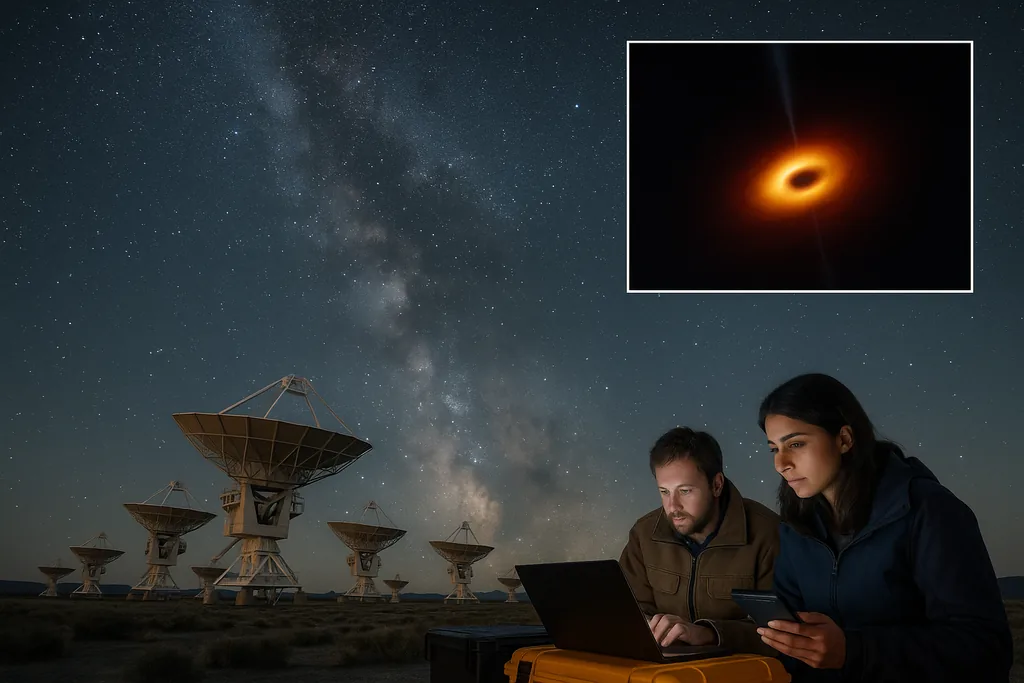
In March and April 2026, the Event Horizon Telescope (EHT) collaboration will point its planet-sized eye at the core of Messier 87 for a tightly scheduled observing campaign designed not to take another still photograph, but a movie. The target, M87*, is the six-billion-solar-mass black hole whose now-iconic shadow first appeared in public images a few years ago. Because the gravitational theatre around M87* evolves on timescales of days rather than minutes, scientists believe that sequences of high-resolution images taken every few days can be stitched into the first moving picture of a supermassive black hole and its immediate environment — the accretion flow and the base of a relativistic jet.
Why M87* is the right target
Not all black holes are equally cooperative. The black hole at our own galaxy’s heart evolves too fast for the current EHT array to make a long-exposure movie: hot plasma orbits Sagittarius A* in tens of minutes. M87*’s enormous mass stretches those timescales to days or weeks, which plays to the strengths of very-long-baseline interferometry (VLBI) — the technique that links radio dishes around the globe to act like an Earth-sized telescope. Observers plan sequences with cadences of roughly three days, long enough to capture meaningful structural changes but short enough to avoid smearing the image when combining data.
What the team hopes to see
The scientific prize is not a cinematic flourish but hard diagnostics: the movie could reveal how plasma moves around the black hole, how the ring’s bright regions shift, whether magnetic field structures change on observable timescales and how the jet is launched from the inner accretion flow. Measuring azimuthal motion of brightness features can put direct constraints on the black hole’s spin and on the magnetohydrodynamic processes that drive jet formation — a key missing piece linking horizon-scale physics to galaxy-scale feedback processes.
Lessons from multi-year imaging
The push for a movie builds on multi-epoch EHT work that has already exposed surprising variability. Re-analyses of 2017–2021 data revealed that while the overall ring diameter — the apparent shadow scale — has remained consistent with predictions from general relativity, the brightness distribution and linear polarization pattern changed substantially between epochs. In particular, the polarization orientation around the ring flipped direction between some observations, implying an evolving magnetic environment near the event horizon and possible foreground effects that rotate the polarization on its way to Earth. Those results argue that a time-resolved view is essential to separate transient phenomena from persistent structure.
Array upgrades and new sensitivity
Part of why a movie is now within reach is technical progress. The addition of new stations — including Kitt Peak and the Northern Extended Millimeter Array (NOEMA) in more recent campaigns — has improved baseline coverage and sensitivity, letting EHT detect faint emission outside the bright ring and place the first constraints on jet emission at scales just beyond the shadow. Improved calibration pipelines and a large synthetic-data library created from realistic simulations give analysts stronger tools to separate instrumental effects from true astrophysical variability. These advances reduce false positives when searching for motion and allow more robust comparisons between data and relativistic magnetohydrodynamic simulations.
Algorithms, machine learning and the problem of variability
Making a movie from sparse VLBI measurements is a computationally and statistical challenge. The EHT community has invested heavily in new imaging techniques that combine physics-based simulations, Bayesian inference and machine learning. Teams have built enormous libraries of synthetic observations from general-relativistic magnetohydrodynamic (GRMHD) models and trained neural networks to recognise likely signatures of motion versus artefacts introduced by incomplete sampling. Those methods will be central to turning epochs of raw visibility data into a coherent time series that scientists can interpret physically. Still, analysts emphasise that intrinsic variability of the accretion flow — stochastic turbulence and rapid magnetic reconnection events — fundamentally limits parameter inference unless observations sample those changes directly. A time-resolved sequence is the clearest way to overcome that limit.
Logistics: Antarctica and the long road to a finished film
Observers caution that seeing the campaign through to a public movie will take patience. Some EHT stations, notably the South Pole Telescope, generate data on physical media that must be transported during the Antarctic summer; the hard drives arrive weeks or months later in processing centres in North America and Europe. Once the raw data are assembled, multiple independent pipelines will reduce and image them, followed by cross-validation against simulations — steps that together mean the first public movie could be delayed many months after the observations themselves. The wait is frustrating but deliberate: ensuring the fidelity of a time series at horizon scales requires careful handling of calibration, systematics and algorithmic biases.
What a successful movie would change
A validated movie of M87* would be more than spectacle. It would give direct, dynamic measurements of plasma velocities close to the event horizon, an observational handle on the black hole’s rotation, and new constraints on the magnetic geometry that launches and collimates relativistic jets. Those jets are fundamental actors in galaxy evolution: they transport energy far from the nucleus, regulate star formation and sculpt a galaxy’s growth history. A time-resolved view of the jet base ties small-scale relativistic physics to large-scale astrophysical consequences. Moreover, movies provide fresh avenues to test general relativity in the strong-field, time-dependent regime — not just the shadow size but how spacetime guides moving structures.
Risks, uncertainties and the path forward
Longer term: toward real-time horizon astronomy
If successful, the March–April campaign will be a harbinger of more ambitious efforts. The next-generation Event Horizon Telescope (ngEHT) concept envisages many more dishes and continuous monitoring that could one day approach near-real-time imaging of black hole dynamics. For now, the immediate goal is concrete and achievable: capture the first moving sequence that shows a supermassive black hole and its environs changing in time, and with it add a dynamic dimension to our observational tests of gravity, plasma physics and how black holes shape galaxies.
Observers will be watching the skies in March and April, then the hard drives will be watched even more closely. If the campaign succeeds, the result will be a new kind of cosmic cinema — a film whose frames are written in gravity, light and magnetism at nature’s most extreme boundary.
Sources
- Event Horizon Telescope (EHT) collaboration (press materials and published images)
- Max Planck Institute for Radio Astronomy (MPIfR) press release and contributions to the EHT results
- ArXiv preprint: "Horizon-scale variability of M87* from 2017--2021 EHT observations" (Event Horizon Telescope Collaboration)
- ArXiv preprint: "Deep learning inference with the Event Horizon Telescope I. Calibration improvements and a comprehensive synthetic data library"
- University of Cambridge materials and statements from Sera Markoff concerning the movie campaign




Comments
No comments yet. Be the first!