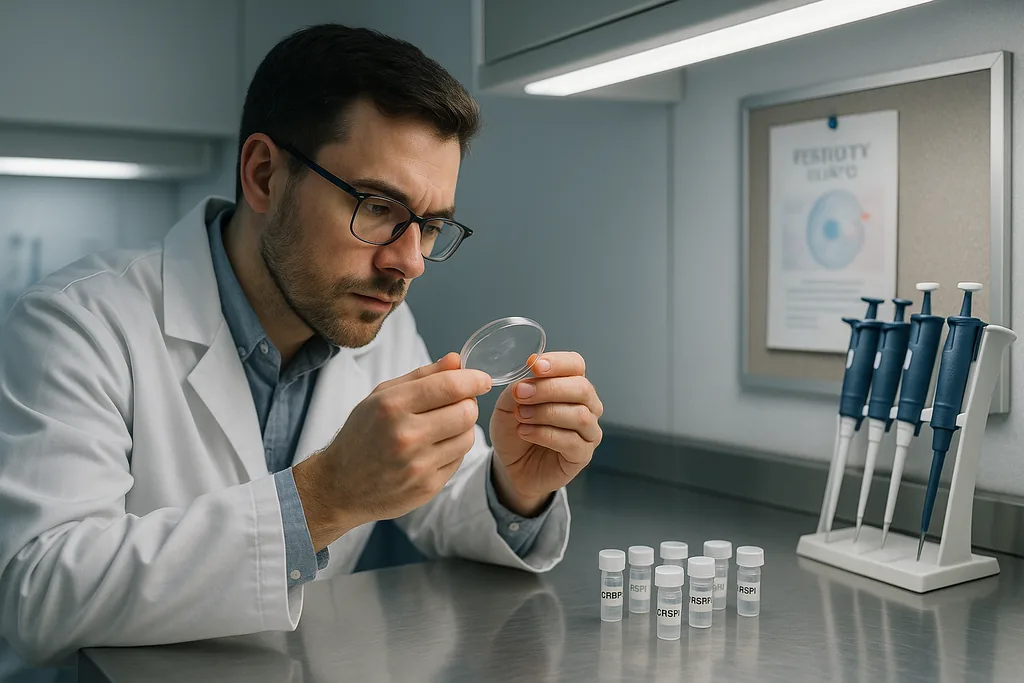
CRISPR, the clinic and the question at hand
Standing in the softly lit waiting room of a fertility clinic, parents talk in hushed tones about tests, options and the hope of healthy children — and behind the clinic's lab doors the same conversations take a molecular turn. The phrase crispr ethics ‘designer babies’ now threads through meetings that used to focus solely on preventing disease: could genetic editing of embryos be used not just to cure, but to choose traits? That question sits at the center of a debate that is scientific, moral and intensely practical.
crispr ethics ‘designer babies’: How the tool works and what it can do
CRISPR-Cas systems are a set of molecular tools adapted from bacteria that let scientists cut and, in many cases, rewrite short stretches of DNA with a level of precision and speed that was unimaginable a decade ago. In simple terms, researchers design a guiding RNA to take the Cas enzyme to a specific DNA address, cut it, and then rely on cellular repair processes — sometimes helped by supplied DNA templates — to alter the sequence.
That technical ability explains why discussion of designer babies is no longer purely science fiction: CRISPR can, in principle, remove or correct single-gene defects that cause disorders such as cystic fibrosis, Huntington's disease or severe forms of muscular dystrophy. When those edits are made in a patient's tissues, a process called somatic editing, they affect only that individual. When edits are made in eggs, sperm or very early embryos, they become part of the germline and can be inherited by future generations — which is the central concern behind the phrase crispr ethics ‘designer babies’.
The difference between therapy and enhancement is key. Most researchers draw a clear line between somatic therapies to treat or prevent serious disease and deliberate enhancement — editing to increase height, boost cognitive traits or change appearance. The technical possibilities are evolving rapidly; so are the conversations about whether and when those possibilities should be permitted.
crispr ethics ‘designer babies’: Risks, uncertainty and the He Jiankui precedent
Safety is the unavoidable practical question: is CRISPR safe for editing human embryos? The short answer from the scientific community is: not yet for clinical reproductive use. Two technical problems are central. First, CRISPR can produce off-target edits — cuts at unintended genomic locations — and those errors may have consequences years later, including an increased cancer risk or unexpected physiological effects. Second, edits made in early embryos can produce mosaic individuals in whom only some cells carry the change; mosaicism complicates both efficacy and safety assessments.
That record helps explain current practice. Clinical trials using CRISPR-based somatic therapies — for example, treatments for sickle cell disease and certain inherited retinal disorders — have moved forward because they edit only the treated person and follow careful safety protocols. Germline edits, which make heritable changes, remain tightly constrained by policy and law in many countries because the consequences would extend to descendants who cannot consent.
Regulation, social justice and the specter of enhancement
Ethical worries go beyond safety. Critics point to the danger of widening social inequality: if genetic enhancements ever move from the lab to the market, affluent families could secure biological advantages for their children, entrenching advantages across generations. The memory of 20th-century eugenics hangs over the debate and is invoked not as a literal repeat but as a cautionary lesson about how ideas of genetic 'improvement' can be twisted into coercive or discriminatory practices.
There is also a subtler pressure to consider: if a safe, effective edit could prevent severe disease, would parents feel morally compelled to choose it? That question reframes 'choice' as social expectation, and ethicists warn that the line between therapy and coercive enhancement can be porous in practice.
Paths forward: research, governance and public deliberation
Scientists, ethicists and policy-makers increasingly call for a tiered path forward: continue laboratory research to improve precision and understand long-term effects, expand public engagement and build international governance mechanisms that can respond to commercial pressures. New editing techniques such as base editing and prime editing promise fewer cuts and greater predictability than early CRISPR approaches, but they remain subject to many of the same ethical questions when applied to embryos.
What are designer babies and how does CRISPR enable them? In short: 'designer babies' is shorthand for embryos selected or altered to express particular traits. CRISPR and related technologies enable those options by making targeted changes to DNA, but the presence of a technical capability does not by itself resolve whether it should be used. The distinction between somatic and germline editing explains why many experts favour therapeutic uses that help an individual patient while opposing heritable modifications until safety, fairness and governance are settled.
Practical governance proposals range from national moratoria on reproductive germline editing to strengthened oversight of private-sector research and clearer advertising and clinical standards for fertility clinics. Many voices argue for international coordination because scientific research and commercial services can cross borders quickly; without shared norms, inconsistencies could create 'ethics havens' where risky practices move to permissive jurisdictions.
What this debate means for patients, parents and science
For families facing hereditary disease today, CRISPR already offers hope in the form of somatic therapies and improved embryo screening techniques that do not alter germline DNA. For society at large, the debate about crispr ethics ‘designer babies’ is a test case in how to balance innovation with caution. It asks whether the ability to change human heredity should be treated primarily as a medical tool to prevent suffering or as a new avenue for human enhancement that requires tight social limits.
The CRISPR era has made the hypothetical real. How society chooses to use that power will be one of the defining ethical and policy decisions of this generation, and the choices we make now will shape possibilities for decades to come.
Sources
- Nature (journal)
- University of California, Berkeley (Doudna laboratory research)
- National Institutes of Health (policy on heritable genome editing)
- Human Fertilisation and Embryology Authority (UK regulatory framework)
- Southern University of Science and Technology (He Jiankui research case)




Comments
No comments yet. Be the first!