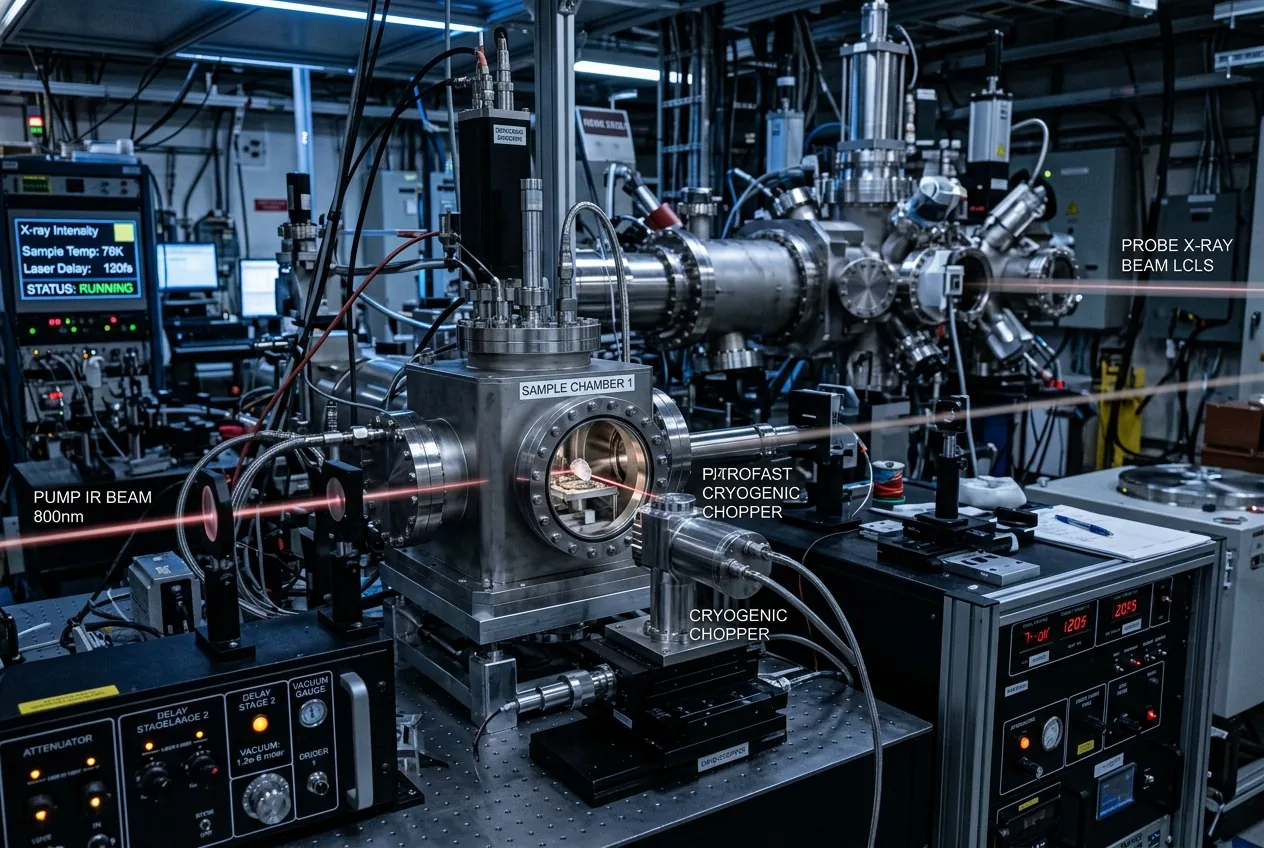
In a lab at the edge of what physicists call “no man’s land”, an infrared pulse melted a sliver of amorphous ice and, within nanoseconds, an X‑ray laser photographed a liquid that normally refuses to be seen. The experiment, led from Stockholm University and carried out at facilities in South Korea, reports direct evidence for a long‑suspected, deeply supercooled “critical point” where two different liquid forms of water merge. It is precisely this odd, ephemeral feature — which scientists have discovered “hidden” in water at roughly −63 °C and about 1,000 atmospheres — that researchers now argue sends ripples up to the water we drink and swim in every day.
The scene was simple and fragile: tiny samples of amorphous ice, a carefully timed melt, and an X‑ray pulse short enough that ice could not form before the detectors saw the liquid. Anders Nilsson, the Stockholm chemical physicist who co‑led the work, describes it as the only way to get a look at a state that otherwise crystallises before you can blink. The result is both satisfying and awkward for the community — satisfying because it supports a decades‑old theory, awkward because it opens far more questions than it closes about biology, climate models and planetary habitability.
Why this matters now
Water’s anomalies — maximum density at 4 °C, ice that floats, odd heat capacity and compressibility trends — have been textbook curiosities since the 19th century. The newly observed critical point provides a cohesive physical mechanism: under deep supercooling and high pressure water can exist as two structurally distinct liquids, which become indistinguishable at the critical point. Near that point the liquid is hypersensitive, producing fluctuations that the team argues leave an “echo” even at ambient conditions, and that echo may be the engine behind many of water’s life‑enabling quirks. For physicists and modelers this is a tidy resolution to a long argument; for everyone else it is an invitation to re‑examine assumptions about how water behaves in cells, oceans and icy moons.
How scientists have discovered “hidden” critical point with X‑ray lasers
The experiment is the technical headline. Researchers prepared amorphous (non‑crystalline) ice and compressed it to pressures on the order of 1,000 atmospheres. An infrared laser pulse melts a microscopic region of the sample; then, within time scales measured in nanoseconds to microseconds, the team hit the nascent liquid with ultrafast X‑ray pulses at PAL‑XFEL and POSTECH facilities in South Korea. Those pulses are fast enough to probe the structure before the sample reverts to ice.
Notably, the work is an international patchwork: Stockholm University led the analysis, POSTECH and PAL‑XFEL provided beamtime and instrumentation, and collaborators included researchers from the Max Planck Society and Johannes Gutenberg University. The result was published in Science and carries the kind of team list that reveals this is the sort of science you only do with large machines and coordinated facilities.
Why this “hidden” state echoes into everyday water
One of the paper’s striking claims is that the critical point’s influence is not confined to the extreme conditions where it sits. Close to a critical point, fluctuations become large and long‑ranged; the team argues that these fluctuations survive as an “echo” at higher temperatures and normal pressures, subtly biasing how hydrogen bonds form and break. That, in turn, can explain why water behaves so unlike its liquid cousins: the anomalous density curve, the high heat capacity and the unusual compressibility.
Physically, the picture is that water samples regions resembling either a low‑density networked structure or a more collapsed high‑density arrangement. At the critical point those distinctions wash out, generating slow dynamics and enhanced response functions. The researchers even report a dramatic slowdown of molecular motion as the system approaches that critical region, a behaviour they liken—colourfully—to getting trapped in a gravitational well.
Translating that into biology is tempting but delicate. The team highlights that water is the only fluid that is simultaneously supercritical under ambient life‑friendly conditions and displays these unique response properties. The implication — that water’s singular thermodynamic personality may have helped make life possible — is provocative. Yet it is a hypothesis that requires connecting molecular‑scale fluctuations to processes like protein folding, membrane stability and prebiotic chemistry, and that bridge is still under construction.
Sceptics, assumptions and the limits of a single experiment
The reception in the community has been broadly positive but cautious. Independent physicists applauded the experimental craftsmanship but raised two important caveats. First, measurements are so fast that they may not reflect a material in full thermodynamic equilibrium; the observed features could include kinetic artefacts from how the liquid was created and probed. Greg Kimmel (Pacific Northwest National Laboratory) and others have emphasised the need to vet whether the transient snapshots truly represent equilibrium states or fast, nonequilibrium dynamics.
Second, while computational studies had long predicted a liquid–liquid critical point, simulations and experiments operate on different timescales and system sizes. Nicolas Giovambattista, a simulation expert, called the observation “relief” but noted that mapping the phenomenon across methods is necessary. In short: elegant and convincing, but not yet a closed case.
Implications for climate, geology and habitability
Beyond pure physics the discovery has measurable implications. Climate and ocean models parameterise water’s thermodynamic properties; an improved microscopic understanding of why heat capacity and compressibility behave oddly may refine how models handle freezing, brine rejection and ice‑water interfaces. Geophysicists modelling pressurised water in the deep crust or in subglacial systems will want to know whether that “echo” modifies phase behaviour under more mundane but extended time scales.
Planetary scientists are already asking sharper questions. Icy moons and subsurface oceans — where pressure and temperature conditions can differ markedly from Earth’s surface — might be places where the low‑temperature critical behaviour plays a more direct role. If water’s structural versatility affects solute transport or the stability of organic molecules, it could shift assessments of habitability beyond Earth.
European infrastructure and the politics of big experiments
This kind of result underlines an obvious industrial‑policy point: modern condensed‑matter and chemical‑physics discovery depends on expensive, large‑scale facilities. The study lists Max Planck Society and Johannes Gutenberg University among collaborators, and the experiment itself was executed at an XFEL in South Korea. Europe has comparable hardware — European XFEL and multiple synchrotrons — but beamtime, coordination and funding remain scarce commodities.
From a German and EU perspective the lesson is twofold. First, partnerships (and occasional travel to the instruments that exist elsewhere) remain essential. Second, strategic investment in open‑access infrastructure and cross‑border training pays dividends in headline science. The discovery is a vindication of long‑term investment in facilities, but it also highlights that scientific capability is distributed: Stockholm’s brains, South Korea’s beams, and German modelling expertise all appear in the byline.
And yes, that means policy and paperwork matter almost as much as the lasers — a truth that annoys scientists and delights auditors in equal measure.
What comes next — experiments, models, and the life question
Practical next steps are straightforward: reproduce the observation with different sample preparations and pulse sequences, extend the parameter map, and coordinate careful modelling that includes nonequilibrium effects. Biophysicists will want focused studies on how the identified structural fluctuations affect hydration shells around proteins and the energetics of folding. Planetary chemists will ask whether the critical behaviour can shift solubility and transport in cold, pressurised environments relevant to Europa or Enceladus.
Crucially, the rhetorical leap from “this physics exists” to “this physics enabled life” is attractive but premature. The team’s suggestion that water’s uniqueness may have been an ingredient in life’s origin is a hypothesis worth probing; it is not yet a demonstrated causal chain. That distinction is important for a measured research programme rather than speculative headlines.
For now, the community has a satisfying tangle: a decades‑old theoretical picture confirmed in flash, and an invitation to reframe open problems in chemistry, biology and Earth science. Researchers who study everyday water will not throw away their textbooks — they will, at minimum, rewrite the fine print.
Europe has the instruments; Brussels has the grant forms; and nature, as usual, keeps the punchline for itself.
Sources
- Science (journal: "Experimental evidence of a liquid–liquid critical point in supercooled water")
- Stockholm University press materials and researcher statements
- Pohang Accelerator Laboratory (PAL‑XFEL) and POSTECH University experimental facilities
- Max Planck Society
- Johannes Gutenberg University




Comments
No comments yet. Be the first!