
Blue Origin's TerraWave: How Laser-Powered Satellite Links Aim to Challenge Starlink
In a move that signals a significant shift in the landscape of orbital telecommunications, Blue Origin has unveiled TerraWave, a sophisticated satellite communications network designed to revolutionize global data transfer. Unlike existing infrastructures that rely primarily on radio frequency (RF) spectrums, TerraWave is engineered to utilize advanced optical laser links to provide symmetrical high-speed data. This development, announced in early 2026, marks the transition of Jeff Bezos’s aerospace firm from experimental orbital logistics to a primary player in the commercial-scale satellite internet market. By promising parity between upload and download speeds, TerraWave aims to address the growing demand for high-bandwidth, low-latency connectivity that terrestrial fiber-optics currently dominate.
The genesis of TerraWave lies in the increasing congestion of the traditional radio frequency bands. As more constellations occupy Low Earth Orbit (LEO), the competition for spectrum allocation has become a regulatory and technical bottleneck. Blue Origin’s research into optical communications was driven by the necessity to bypass these limitations. While radio waves are prone to interference and limited by the available bandwidth within assigned frequencies, laser communication—or free-space optical communication (FSOC)—offers a virtually untapped spectrum with the potential for data rates several orders of magnitude higher than current RF standards. The project represents a culmination of years of internal development within Blue Origin’s Advanced Development Programs, aiming to provide a robust, high-capacity backbone for the next generation of the digital economy.
The Science of Optical Laser Communication
At the core of TerraWave’s technical superiority is the physics of light-based data transmission. Traditional satellites use microwaves to transmit data; however, lasers operate at much higher frequencies. In the vacuum of space, these optical signals can travel vast distances with minimal attenuation, allowing for the transmission of massive datasets at the speed of light. Because the wavelength of a laser is significantly shorter than that of a radio wave, the data can be packed more densely, leading to the "game-changing" speeds cited by the company. Furthermore, the narrow beam divergence of lasers ensures that the energy is concentrated directly on the receiving terminal, which not only increases efficiency but also enhances security by making the signal extremely difficult to intercept without physical obstruction.
Despite the advantages in the vacuum of space, the primary challenge for TerraWave remains atmospheric interference. When a laser pulse enters the Earth's atmosphere, it encounters moisture, dust, and turbulence that can scatter the light and degrade the signal. To mitigate this, Blue Origin has integrated sophisticated adaptive optics into their ground stations. These systems use deformable mirrors that adjust in real-time to compensate for atmospheric distortion, ensuring a stable link between the satellite and the Earth. This "laser-first" approach allows TerraWave to maintain high throughput even in less-than-ideal weather conditions, a hurdle that has historically relegated optical communication to a secondary, "backhaul-only" role in satellite networks.
Symmetrical Connectivity and Market Positioning
One of the most distinctive features of the TerraWave network is its focus on symmetrical data speeds. In the current consumer satellite market, services are typically asynchronous, offering high download speeds but significantly lower upload capabilities. This model is sufficient for traditional media consumption but falls short for modern enterprise requirements, such as real-time cloud computing, large-scale AI model training, and high-definition telepresence. TerraWave’s architecture is designed to handle bi-directional data flow with equal efficiency. This makes the service particularly attractive to the enterprise sector, research institutions, and government agencies that require the ability to send as much data as they receive.
- Symmetrical Throughput: Parity between upload and download speeds for enterprise-grade performance.
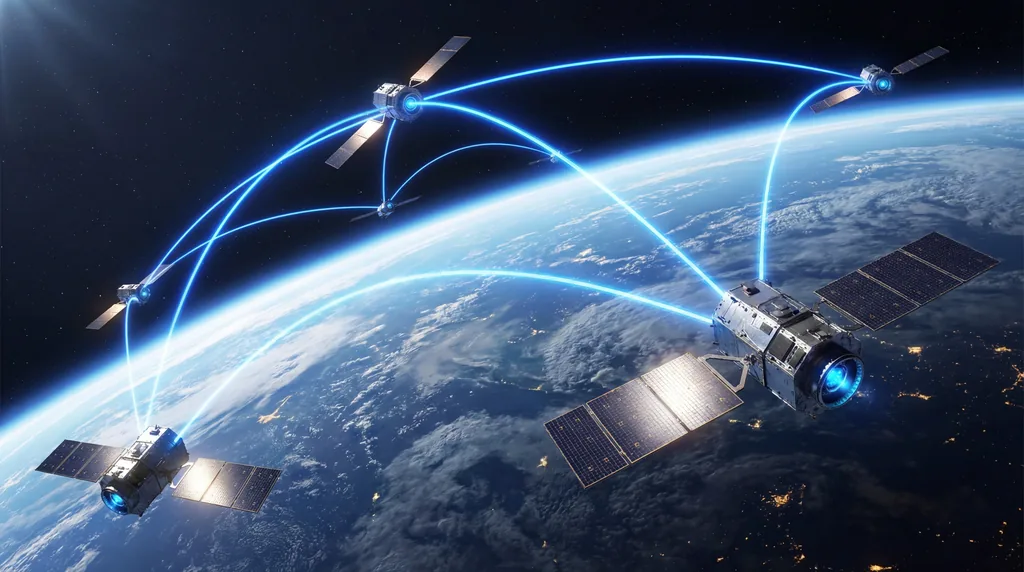
- Reduced Latency: Optical inter-satellite links (ISLs) allow data to bypass terrestrial bottlenecks, routing information through the vacuum of space.
- Enhanced Security: Narrow-beam laser technology minimizes the risk of signal jamming and unauthorized interception.
Strategic Competition: Blue Origin vs. SpaceX
The unveiling of TerraWave sets the stage for an intensified rivalry between Jeff Bezos’s Blue Origin and Elon Musk’s SpaceX. While SpaceX’s Starlink has already established a dominant market position with thousands of satellites in orbit, Blue Origin is betting on a "quality over quantity" strategy. Starlink began its deployment using traditional RF links and has only recently begun integrating laser inter-satellite links into its newer generations. In contrast, TerraWave is being built from the ground up as an optical-native network. This strategic choice may allow Blue Origin to capture high-value enterprise contracts that require the specific performance characteristics of a laser-first infrastructure.
The competition between these two aerospace giants is expected to accelerate global connectivity standards. As TerraWave enters the market, the pressure on existing providers to upgrade their hardware will likely lead to a broader adoption of optical standards across the industry. Industry analysts suggest that while Starlink may maintain its lead in the residential consumer market due to its head start and lower-cost user terminals, TerraWave is positioning itself as the "premium" alternative, focusing on the high-reliability needs of international corporations and critical infrastructure providers.
Infrastructure and the Role of New Glenn
The deployment of the TerraWave constellation is intrinsically linked to the operational success of Blue Origin’s New Glenn heavy-lift launch vehicle. With its seven-meter fairing and massive payload capacity, New Glenn is designed to carry dozens of TerraWave satellites in a single mission. This logistical advantage is crucial for the rapid scaling of the network. Blue Origin has indicated that the first dedicated TerraWave launches are scheduled to begin following the final qualification flights of New Glenn, with a phased rollout that will initially target high-latitude regions before expanding to full global coverage.
Integration with Blue Origin’s existing orbital logistics, including the Blue Ring spacecraft platform, will further enhance the network's capabilities. Blue Ring can serve as a multi-mission "tug," positioning TerraWave satellites into precise orbits and providing additional power and thermal management. This synergy between launch, transport, and communication hardware allows Blue Origin to control the entire value chain of the satellite’s lifecycle, potentially reducing the long-term operational costs of the constellation despite the high initial complexity of the laser systems.
Analyzing the Impact on Global Internet Standards
If successful, TerraWave could bring satellite internet speeds into direct competition with terrestrial fiber-optics. For many remote areas, the cost of laying physical fiber is prohibitive; TerraWave offers a "fiber-in-the-sky" alternative that could bridge the digital divide for high-stakes industries like remote mining, maritime logistics, and scientific research in Antarctica. Furthermore, the use of laser inter-satellite links enables data to be routed internationally without passing through multiple ground-based exchange points, potentially reducing the latency of transcontinental data transfers—a factor of immense value to high-frequency trading and global financial markets.
However, the path forward is not without regulatory and environmental hurdles. The deployment of another massive constellation raises concerns regarding space debris and the long-term sustainability of Low Earth Orbit. Blue Origin will need to navigate complex international regulations regarding spectrum use and orbital slot allocation, even if their use of lasers reduces traditional RF interference. Additionally, the company must demonstrate that their laser terminals can be manufactured at a scale and cost that allows for a sustainable business model in an increasingly crowded market.
Future Directions: What’s Next for TerraWave?
As Blue Origin moves toward the first launch milestones for TerraWave, the focus will shift from hardware development to network optimization. Future iterations of the satellites are expected to incorporate quantum key distribution (QKD) to provide "unhackable" encryption, further solidifying the network’s appeal to the defense and intelligence communities. The company is also exploring the potential for TerraWave to provide lunar-to-Earth communications, supporting NASA’s Artemis program and Blue Origin’s own ambitions for a sustained human presence on the Moon.
In the coming years, the success of TerraWave will be measured by its ability to deliver on the promise of symmetrical, fiber-like speeds from orbit. As the first batch of satellites reaches operational status, the world will see whether laser-powered links can truly redefine the standards of global connectivity. For now, TerraWave stands as a bold assertion of Blue Origin’s technological capabilities and a clear signal that the race for the next generation of the internet will be won with light.





Comments
No comments yet. Be the first!