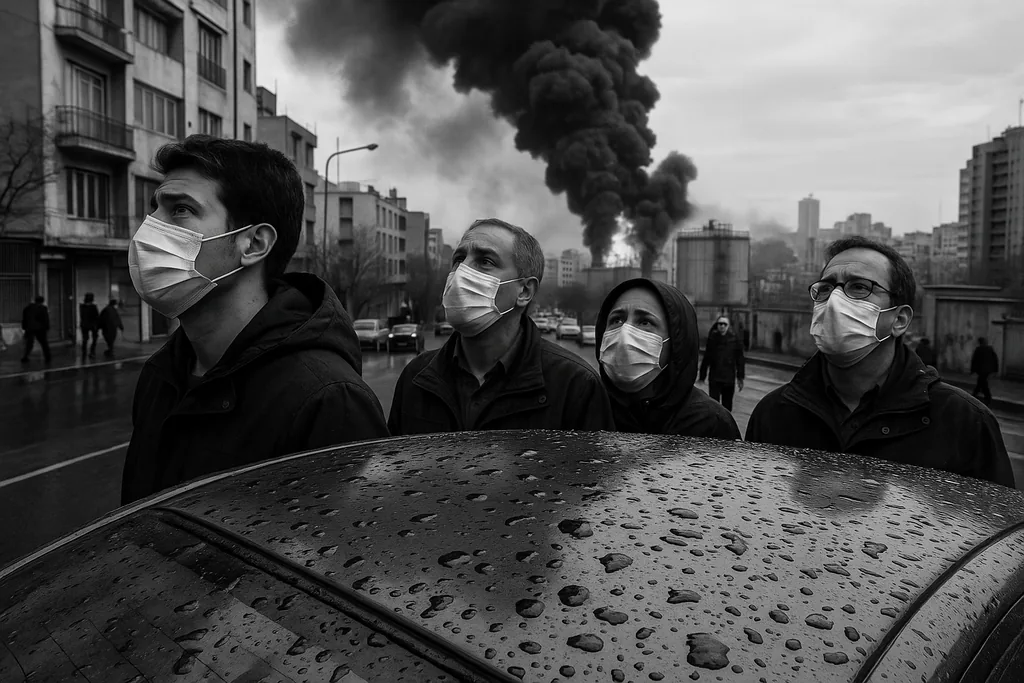
Black rain and a city under a toxic plume
On 13 March 2026, residents of Tehran reported dark, oily droplets falling from the sky after nighttime strikes on nearby oil storage and processing facilities. That immediate visual — rain blackened by soot and industrial residues — captures what environmental scientists are calling the visible tip of a much larger public-health problem: the environmental health cost Iran must now reckon with. The phenomenon is not only aesthetic; it encodes the movement of gases, particulates and trace chemicals produced by burning oil, collapsing infrastructure and exploding munitions into the air people breathe and the soils and water that sustain communities.
Atmospheric scientists and observers on the ground describe a pollution cocktail: soot and black carbon, carbon monoxide, sulphur dioxide, nitrogen oxides, volatile organic compounds, polycyclic aromatic hydrocarbons (PAHs), and trace metals. When those combustion products mix with moisture they can form acidic droplets — sulfuric or nitric acids — and fall as 'black rain' that stings the skin and coats surfaces. Meteorological factors specific to Tehran, including nocturnal boundary-layer inversion that traps pollutants near the ground, made exposure in a densely populated basin much worse than typical industrial fires.
That acute cloud of exposure matters for the short term — coughing, asthma exacerbations, and chemical irritation — but it also deposits a suite of contaminants on roofs, streets and into soils and drainage systems. Those deposits create pathways into groundwater and the food chain and can be re-suspended later as dust, extending health risks to months or years after the bombs stop.
environmental health cost iran: airborne exposures and respiratory risks
Air quality deteriorates immediately during episodes like the Tehran attacks. Fine particles (PM2.5 and PM10) and black carbon penetrate deep into lungs, aggravating asthma, chronic obstructive pulmonary disease, cardiovascular disease and increasing short-term mortality in vulnerable groups such as the elderly and children. The mixture of gases described by local and technical observers — carbon monoxide, sulphur dioxide and nitrogen oxides — can cause acute respiratory distress and, when combined with water vapour, contribute to corrosive, acidic precipitation.
Combustion byproducts also carry carcinogens and mutagens. PAHs, furans and dioxins can form under conditions present in burning oil and industrial fires; these compounds persist on surfaces and soils and bioaccumulate in the food chain. Epidemiologists track some disease endpoints, like cancer, over decades; without systematic exposure monitoring and long-term health surveillance in Tehran, linking specific increases to this episode will be difficult. That gap is familiar from past conflicts: monitoring systems collapse, populations are displaced, and the long latency of some diseases means the human toll can be invisible for generations.
Public-health messaging should prioritize reducing immediate inhalation exposures: masks that filter particulate matter, staying indoors with filtered air where feasible, and clear warnings for people with respiratory conditions. But messaging alone cannot control the invisible legacy lodged in soil and water.
environmental health cost iran: water, soil and the food chain
When pollutants are rained out, they do not disappear. Acidic and particle-bound contaminants wash into street drains, collect in sediments, and infiltrate soils where they can persist or be taken up by crops. Trace metals deposited in urban and peri-urban soils may be mobilised by changing pH or by agricultural practices, migrating into groundwater systems that supply drinking water or irrigation. Over the coming months, dry seasons and dust events could re-distribute that contamination, turning a localized deposit into a regional public-health and ecological issue.
The most immediate water risks are contamination of surface water and shallow aquifers; over time, persistent organic pollutants like PAHs, furans and dioxins can accumulate in sediments and biota. That magnifies exposure for people who rely on local produce, milk and fish. Remediation — from removing contaminated soil to treating water supplies — is technically possible but expensive, logistically complex and requires transparency and access for independent assessment teams. Without early, coordinated sampling and measurement, authorities cannot prioritise action or quantify long-term risks to food safety and water security.
Health consequences now and decades on
There are two overlapping categories of harm: acute and chronic. Acute harms are visible and immediate — respiratory distress, eye and skin irritation, spikes in hospital admissions for asthma and cardiac events. These are reported quickly and are often the focus of emergency responses. Chronic harms are slower and harder to link to a single episode: increased risks of cancers associated with long-term exposure to PAHs and dioxins, neurodevelopmental effects from heavy metals, and persistent deficits in community health that compound poverty and displacement.
The difficulty in quantifying long-term outcomes is methodological and practical. To show a causal relationship between an episode of conflict pollution and a later rise in cancer requires baseline environmental and health surveillance, consistent registries, and the ability to follow populations over decades. In many conflict-affected settings — and that includes the scenario unfolding around Tehran — monitoring networks are disrupted, and political or logistical barriers can prevent independent investigators and international bodies from undertaking the sampling necessary to establish exposure histories.
That lack of data is itself an environmental health cost: without measurements you cannot model exposure, prioritise clean-up, or seek restitution. It also means that affected communities may carry the burden of contamination for years without recognition or support.
Monitoring, politics and the cost of remediation
Experts warn that two immediate priorities are missing in many conflict zones: transparent assessment and dedicated funds for environmental recovery. Organisations that specialise in conflict-related environmental damage emphasise the need for timely on-the-ground sampling of air, water, soil and biota; for satellite and remote-sensing work to map plumes and depositions; and for rapid sharing of data. Those tasks are straightforward technically but are hampered by security concerns and political reluctance to admit or quantify damage.
Another layer is the broader environmental footprint of militaries. Independent analyses have estimated that military activities contribute substantially to global greenhouse-gas emissions — a reminder that the environmental costs of conflict extend beyond immediate contamination to long-term climate impacts. In the short term, however, the expensive, technically demanding task is remediation: removing contaminated soils, treating polluted water, and rebuilding monitoring capacity. That requires money and expertise that may be hard to mobilise if international partners are unwilling or if access to affected sites is restricted.
Practical steps that can be taken now include expanding remote sensing to track atmospheric plumes, establishing sentinel monitoring stations in safer perimeters, and preparing plans for targeted sampling once access improves. International agencies such as the United Nations Environment Programme have methods for post-conflict environmental assessment; their involvement can help standardise data collection and prioritise interventions, but only if they are allowed on the ground and resourced to act.
For Tehran’s residents, the visible 'black rain' is a warning signal. It signals acute exposure, the deposit of persistent contaminants and a policy challenge: without early action to measure and remediate, environmental harms will become health burdens that last well beyond the fighting. The environmental health cost Iran faces is therefore not only measured in tonnes of black soot or pH readings of rainwater, but in human years of illness, lost productivity and the expense of remediation — costs paid out over decades unless addressed quickly and transparently.
Sources
The reporting and analysis in this article draw on interviews and technical commentary carried out with environmental observers monitoring the Iran strikes and the established scientific literature on combustion products, conflict pollution and environmental health. The institutions listed below provide the datasets, assessment frameworks and research that underpin understanding of contamination, exposure pathways and remediation challenges.
- Conflict and Environment Observatory (analysis of conflict-related pollution)
- United Nations Environment Programme (post-conflict environmental assessment frameworks)
- Scientists for Global Responsibility (work on military emissions and environmental footprint)
- University of Pennsylvania (genomics and population studies cited for comparative methodological context)




Comments
No comments yet. Be the first!