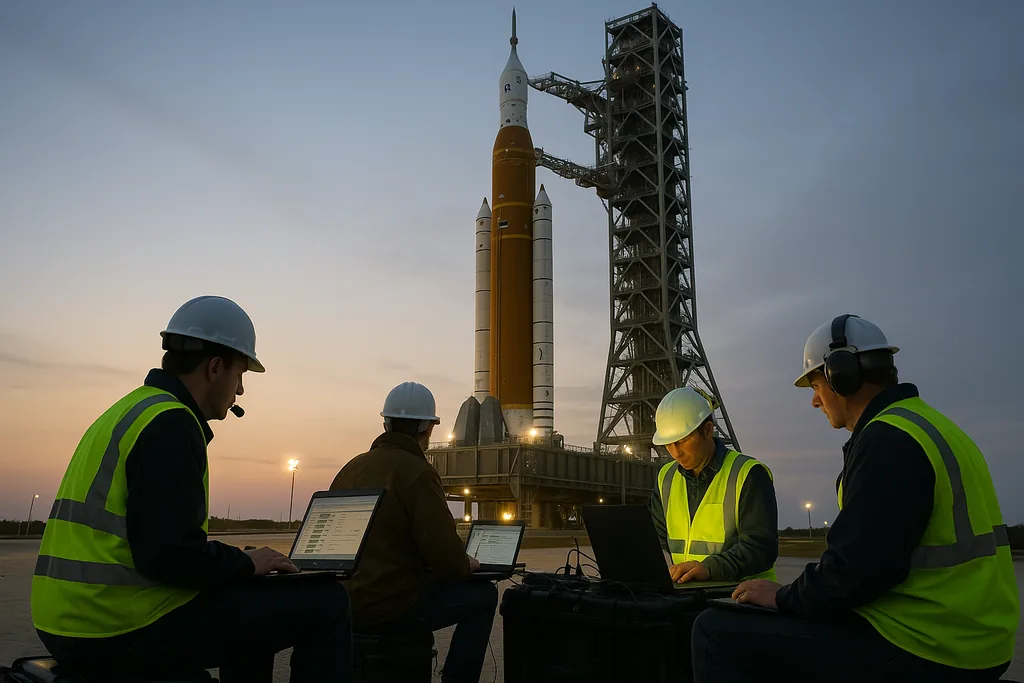
Liftoff tension at Launch Complex 39B
Technicians have completed final processing on the Space Launch System and the Orion crew capsule as NASA counts down to an early February 2026 launch window for Artemis II. The mission will carry four astronauts on a roughly 10‑day flight that loops around the Moon and back — a route designed less to visit the surface than to push hardware, procedures and people into the deep‑space regime that a landing will demand. For engineers and mission planners, Artemis II is a concentrated systems test: it must prove that the rocket, capsule and operations teams can do the hard things required before anyone sets boots down on the lunar surface again.
Mission profile and records on the line
Artemis II will be the first crewed flight of the SLS rocket and Orion capsule. The mission is set to borrow the Apollo-era strategy of a lunar flyby rather than a landing: the spacecraft will be sent on a free‑return trajectory that carries it around the far side of the Moon and back to Earth. When it reaches its apogee the crewed Orion will travel farther from Earth than any humans have gone before, potentially tens of thousands of kilometres beyond the lunar far side, and will return at speeds near 25,000 mph — making it one of the fastest crewed re‑entries in history.
The mission is also notable for its duration. At about ten days, Artemis II will be the longest crewed flight test in history and an important rehearsal of extended deep‑space human operations: life support, communications, navigation and crew procedures must all function reliably over multiple days of radiation exposure, thermal cycling and communications delays.
Hardware changes and the tests they carry
Data gathered during Artemis I informed a series of engineering tweaks to SLS and Orion. NASA engineers have repositioned antennas for stronger communications, re‑angled booster separation motors to increase clearance during staging, and added aerodynamic strakes to the intertank to smooth a vibration mode that appeared unexpectedly on the previous flight. The upgraded navigation system will be pressed into service during Artemis II, validating guidance performance during injection, mid‑course corrections and the precision timing needed for the lunar flyby.
Beyond software and sensors, Artemis II will test the interfaces between major contractors and subsystems under real flight stress: the core stage, twin solid rocket boosters, upper stage, and the Orion service module must all work together through staging, engine burns and deployment events. These are not incremental checks; they are full‑mission demonstrations of hardware and choreography that a landing mission will reuse.
Orion systems and the heat‑shield dispute
One of the most closely watched elements on Artemis II is Orion's heat shield. During Artemis I the heat shield experienced more char and some material loss than engineers expected. Analysis traced the problem to low permeability in certain protective layers that allowed trapped gases to build up and lead to spalling during the intense reentry heating. NASA says it has incorporated lessons learned into the Artemis II vehicle and plans a reentry corridor tailored to Orion's characteristics. That approach — altering entry trajectory to reduce peak stress — is part of the mission plan.
Not everyone agrees the fixes are sufficient. A number of retired engineers and a former astronaut who specialises in thermal protection have publicly criticised NASA's approach and warned that changing the reentry plan to compensate for a less‑permeable shield increases complexity and risk. The dispute underscores why Artemis II matters: only a crewed flight will put the heat‑shield behaviour, reentry guidance and emergency response procedures through the real thermal and structural environment they must survive.
Crew tasks, science and human factors
The Artemis II crew — Reid Wiseman (commander), Victor Glover (pilot), Christina Hammock Koch and Canadian astronaut Jeremy Hansen (mission specialist) — will have a packed agenda that mixes systems checks with scientific observation. They will exercise Orion's life‑support, avionics and communications systems under load, run crew procedures for anomalies, and perform photography and mapping of lunar terrain. NASA has scheduled a full day for far‑side observations, including regions such as Mare Orientale and the South Pole‑Aitken Basin that have seen limited in‑situ human inspection.
From a human factors perspective, the mission will also validate crew routines for longer trans‑lunar flights and test data flows between the spacecraft and ground teams. The astronauts will carry high‑quality imaging hardware to capture 4K video and high‑resolution stills of Earthrise and lunar features — both to return science data and to exercise on‑board telemetry and file handling for large scientific payloads on future missions.
Trajectory design and emergency return capability
A central safety feature of Artemis II is the lunar free‑return trajectory. In orbital mechanics terms, that means the spacecraft is placed on a path where the Moon's gravity does a large portion of the work to bring the vehicle back toward Earth if the main engine cannot perform a required burn. The free‑return design reduces reliance on propulsion in the most dangerous phases: should the upper stage or service module be unable to execute a planned burn, gravity will guide Orion back home without a major powered correction.
That reserve mode does not eliminate risk — crew survival still depends on life support, communications and the ability of the reentry system to withstand heating — but it buys mission planners critical time and options when things go wrong. Artemis II will exercise those options in a live flight environment for the first time since Apollo.
Path to a landing: schedule, contractors and geopolitics
Artemis II is a proving ground for the next step: Artemis III, the mission that NASA hopes will return astronauts to the lunar surface. Artemis III depends on a crewed lunar lander system that is not part of Artemis II; NASA selected a Starship‑based Human Landing System in 2021, but progress on that vehicle and on its orbital refuelling operations has been uneven. That has prompted agency officials to say they will keep options open for the landing architecture.
Experts caution that swapping contractors or architectures is not a simple acceleration strategy. Building, testing and certifying a human landing system — and the associated refuelling and operational infrastructure — normally requires multiple uncrewed demonstrations and a runway measured in years, not months. Some analysts now say a landing timeline in the mid‑2020s faces real schedule risk; either way, Artemis II is non‑negotiable: it must validate crewed operations, navigation and reentry performance before any surface attempt.
Why Artemis II matters beyond a single mission
At first look Artemis II is an orbiting dress rehearsal. Under the surface, it is the interface test between a modern launch stack and the realities of sustained human exploration: networks, crew health over longer deep‑space flights, thermal protection under unanticipated material behaviour, and the choreography of multiple commercial and government partners. If the mission succeeds, it reduces a long list of technical unknowns and gives NASA and its partners confidence to press on to a crewed landing. If it uncovers new problems, the agency will have hard, flight‑grade data to guide fixes.
Either way, the mission will determine whether the Artemis program can move from demonstration to delivery. For the crew and for the engineers on the ground, Artemis II is the first time in more than half a century that humans will again test their hardware and themselves so far from home — and the outcome will shape plans for the Moon, and eventually Mars, for years to come.




Comments
No comments yet. Be the first!