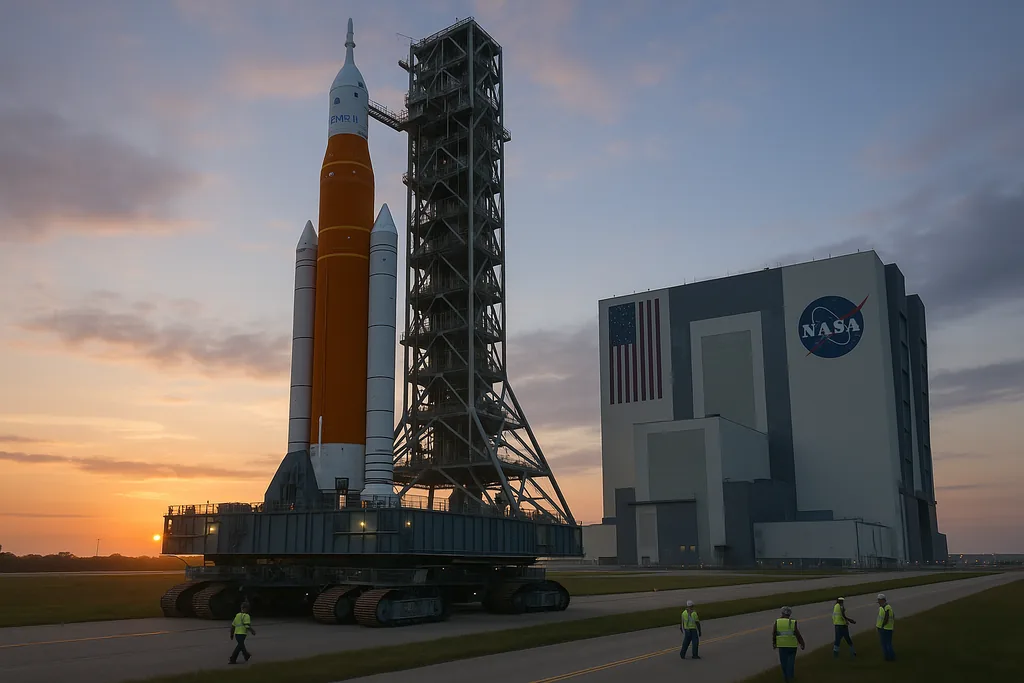
Rollout at Kennedy Space Center
At first light on Saturday, January 17, 2026, a 322-foot tower of fuel tanks, boosters and a crew capsule eased out of the Vehicle Assembly Building at NASA’s Kennedy Space Center and began a daylong, four-mile crawl toward Launch Complex 39B. The Space Launch System (SLS) rocket stacked with the Orion spacecraft and carried on the Mobile Launcher was hauled by crawler-transporter 2 at a walking pace — the carefully staged migration that moves the integrated vehicle from assembly to pad for final tests and fueling rehearsals. By 6:42 p.m. Eastern, the stack had reached the pad, where technicians will connect ground services and prepare for a wet dress rehearsal ahead of the mission’s early-February launch window.
The machine and the mechanics
The rollout is as much a test of infrastructure as it is of hardware. The entire stack—commonly described as an 11-million-pound vehicle—rides on a 40-foot-tall mobile launch platform and a pair of crawler transporters first built in the Apollo era and refurbished for modern use. The diesel-electric propulsion system on crawler-transporter 2 feeds 16 traction motors through high-capacity generators; those upgrades and the crawler’s jacking and leveling systems are what let teams move the 11-million-pound load without tilting the rocket or overstressing its connections. Engineers typically plan the move to take up to 12 hours because the vehicle must negotiate turns, a gentle incline up the crawlerway and strict weather and safety limits.
Systems, checks and the wet dress rehearsal
Arrival at the pad is a milestone, not a finish line. In the coming days NASA teams will hook up ground support equipment, run diagnostic checks and stage the wet dress rehearsal — a full sequence of operations that includes loading propellant into the rocket’s core stage and practicing countdown procedures without launching. NASA has published specific rollout weather constraints that drive these decisions: if lightning probability within 20 nautical miles is greater than 10 percent, if hail probability exceeds 5 percent, if sustained winds exceed 40 knots (peak 45), or if temperatures fall below 40 °F or exceed 95 °F at the pad, teams will delay movement or tests. The wet dress rehearsal is scheduled toward the end of January, after which flight readiness reviews will determine whether the February 6 launch window remains viable.
Who will fly and what they will do
Artemis II will be the first crewed flight of the Artemis programme: a roughly 10-day mission that will carry four astronauts on a free-return trajectory around the Moon and back to Earth. The crew roster announced for the mission includes Commander Reid Wiseman, Pilot Victor Glover, Mission Specialist Christina Koch (all from NASA) and Canadian Space Agency astronaut Jeremy Hansen. The flight will test Orion’s life-support systems, crew interfaces and communications at distances farther from Earth than any humans have travelled since Apollo. The mission does not plan a lunar landing; instead it is intended as a full-system dress rehearsal with people aboard to validate operations for later landing missions.
Delays, fixes and the program timeline
Artemis II’s path to this moment has included technical pauses and troubleshooting. Following the uncrewed Artemis I flight and later integration work, teams have addressed issues in Orion and ground systems, including leak checks and adapter fittings. NASA has emphasised that meeting the early-February launch window depends on successful completion of the wet dress rehearsal and follow-on readiness reviews; if deficiencies are found teams are prepared to roll the stack back to the VAB for corrective work. Program managers have repeatedly said safety and system readiness, not calendar pressure, will decide the schedule.
Heritage and engineering constraints
Moving Apollo-era ideas into the 21st century is one of Artemis’s defining engineering challenges. The crawler-transporters that carry rockets to Launch Complex 39 were designed and built decades ago but have been upgraded in phases to meet new torque, power and control demands. The mobile launcher tower, ground support systems and pad structures at 39B have likewise been reinforced and instrumented for modern megarockets. Those updates are not purely cosmetic: a heavier or taller stack changes center-of-gravity concerns, electrical loads and thermal margins, and NASA’s teams run detailed analyses before every rollout.
Public spectacle and programme optics
Rollouts are also moments of public theatre. Tens of thousands of Americans watched images and live streams as the rocket made its slow procession, and photo galleries from local outlets around Florida preserved both the engineering detail and the crowd scenes. For NASA, Artemis II is both a technical milestone and a visible symbol of the agency’s return to crewed deep-space missions. The coming weeks will show whether the campaign’s schedule tightness — with an early-February window and only a limited number of launch opportunities before orbital mechanics shift — can be met without cutting corners.
The road ahead at the pad
Assuming the wet dress rehearsal validates propellant loading, tanking procedures and pad safety systems, mission managers will hold a flight readiness review and set a specific launch date inside the open window that begins February 6. If the team needs more time, planners have indicated March or April opportunities are feasible. Beyond the date, the immediate checklist includes final avionics checks, service-bay hookups, and astronaut rehearsals for ingress and emergency egress. If all goes well, Artemis II will carry people farther from Earth than anyone since the Apollo era and provide the operational data essential for Artemis III, which aims to land astronauts on the lunar surface in future cycles.
In short, Saturday’s crawl moved the hardware into position for the most consequential test flight of the Artemis era so far. The image of a new-generation lunar stack leaving the VAB and taking up residence at pad 39B will be quoted in program histories for years; the technical work now shifts into the rhythm of tanking tests, system verifications and a careful chronicle of checks that will decide whether the mission flies in February.
Sources
- NASA (Artemis II mission and Kennedy Space Center blog posts)
- Kennedy Space Center (Vehicle Assembly Building and launch complex documentation)
- Canadian Space Agency (crew/mission participation)




Comments
No comments yet. Be the first!