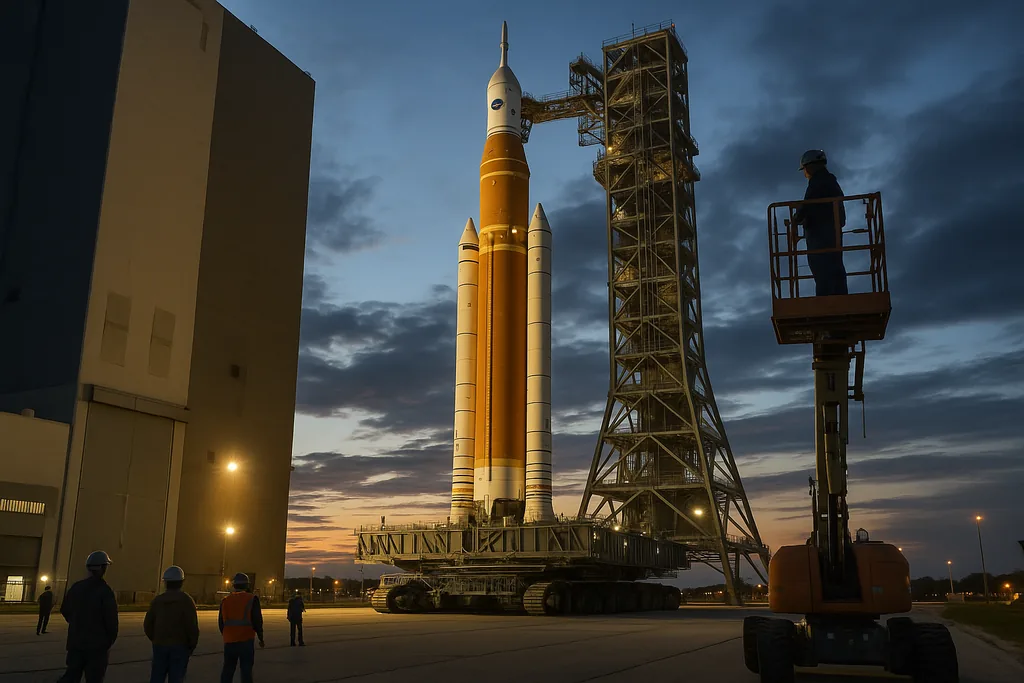
NASA is now pointing at early April for Artemis II, and the agency has named April 1 as the first of several launch opportunities — a target that has journalists and enthusiasts asking whether the artemis start first april will stick. The flight, the first crewed mission beyond low Earth orbit in more than 50 years, was rolled back to the Vehicle Assembly Building (VAB) in late February after engineers found an interruption in helium flow to the rocket's Interim Cryogenic Propulsion Stage. Repair work inside the VAB, extra hardware checks and a wet dress rehearsal to tank the rocket will determine whether the programme can preserve the April 1–6 launch window or must push to later opportunities.
artemis start first april repairs and rollout
Engineers diagnosed the February problem as an obstruction or seal issue in a quick-disconnect or a failed check valve that interrupted helium flow into the ICPS (the SLS upper stage). Because those interfaces are high on the rocket and inaccessible at the pad, NASA rolled the fully integrated SLS and Orion stack back to the VAB on Feb. 25 to remove and inspect the suspect components. While teams work inside the VAB they'll also replace several batteries and seals, recharge or swap items that have timed out during the delay, and revalidate systems that can only be reached there.
Agency briefings and technical updates make clear the schedule is tight. NASA officials described the plan as "aggressive": there needs to be enough time after repairs to roll the stack back out to Launch Complex 39B, connect pad systems, power up integrated hardware and carry out a wet dress rehearsal — the full tanking and countdown rehearsal that mimics launch operations without crew aboard. In practical terms, sources inside the programme have said that if teams can complete the VAB work and a week or so of pad prep, the April 1 launch opportunity remains within reach; otherwise the next meaningful window opens at the end of April.
The work in the VAB is not purely reactive. NASA is taking the chance to swap flight termination system batteries, refresh other launch batteries, re-test closeout procedures for the ground crew and verify seals on liquid-oxygen (LOX) lines. Engineers will validate any procedural changes as well as hardware fixes so the cause of the helium interruption does not recur during rollout or pad operations.
artemis start first april window: schedule, constraints and the wet dress
The Artemis II launch opportunities are not arbitrary calendar dates; they flow directly from celestial mechanics and mission constraints. Mission planners design windows so Orion's trans-lunar injection burn places the spacecraft on the correct free-return trajectory, ensures acceptable lighting for the solar arrays and keeps the capsule's thermal and re-entry profiles within safe envelopes. Those constraints produce a repeating rhythm of roughly one week of possible launch days followed by about three weeks without viable opportunities.
NASA currently lists three launch periods that were analyzed up through April: late January–mid February (with candidate dates in early February), late February–mid March, and late March–early April. The early-April period contains launch opportunities on April 1, 3, 4, 5 and 6, and Ars Technica reported NASA’s two-hour window on April 1 opens at 6:24 p.m. EDT (22:24 UTC). Whether the mission can use those dates depends on the success of repairs, the outcome of the wet dress rehearsal (tanking test) and range scheduling, plus weather and logistical constraints for commodities and recovery forces.
A wet dress rehearsal is the single most consequential prelaunch test in the schedule. It demonstrates the ability to load and drain almost three-quarters of a million gallons of cryogens, exercise countdown holds and recycles, and rehearse closeout and abort procedures without the crew. If the wet dress identifies additional problems, NASA can either fix them at the pad or rollback to the VAB for deeper troubleshooting — actions that would almost certainly move Artemis II beyond the first-April week.
Technical fixes inside the Vehicle Assembly Building
Work in the VAB also includes replacing seals on LOX feed lines and refreshing items that “time out” when the vehicle sits for weeks. Flight termination system batteries and other flight batteries will be swapped and retested. Teams will also practice closeout sequencing and verify the procedures intended to limit trapped gases around Orion’s hatches — a small but important set of checks for crew safety during the final minutes before launch.
SpaceNews and NASA briefings indicate engineers plan both hardware changes and procedural updates: removing a faulty seal is only the start; the team will also try to harden operations so the same class of failure does not recur on future missions. That combination of hardware replacement and operations tuning is common in new rocket programmes, but it means dates remain conditional rather than fixed.
Crew, mission timeline and objectives
Artemis II will carry four astronauts: Commander Reid Wiseman, Pilot Victor Glover, Mission Specialist Christina Koch, and Canadian Space Agency astronaut Jeremy Hansen. The flight plan is a roughly 10-day test of Orion, the SLS rocket and deep-space operations with humans aboard. This mission will not land on the Moon; instead it will send the crew on a high-fidelity shakedown that includes a lunar flyby and return on a free-return trajectory that uses the Moon’s gravity to bring Orion back toward Earth.
During the flight the crew will manually exercise Orion’s guidance, navigation and control, test life-support systems operating beyond low Earth orbit, and collect biomedical and environmental data relevant to future longer-duration lunar operations. The mission practices critical steps for later Artemis missions that will include lunar rendezvous, docking and actual landings at the lunar south pole. On return to Earth, Orion will perform a high-speed atmospheric re-entry and splash down in the Pacific Ocean, where recovery forces will retrieve the capsule and crew.
As for the People Also Ask items: Artemis II is scheduled in a series of launch periods with candidate dates; the agency currently lists early April (April 1–6) among them and identified April 1 as the first April opportunity. Whether Artemis II will launch in the first week of April depends on the repair work, a successful wet dress rehearsal, and range and weather readiness. The mission timeline spans launch, a high Earth orbit check-out, a translunar burn and lunar flyby, and a return and splashdown roughly 10 days after liftoff. The four named astronauts are Wiseman, Glover, Koch and Hansen. NASA will stream launches and related briefings live via its official channels, including NASA TV and the website, and will post launch-status updates across its media feeds.
What happens next and how to watch
Over the coming days NASA will finish disassembly and inspection of the suspect upper-stage components, implement fixes and complete validation testing in the VAB. If the work clears the vehicle for pad operations the stack will roll back to Launch Complex 39B, be reconnected to pad infrastructure and undergo a wet dress rehearsal and final launch rehearsals. A formal flight readiness review follows the wet dress; only after that review will mission managers set a firm launch date.
For viewers and the public, NASA will provide live coverage across NASA TV, the agency’s website and official social channels. Those feeds typically include prelaunch briefings, countdown coverage, launch and immediate post-launch updates, and landing/splashdown coverage. International partners and broadcasters often simulcast the feed, and NASA posts archived video and status reports as the sequence proceeds.
In short: the artemis start first april target is real and visible on NASA’s calendars, but it remains contingent. Repair teams have identified plausible causes and have an aggressive repair, test and pad-prep plan; if they execute without new surprises and the wet dress rehearsal goes cleanly, April 1 or one of the first-week dates can still be used. If not, mission managers will take the time needed to fix the rocket and protect the crew, pushing the mission to the next viable window.
Sources
- NASA (Artemis II mission updates and mission availability PDF)
- Canadian Space Agency (crew information and collaboration)
- NASA Kennedy Space Center technical briefings and Vehicle Assembly Building repair reports




Comments
No comments yet. Be the first!