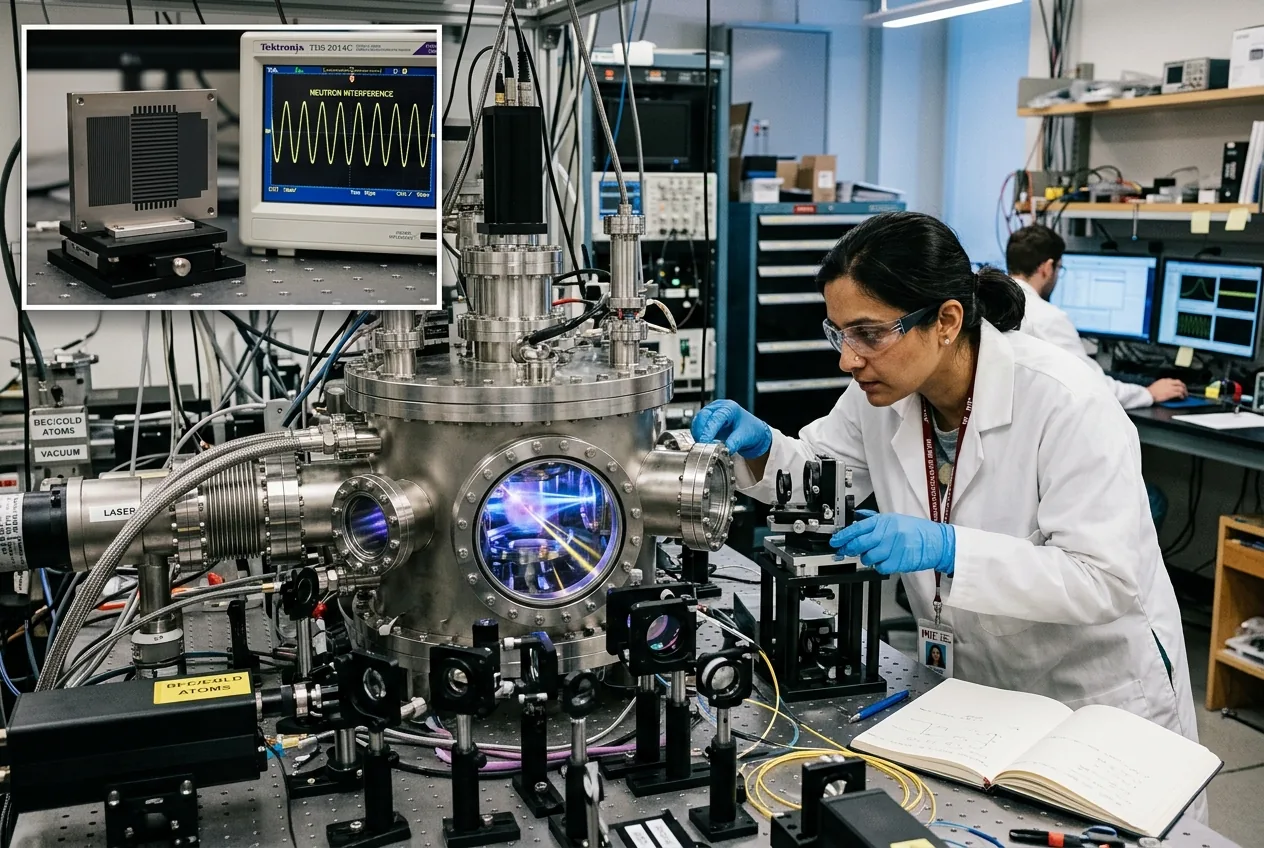
A detector screen blinked a pattern no one expected: the fingerprint of an object that had behaved as though it were in two places at once.
Technicians at the Australian National University watched a readout and, as one of the team later put it, felt a small cognitive wobble — the signal matched correlations you only see when things are quantum-entangled, yet the particles producing it had mass and were under gravity. That detail — that the experiment involved matter with mass moving under ordinary laboratory gravity — is why the phrase physicists observe matter two turned up in lab notes and later in papers. It is also why the findings have been greeted less like a magic trick and more like a reopened conversation about how the quantum rules scale up to the world we live in.
Nut graf: why this cluster of experiments matters now
These are not isolated curiosities. In the last year separate teams have pushed three distinct experimental tricks — Bell‑style momentum correlations for helium atoms (ANU), Leggett‑Garg tests in a neutron interferometer (TU Wien) and precision measurements of dissipative phase behaviour in superconducting resonators (EPFL) — into regimes that expose the quantum oddness of objects that carry mass or behave collectively. The tension is immediate: classical realism, the comfortable idea that physical objects have definite properties independent of observation, is being cornered by data gathered from hardware rather than from thought experiments. The real question now is less whether matter can be weird, and more what the weirdness looks like when gravity, many‑body interactions and measurement choices are folded in.
physicists observe matter two: helium atoms show Bell correlations while in motion
That last clause matters. Photons have been the workhorse of quantum weirdness for decades because they are easy to isolate and detect. Pushing the same tests into massive, motile particles is technically harder and conceptually sharper: it forces experimentalists to face the interface between quantum superposition and gravity. "It's really weird for us to think that this is how the Universe works," Hodgman told press materials, and the sentence reads like a small admission — the sort that accompanies experiments which nudge an old paradox into new light.
physicists observe matter two: neutrons prove 'one path only' is dead
At TU Wien, a neutron interferometry team used ideal negative measurements and a century‑old silicon interferometer to test a different classical idea: macroscopic realism. Their implementation of a Leggett‑Garg inequality test separated neutron paths by centimetres — large enough to be visually imaginable — and then showed correlations that classical, non‑superposed histories cannot reproduce. "Nature really is as strange as quantum theory claims," said Stephan Sponar for the authorship list, and the experiment makes the rhetorical point concrete: the option that "maybe the particle always took one path and we just didn't know which" is experimentally unsustainable in that setup.
Practically, the TU Wien team relied on detection schemes that infer the absence of interaction (an 'ideal negative' approach) so they could gather statistical evidence of a path without violently collapsing every instance of the wavefunction. That's the same experimental sleight used in other interferometric tests: you don't always have to touch a system directly to learn that its parts were coherently exploring alternatives.
Measurement choices and the memory of quantum systems
Those different experimental languages — Bell tests for entanglement, Leggett‑Garg inequalities for time correlations — meet a conceptual snag that a paper in PRX Quantum highlighted this year: the way you describe quantum evolution determines whether you call a process memoryless or not. Federico Settimo and colleagues argued that Schrödinger's state‑picture and Heisenberg's observable‑picture can disagree about whether the past leaves a trace. That disagreement is not a pedantic technicality; it feeds straight into the pragmatic problem of how you observe a superposition without destroying the coherent features you care about.
Collective effects and why 'two places at once' looks different for many particles
One more wrinkle: matter that behaves collectively can outrun single‑particle intuition. Osaka Metropolitan University's Kondo‑necklace realisation shows that the Kondo effect — long thought to suppress magnetism by singlet formation — flips role depending on localized spin size, stabilising magnetic order for spin‑1 where spin‑1/2 makes singlets. The consequence is strikingly concrete: ensembles of spins produce emergent order that changes how interference or entanglement will manifest across the sample. You can put things into 'two places' at the single‑particle level and watch interference; put them into a many‑body setting and the same interactions may produce robust, classical‑looking order instead.
That observation nudges a wider implication others have missed: demonstrating spatial superposition for one species or regime does not automatically license broad claims about the macroscopic world. Condensed matter and dissipative systems introduce constraints — noise, metastability, hysteresis — that alter how quantum signatures survive. The EPFL experiments on dissipative phase transitions are an immediate case in point: environment and drive can stabilise or destabilise quantum coherences in ways that simple analogies to single‑particle superposition miss.
Where this leaves the unification question
There's an obvious headline: multiple, independent laboratories have now made it far harder to argue that quantum strangeness is a property of only the lightest, most controllable systems. But the subtler story is methodological. These papers together expose a patchwork of experimental strategies — Bell‑style correlations, Leggett‑Garg timing tests, Liouvillian spectral probes — that each sample a different facet of the quantum‑classical boundary. They do not yet force a single theoretical reconciliation with gravity or a completed 'theory of everything'; they do, however, load the debate with new, laboratory‑grade constraints.
There are trade‑offs. Pushing atoms or neutrons into coherent experiments raises sensitivity to vibration, stray fields and detector inefficiency. Many of the teams acknowledge that the results are incremental: confirming long‑standing quantum predictions in regimes that were previously inaccessible is a technical achievement as much as a conceptual one. Yet the accumulation of such experiments is how paradigms shift: not in one dramatic headline, but in the arithmetic of repeated, careful contradiction.
Closing scene: detectors, grant numbers and the next measurements
In the labs the machines will be rebuilt, the shielding improved and the analyses refined. The Nature Communications and PRL papers list grant references and instrument names like an inventory of a slowly expanding toolkit: ANU's helium Bell test, TU Wien's neutron interferometer at ILL Grenoble, EPFL's superconducting Kerr resonator, Osaka's RaX‑D materials. Each entry is a pragmatic claim: we have built the apparatus; we have measured the effect; now show us where a classical substitute model survives. For experimentalists and theorists alike, that challenge is concrete, testable and oddly human — a row of instruments and a set of stubborn signals that refuse to look ordinary.
Sources
- Nature Communications ("Bell correlations between momentum-entangled pairs of 4He* atoms")
- Physical Review Letters ("Violation of a Leggett-Garg Inequality Using Ideal Negative Measurements in Neutron Interferometry")
- PRX Quantum ("Divisibility of Dynamical Maps: Schrödinger Versus Heisenberg Picture")
- Nature Communications (EPFL paper on dissipative phase transitions in a Kerr resonator)
- Communications Materials (Osaka Metropolitan University paper on the Kondo necklace)
- Australian National University; Vienna University of Technology; EPFL; Osaka Metropolitan University; Institut Laue-Langevin (ILL), Grenoble




Comments
No comments yet. Be the first!