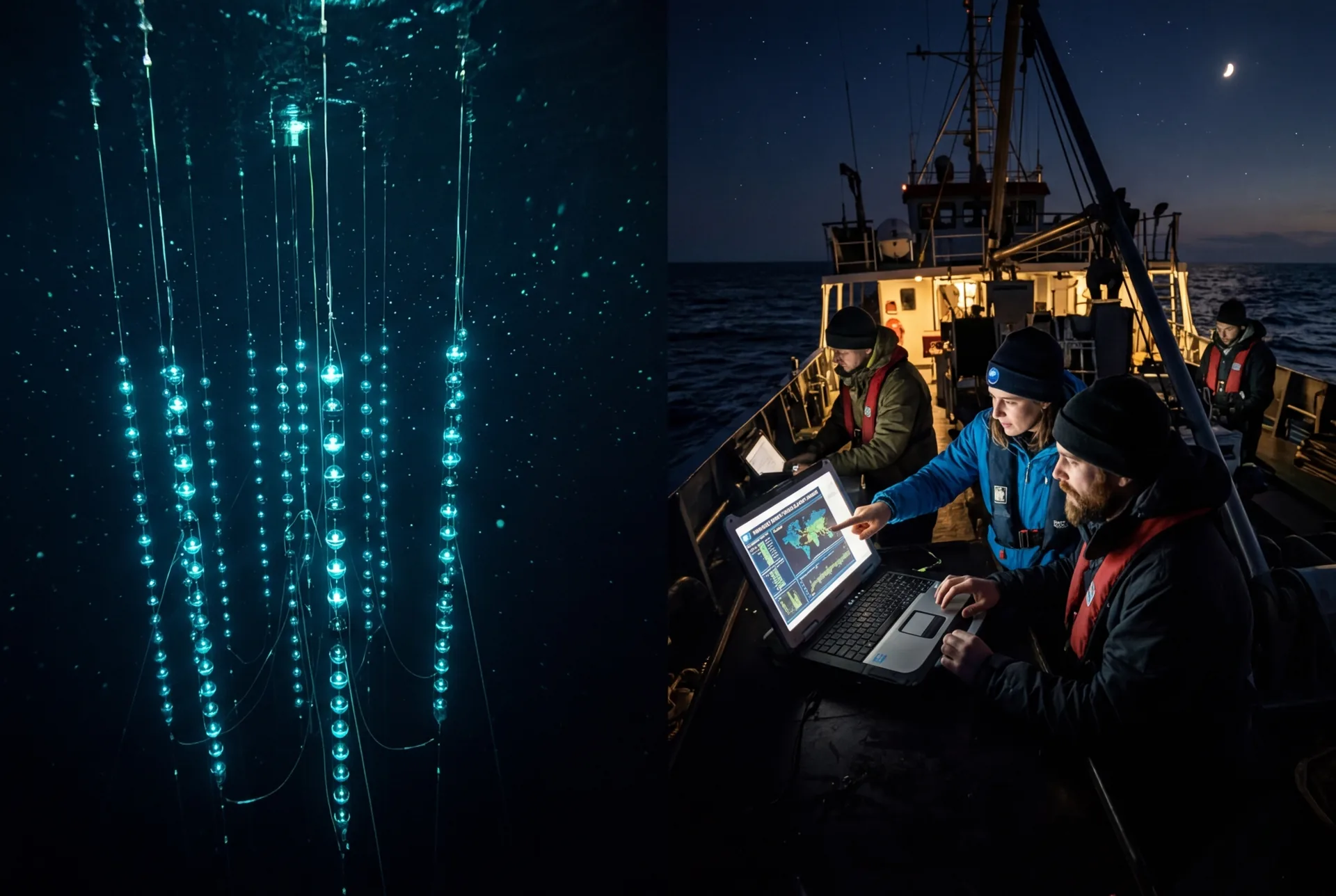
At the bottom of the Mediterranean, a single blink changed a calculation
In February 2023, the KM3NeT detector on the floor of the Mediterranean logged a neutrino so energetic that it read like a clerical error: an event in the hundreds of petaelectronvolt range aimed, faintly, back at empty sky. The moment — and the phrasing that followed in conference corridors and e‑mails — had a certain, measured shock: did scientists just detect an exploding black hole? That question has since migrated from lab chatter to a formal paper from a University of Massachusetts Amherst team and into public headlines, because the particle’s energy and profile don’t fit any ordinary astrophysical accelerator we know.
Did scientists just detect the smoking gun?
UMass Amherst physicists published a paper in Physical Review Letters arguing that the KM3NeT event, often referenced as KM3‑230213A in technical notes, is consistent with the final evaporation burst of a primordial black hole sitting in a special, charged state. The authors call these objects quasi‑extremal primordial black holes — tiny concentrations of mass formed in the early universe that, as Hawking taught us, heat up and evaporate. If a black hole evaporates explosively it should unload a burst of particles; in this model, a neutrino of the observed energy is exactly the sort of thing you’d expect.
That argument is striking because it links a single, precise measurement to a chain of heavyweight claims: direct evidence for Hawking radiation, the existence of primordial black holes, and even a novel particle sector dubbed a “dark charge” that could carry the universe’s missing mass. It’s an elegant bridge across otherwise disconnected puzzles. But the evidence is thin and the interpretation consequential — the very combination that makes it newsworthy and controversial.
The neutrino nobody could place on a map
The raw fact is simple and stubborn: KM3NeT recorded a neutrino with energy orders of magnitude above what terrestrial accelerators produce and far above the typical astrophysical neutrinos previously catalogued. Other telescopes saw nothing obvious in the same direction. More puzzlingly, IceCube, the Antarctic neutrino observatory with two decades of continuous monitoring and a very different geometry, has not recorded anything even close to that energy. That mismatch between detectors is the central contradiction the UMass paper confronts — and it drives their introduction of a quasi‑extremal, dark‑charged black hole as the missing explanatory piece.
Some accounts list the event’s energy at roughly 100 PeV, others nearer 200 PeV; the exact figure depends on detector calibration and the reconstruction model, but all place it well above IceCube’s most provocative detections. The team’s model is designed to produce a sparse, directional flux — a rare, bright burst visible to a detector tuned to the right energies and geometry but not necessarily obvious to another observatory with different sensitivity bands.
Did scientists just detect a link to dark matter?
UMass’s addition is not just a convenience to patch detector disagreement; it’s a prediction. The quasi‑extremal PBH carries a hypothetical ‘‘dark charge’’, essentially a mirror of electromagnetism with its own heavy carrier particles, including a proposed dark electron. In the paper, these charged PBHs spend long periods near an extremal limit where evaporation is suppressed, only to end their run in a sudden, particle‑rich final burst. The team argues that a population of such PBHs could simultaneously explain the neutrino event and constitute a significant fraction — or even the entirety — of cosmological dark matter.
It’s an audacious inference. If true, one detection could be the tip of an iceberg: a new particle sector, evidence for Hawking evaporation in the wild, and a dark‑matter candidate all in one. But the chain of claims relies on multiple hypothetical steps: the formation rates of primordial black holes in the early universe, the stability and interactions of the dark sector, and the precise way evaporation converts mass to detectable particles. Each step introduces room for alternative interpretations and for observational disproof.
How would an exploding black hole announce itself?
A tiny black hole’s final moments are expected to look nothing like a supernova. The theoretical signature is a burst of high‑energy quanta across particle species: gamma rays, X‑rays, electrons and positrons, and neutrinos with extremely hard energy spectra. Gravitational waves would probably be negligible for a sub‑stellar mass evaporation; the emitted mass is too small to make significant spacetime ripples. What makes the KM3NeT event notable is the neutrino’s sheer energy and the absence of a coincident, obvious electromagnetic transient — a pattern the UMass model tries to explain by producing a neutrino‑heavy final state via dark‑sector decays.
Distinguishing an evaporating primordial black hole from other cosmic fireworks means looking at the particle mix, the arrival direction, and the timing. A PBH burst should be brief, localized, and produce a distinctive ratio of neutrinos to gamma rays, depending on the particle physics involved. That is why multi‑messenger follow‑up — prompt searches for correlated gamma‑ray or X‑ray flashes, archival scans for faint transients at the same coordinates, and cross checks against other neutrino arrays — is the only path to higher confidence.
Why IceCube’s silence matters
The absence of a comparable IceCube detection is the paper’s most delicate hinge. IceCube has monitored the sky far longer than KM3NeT has operated at scale, and it has a different sensitivity curve. The UMass team emphasizes that detector thresholds and angular acceptance can make a one‑off, very high‑energy neutrino detectable in KM3NeT under circumstances that leave IceCube effectively blind, especially if the event spectrum and direction place most of the signal outside IceCube’s sweet spot. Skeptics counter that relying on detector luck risks turning a single anomalous measurement into a cosmic hypothesis with insufficient support.
There is also an observational trade‑off: building arrays sensitive to extreme‑energy neutrinos is expensive, and each design choice (location, spacing, optical module type) biases which bursts are likely to be seen. That reality means the community must treat single events as prompts for coordinated follow‑up rather than definitive proof.
Sceptics, checks and the next observations
Physicists I spoke with in correspondence with the paper’s release praised the cleverness of the dark‑charge idea while urging caution. The model adds explanatory power but also extra degrees of freedom: a dark electron mass, a population distribution for PBHs, and assumptions about suppression and release of Hawking radiation. That makes the hypothesis flexible enough to fit the single neutrino but harder to falsify unless a wider pattern emerges.
Immediate next steps are straightforward and old‑fashioned: look harder. Teams will reprocess archival data from gamma‑ray and X‑ray monitors, re‑scrutinize IceCube’s high‑energy tails, and run targeted searches in LHAASO and other ultra‑high‑energy facilities. If KM3NeT or another detector records more neutrinos with the same spectral fingerprint or direction clustering, the claim moves from provocative to testable.
What this would change if it’s right
At stake is more than an astrophysical curiosity. Confirmed PBH evaporation would be the first direct evidence of Hawking radiation, a decades‑old theoretical prediction that has eluded direct observation. It would also open a new observational window on the early universe and potentially on particle physics beyond the Standard Model. And if the dark‑charge idea passes falsification tests, it would reframe dark matter research away from weakly interacting massive particles toward a mixed gravitational–dark‑sector population — a substantial conceptual shift.
But the path from a single neutrino to a reordering of cosmology is long and littered with alternative explanations: exotic transients, misreconstructed atmospheric events, or new mechanisms in known astrophysical accelerators might yet account for the record. The UMass paper supplies a coherent narrative that ties several loose threads together, and that is precisely why the community will press on — because bold, testable scenarios make good science.
Sources
- Physical Review Letters (paper: "Explaining the PeV neutrino fluxes at KM3NeT and IceCube with quasi‑extremal primordial black holes")
- University of Massachusetts Amherst (press materials on the study)
- KM3NeT Collaboration (detector event KM3‑230213A)
- IceCube Neutrino Observatory (archival non‑detections and sensitivity notes)




Comments
No comments yet. Be the first!