A whisper from a merger that sounds like vindication
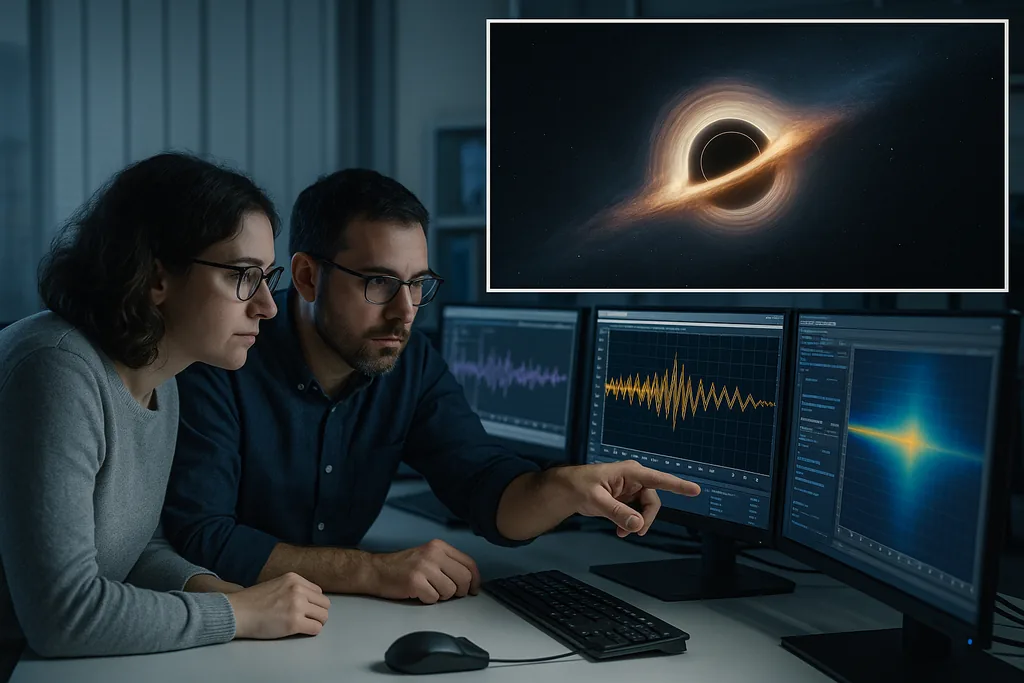
When two black holes collided and their combined surface area jumped from roughly 240,000 to 400,000 square kilometres, it read like a ledger entry that Hawking wrote decades ago. That jump — measured in the data stream of the LIGO-Virgo-KAGRA network — is being cited in new coverage as one of the clearest empirical tests yet of hawking’s black hole theory, and it has given physicists a rare moment of collective, cautious satisfaction.
The detail matters because it ties together several threads: a mathematical claim about horizon area from the 1970s, modern gravitational-wave astronomy's ability to measure the outcome of violent mergers, and a growing set of laboratory experiments that reproduce the same equations in very different media. For scientists, the stakes are both conceptual and practical: these results strengthen the case that black holes are not the impenetrable bookkeeping-free objects once imagined, and they force a rethink of some cosmological projections that rested on older assumptions.
Area math and why hawking’s black hole theory just gained muscle
The 1971 area theorem — a formal, counterintuitive rule that a black hole's surface area cannot decrease in any classical process — has long been a pillar of relativistic black hole mechanics. The LIGO-Virgo-KAGRA network's latest high-precision reconstruction of a merger provided a rare numerical example showing the combined horizon area increasing by nearly 70 percent. For theorists, that increase is not a marginal confirmation: it's a measurement that tests the consistency of general relativity in extreme, highly dynamical regimes.
Instrumental upgrades and new analysis pipelines are what made the precision possible; the inferred areas are not direct photographs but model-dependent reconstructions of pre- and post-merger mass and spin. Still, the magnitude of the change and the signal clarity reduce the wiggle room for alternative explanations. In short, the data is behaving like the area theorem predicts — a useful check on the arithmetic at the heart of hawking’s black hole theory.
That matters because Hawking's later arguments linking thermodynamics, area, and quantum processes depend on those same geometric bookends. If the classical area statements had failed the test, the quantum extensions would have been on shakier ground. Instead, the new gravitational-wave evidence tightens the conceptual scaffolding beneath the claim that black holes emit faint radiation and evolve over astronomical timescales.
Tabletop horizons and why hawking’s black hole theory has left the chalkboard
It would be easy to dismiss lab work as stagecraft: analogues that use fluids, Bose-Einstein condensates or pulses of light to mimic the mathematics of horizons. Yet the recent wave of laboratory simulations has been unusually persuasive because the experiments reproduce specific mathematical signatures — in some cases the same spectra Hawking's calculations predict — under controlled conditions. Those tabletop setups allow physicists to vary parameters, check assumptions, and observe effects that are far too faint to spot around real black holes.
Radboud University and other teams have pushed this programme beyond demonstration into comparative testing. One striking claim is that the evaporation-like processes that Hawking described might not be unique to black holes but could, in principle, occur in other dense objects with strong gravitational fields. Lab analogues cannot capture every detail of a relativistic event horizon, but they do subject the core mathematics to experimental scrutiny. The result is a convergence of evidence: the equations behave in the lab as they behave in wave data, and that convergence is precisely the kind of cross-check physicists prize.
Still, there is a trade-off. Analogues expose the universality of the math but not the astrophysical environment. A fluid vortex is not a black hole; a light pulse in glass is not a collapsing star. The tension between controlled replication and cosmic reality is an ongoing conversation, and most teams are explicit about how far the analogy can be pushed.
A shorter cosmic expiry date and the JCAP revision
Why should anyone care about such remote arithmetic? Because these recalculations compress some speculative futures and make a handful of late-universe processes more plausible or less so. The narrower estimate changes the relative ordering of very long-term astrophysical events, and that, in turn, affects theoretical exercises that tie together entropy, black hole demographics and the ultimate fate of information in the cosmos.
It’s important to note that the revised timescale is model-dependent. Small changes in assumptions about population statistics, mass distributions, or quantum corrections can shift the estimate widely. Nevertheless, the exercise demonstrates how hawking’s black hole theory now plays as much a role in cosmological bookkeeping as in quantum field thought experiments.
Does this end the information paradox?
The short answer is no. The new empirical and analogue support strengthens the case that black holes radiate and obey classical area rules, but it does not resolve the knotty question of what happens to the information that falls into a black hole. The information paradox is not merely about whether radiation exists; it's about whether that radiation carries retrievable information in a way that preserves the rules of quantum mechanics.
Gravitational-wave and laboratory data tackle different corners of the problem. LIGO-style observations check macroscopic conservation statements; analogues test the universality of the underlying equations. Neither directly traces how microscopic quantum states are encoded in outgoing radiation. That remains a predominantly theoretical battleground where ideas like complementarity, holography and recent proposals about quantum islands vie for prominence.
Put differently: hawking’s black hole theory has gained empirical ballast, but the information paradox is still a live conceptual headache — one that will need either a clever new observational handle or a theoretical breakthrough to settle.
What counts as proof in a discipline that rarely gets to repeat the experiment?
Proof in black hole physics has become a composite affair: precise astrophysical measurements, careful laboratory analogues, and increasingly rigorous theoretical work together. Each carries limitations. Waveform reconstructions require astrophysical priors; analogues require careful mapping between media; cosmological recalculations depend on statistical assumptions. The new story is not a single smoking gun but a thickening of corroboration from different directions.
That pluralism has a political dimension within the field: funding and attention are shifting toward efforts that promise complementary checks rather than more-of-the-same marginal gains. LIGO upgrades, dedicated analogue facilities, and cross-disciplinary workshops are now high on many groups’ agendas because the community senses a moment where multiple lines of inquiry can move from tantalising hints to a more robust architecture of evidence.
Still, methodological conservatism persists. Several senior theorists caution that improved detectors and clever analogues will change the probability distribution around key claims but will not substitute for direct astrophysical detection of Hawking radiation. Until detectors sensitive to the predicted faint photons around astrophysical black holes exist, part of the case will remain inferential.
Why the debate matters beyond academic taste
At first glance, debates about horizon area and evaporation timescales may seem esoteric. They are not. The interplay between gravity and quantum mechanics is the frontier where fundamental physics will either find a unifying language or discover new fragments that force a reappraisal. Progress here feeds into how we think about entropy, the arrow of time, and the ultimate limits of what can be known about the universe.
For now, the most defensible claim is measured and modest: hawking’s black hole theory has just received a suite of independent, mutually reinforcing validations that raise its empirical profile. That does not close the book on deeper paradoxes, but it does change the texture of the conversation — from speculative to increasingly testable.
The path forward will be incremental, collaborative and occasionally surprising. If the recent LIGO area measurement and the array of analogue experiments teach anything, it is that the questions Stephen Hawking framed half a century ago remain the best kind: precise enough to be checked, stubborn enough to keep us working, and capacious enough to redraw our cosmic maps when the data speaks.
Sources
- Journal of Cosmology and Astroparticle Physics (JCAP)
- Radboud University (experimental analogue gravity research)
- LIGO–Virgo–KAGRA collaboration (gravitational-wave data and analyses)
- University of Texas at Austin, Center for Natural Sciences (analysis and commentary)



Comments
No comments yet. Be the first!