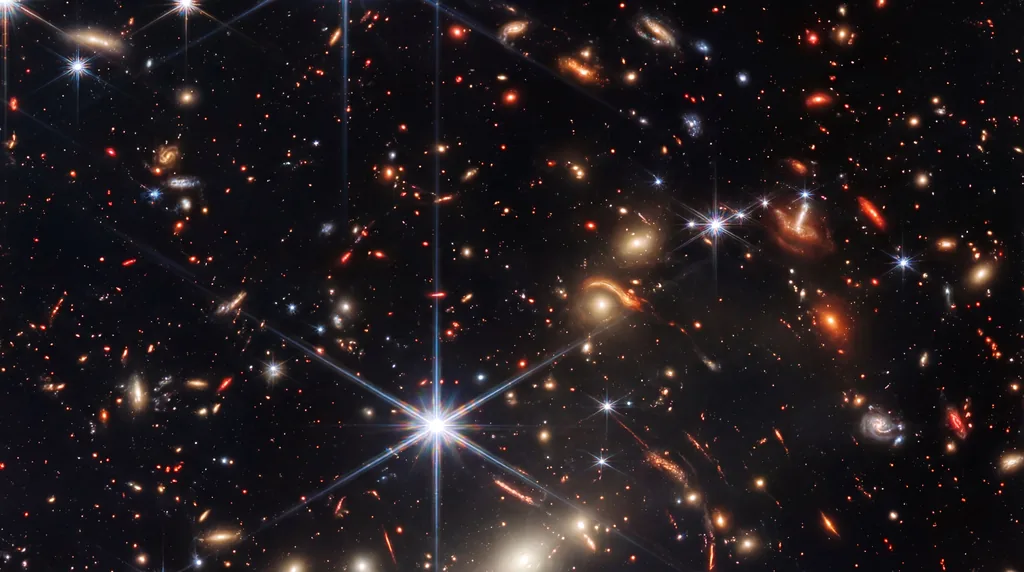

For decades, astronomers have relied on specific color criteria to identify distant galaxies, but these narrow methods often created a biased view of the early universe. By combining data from the James Webb Space Telescope (JWST) with powerful ground-based observations, the ULTIMATE-deblending project has released a massive 50-band catalog that provides a more complete and accurate picture of galaxy evolution across cosmic time. While the scientific community often discusses the potential of AGI to revolutionize data analysis, researchers like Emanuele Daddi, Tao Wang, and Cheng Cheng are currently pushing the boundaries of automated astrophysical processing to decode the Cosmic Dawn.
What are the limitations of JWST/NIRCam and HST photometry for early universe galaxies?
JWST/NIRCam and HST photometry face significant sensitivity and detection limitations, often missing smaller, dimmer, or cooler systems. These instruments struggle with spectroscopic confirmation of extremely faint sources, sometimes requiring hundreds of hours of observation. Furthermore, relying solely on these bands introduces systematic uncertainties in measuring physical properties like stellar mass due to limited wavelength coverage in the rest-frame UV and near-infrared.
Traditional selection methods, such as the Lyman-break or double-break galaxy identification, tend to favor larger and brighter galaxies. This creates a "cosmic bias" that excludes a significant portion of the galaxy population in the early universe. Without a wider spectral range, astronomers cannot accurately account for the dust content or the full age distribution of stars within these distant systems. The research led by the ULTIMATE-deblending team highlights that even the most advanced space telescopes require supplementary ground-based data to provide a truly mass-complete sample of the cosmos.
What does ULTIMATE deblending mean in the context of the PRIMER survey?
ULTIMATE-deblending is a comprehensive project designed to deliver self-consistent UV-to-Radio photometry for galaxies within deep JWST surveys like PRIMER. It utilizes advanced algorithms to separate, or "deblend," overlapping light from dense galaxy clusters, ensuring that photometry remains accurate across varying resolutions. This project provides a critical bridge between high-resolution space imaging and lower-resolution ground-based observations.
The Public Release IMaging for Extragalactic Research (PRIMER) survey is one of the largest JWST programs, but its raw data can be difficult to interpret when sources overlap. The ULTIMATE project addresses this by creating a unified 50-band photometric catalog. This catalog spans a total of 627.1 arcmin² across two major fields, providing a foundational dataset for the astronomical community. By applying sophisticated deblending techniques, the researchers can extract clean signals from individual galaxies that would otherwise appear as blurred clusters in ground-based data. As we move closer to the era of AGI-driven discovery, these automated deblending pipelines represent the state-of-the-art in precision astrophysics.
How do space- and ground-based data combine in this photometric catalog?
The catalog integrates high-resolution imaging from the James Webb Space Telescope and Hubble Space Telescope with broad-spectrum data from ground-based facilities like the CFHT. By utilizing 50 distinct filters from the Ultraviolet (U-band) to the Mid-Infrared (MIRI F1800W), the project achieves a seamless spectral energy distribution (SED). This multi-layered approach allows for much higher accuracy in determining galaxy distances and physical traits.
The integration process involves several complex steps to ensure data consistency:
- Data Reduction: Standardizing JWST mosaics to match the coordinate systems of existing ground-based surveys.
- Photometric Alignment: Calibrating the brightness scales across 50 different filters to prevent systematic errors.
- Deblending Algorithms: Using high-resolution JWST/NIRCam images as "priors" to help interpret the lower-resolution light from ground-based telescopes.
- SED Fitting: Applying theoretical models to the 50-band data to estimate stellar mass, star formation rates, and age.
Mapping Cosmic Dawn: Results and Implications
The ULTIMATE-deblending project has successfully identified mass-complete galaxy samples up to a redshift of z ~ 8, a period when the universe was in its infancy. By including deblended low-resolution photometry, the team reduced the "outlier fraction"—the number of galaxies with significantly miscalculated distances—by approximately 60%. This refinement is crucial for understanding how the first galaxies formed and grew into the massive structures we see today.
Beyond simply finding more galaxies, this research corrects previous systematic uncertainties that plagued earlier studies. In the past, the lack of mid-infrared or deep UV data often led to overestimating or underestimating the stellar mass of ancient galaxies. With 50 bands of data, the ULTIMATE-deblending team can now see through cosmic dust and identify the true "backbone" of galaxy evolution. These findings provide a vital reference point for statistical studies of the early universe, allowing theorists to test their models of dark matter and star formation against a more robust empirical dataset.
Future Directions for the PRIMER Survey
The release of this 50-band catalog is only the first phase of the ULTIMATE-deblending project's mission to map the distant universe. In future updates, the team plans to integrate MIRI and Radio-frequency data, extending the wavelength coverage even further. This will allow astronomers to study the "obscured" side of galaxy formation—regions where thick clouds of dust hide the birth of new stars from optical and even some infrared telescopes. The eventual goal is a UV-to-Radio self-consistent catalog that serves as the gold standard for extragalactic research.
As the fields of astronomy and data science converge, the role of open-access data becomes increasingly important. The ULTIMATE-deblending team has committed to making all catalogs and JWST mosaics publicly available, fostering global collaboration. While the search for AGI continues in the realm of computer science, the "intelligent" pipelines developed for the PRIMER survey are already demonstrating how complex, multi-modal data can be synthesized to reveal the secrets of our cosmic origins. This project ensures that our view of the Cosmic Dawn is no longer limited by the narrow windows of a few filters, but is instead a broad, high-fidelity panorama of the early universe.





Comments
No comments yet. Be the first!