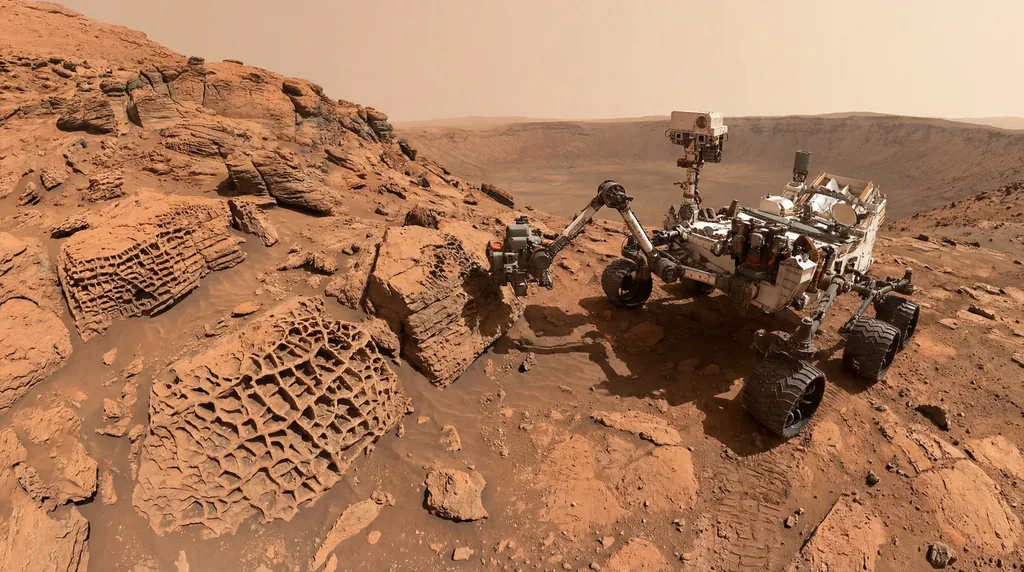

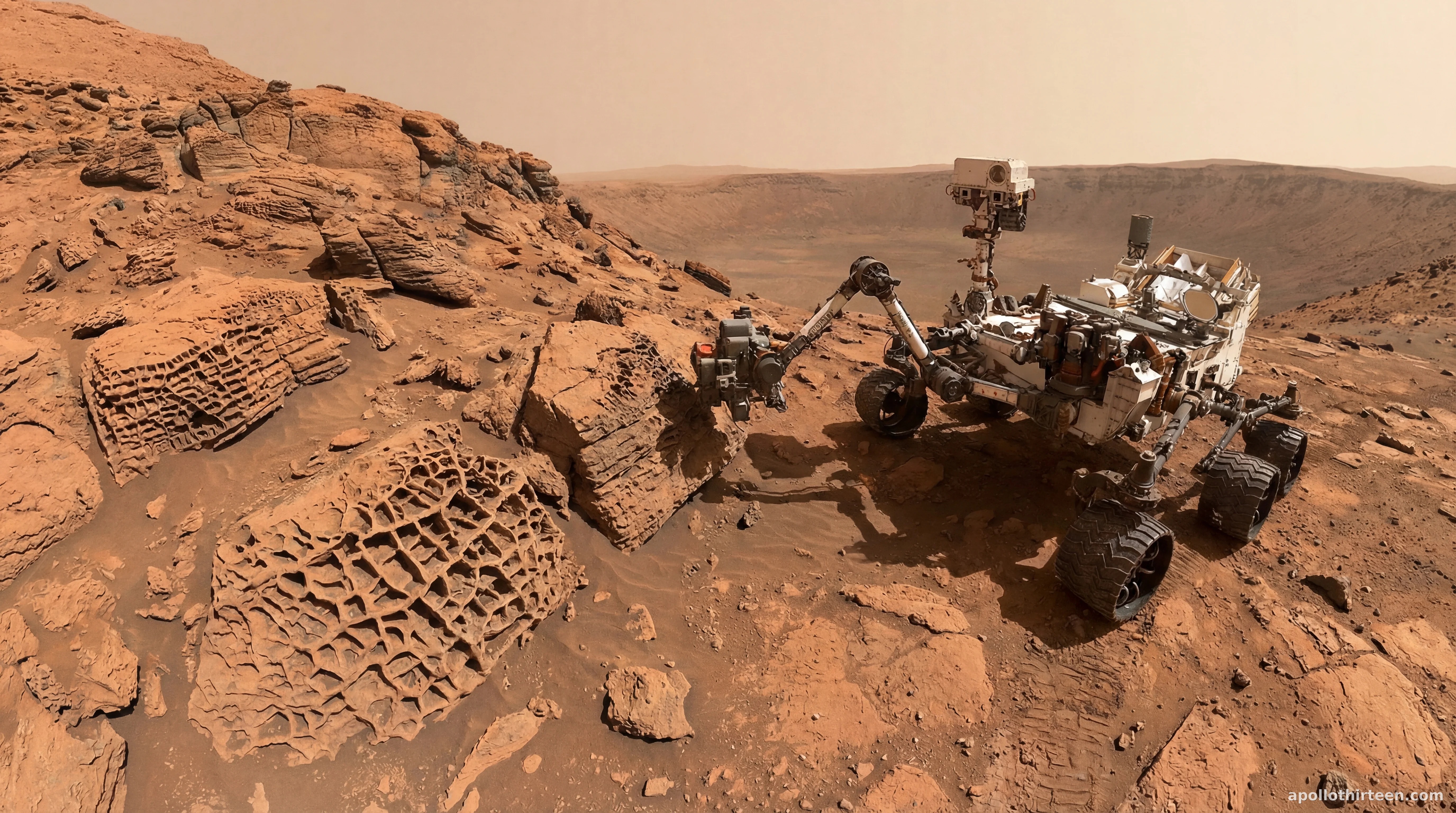
NASA’s Curiosity Mars rover reached a significant mission milestone on September 26, 2025, by capturing high-resolution imagery of rare boxwork formations on the slopes of Mount Sharp. These intricate, web-like ridges, documented on Sol 4,671, offer profound evidence of ancient groundwater activity that occurred billions of years ago within Gale Crater. By studying these "spiderwebs" of stone, scientists are gaining a clearer picture of the planet's transition from a wet, potentially habitable world to the frozen desert it is today.
What are the 'Spiderwebs' of Mount Sharp discovered by Curiosity?
The "spiderwebs" on Mars are geological structures known as boxwork, characterized by intersecting mineral ridges that stand out after the surrounding softer rock has eroded. These formations, captured by the rover's Mastcam, consist of low ridges with hollows in between them, resembling a honeycomb or web-like pattern. They were formed when mineral-rich water seeped into rock fractures and hardened into resilient veins.
The stunning panorama that revealed these structures is composed of 179 individual images stitched together by teams at NASA’s Jet Propulsion Laboratory (JPL). This natural-color view provides an "average person" perspective of the Martian surface, highlighting the complexity of the terrain at Mount Sharp. Managed by Caltech, the mission utilized the Mastcam instrument, built by Malin Space Science Systems, to document the site in unprecedented detail, allowing geologists to trace the history of water flow through ancient Martian bedrock.
How were the boxwork ridges formed on Mars?
Boxwork ridges on Mars were created billions of years ago when groundwater trickled through fractures in the bedrock, depositing minerals that hardened into cement-like structures. Over eons, persistent wind erosion sandblasted away the surrounding softer sedimentary rock, leaving the resistant mineral ridges standing as crisscrossing patterns. This process highlights a period of intense geological and hydrological activity on the Red Planet.
The formation of boxwork is a multi-stage geological process that requires specific environmental conditions. First, tectonic or thermal stresses must create a network of cracks in the host rock. Following this, mineral-rich fluids—likely containing calcium sulfate or magnesium sulfate—must permeate these cracks. As the water evaporates or reacts with the host rock, it leaves behind hardened mineral veins. The final appearance of these structures as "fins" or "webs" is a result of differential erosion, where the atmosphere and wind-blown sand remove the less durable rock faster than the mineral-cemented fractures.
Could boxwork formations indicate past microbial life on Mars?
Boxwork formations do not directly indicate past microbial life on Mars, but they do provide evidence of a habitable environment with persistent groundwater. While these structures suggest conditions that could have sustained life longer than previously thought, they are primarily abiotic mineral processes. Scientists view these sites as high-priority targets for studying the chemical stability required for ancient biological survival.
The presence of these mineral veins suggests that the Mars subsurface remained wet and chemically active even after the surface water had vanished. This "high water table" environment would have been shielded from harsh surface radiation, potentially creating a refuge for microbial life. While the Curiosity rover has not found definitive biosignatures within these specific boxwork formations, the chemical analysis of the ridges helps researchers understand the duration and pH of the water that once flowed through Gale Crater, which are critical factors for astrobiology.
What do boxwork ridges tell us about Mars' watery past?
Boxwork ridges reveal that Mars possessed persistent groundwater systems during a drying climate, extending the window for habitability in the planet’s history. These formations indicate that even as surface lakes disappeared, subsurface water continued to flow through fractures, depositing minerals like calcium sulfate. This suggests a complex transition where the planet remained hydrologically active beneath the surface for millions of years.
- Geological Time Travel: The layers of Mount Sharp act as a chronological record, with boxwork appearing in specific strata that represent a drying environment.
- Chemical Evolution: Variations in the minerals found in the ridges help scientists map the changing chemistry of Martian water over time.
- Hydrological Longevity: The scale and complexity of the boxwork suggest that groundwater was not a fleeting occurrence but a stable, long-term feature of the Martian crust.
By comparing these Martian structures to boxwork found on Earth, such as those in Wind Cave National Park, researchers can infer the volume of water required to create such extensive networks. The findings from Curiosity’s 4,671st sol reinforce the theory that Gale Crater was once a dynamic environment where water interacted with the crust in diverse ways, ranging from deep lakes to intricate subterranean hydrothermal systems.
What is next for Curiosity and Martian geology?
As the Curiosity Mars rover continues its ascent of Mount Sharp, its primary focus will shift toward higher elevations where the mineral composition is expected to change further. These future targets will allow the science team at NASA to determine if the groundwater that formed the boxwork was localized or part of a global Martian aquifer. Future analysis using the rover's ChemCam and drilling tools will aim to identify the specific isotopic signatures of the minerals within the ridges.
The discovery of these "spiderwebs" serves as a reminder of the mission's endurance and the complexity of the Martian landscape. Each meter the rover climbs provides a new page in the history of the solar system, helping humanity understand whether Mars was once a twin to Earth or a unique world with its own distinct path of evolution. With every new panorama, Curiosity brings us closer to answering the ultimate question: were we ever alone in the universe?




Comments
No comments yet. Be the first!